Visko launches Orbis live model and closes pre-seed funding round
https://www.therobotreport.com/wp-content/uploads/2026/09/orbis-720p.webm To generate video with artificial intelligence, a user typically submits a prompt, waits, and then receives a finished clip that cannot be altered. Visko Platform Inc. today opened public access to Orbis, a foundation model that streams worlds in real time with persistent memory, interactivity, and physics-grounded generation for unlimited duration. The company has also raised $10 million in pre-seed funding led by Llama V
Make your prediction
Will Visko raise an additional funding round beyond its $10M pre-seed before December 1, 2026?
Resolves by Dec 1, 2026
Your prediction
50% · 50/50 coin flip
NOYES
Get smart on it
A startup has launched Orbis, a foundation model that generates video continuously in real time rather than producing finished clips, with the ability to change prompts mid-generation while the video keeps streaming. Unlike conventional video generation systems that process entire clips at once, Orbis generates video frame-by-frame in a streaming fashion similar to how large language models predict tokens one at a time, delivering 4K video at 24 frames per second while maintaining physical consistency for hour-long durations. The company raised $10 million in pre-seed funding and claims this technology could enable applications in robotic training, simulation, and generating test footage for autonomous systems. The capability represents a shift toward AI systems that run continuously and respond interactively rather than simply processing requests and returning finished outputs.
Related news
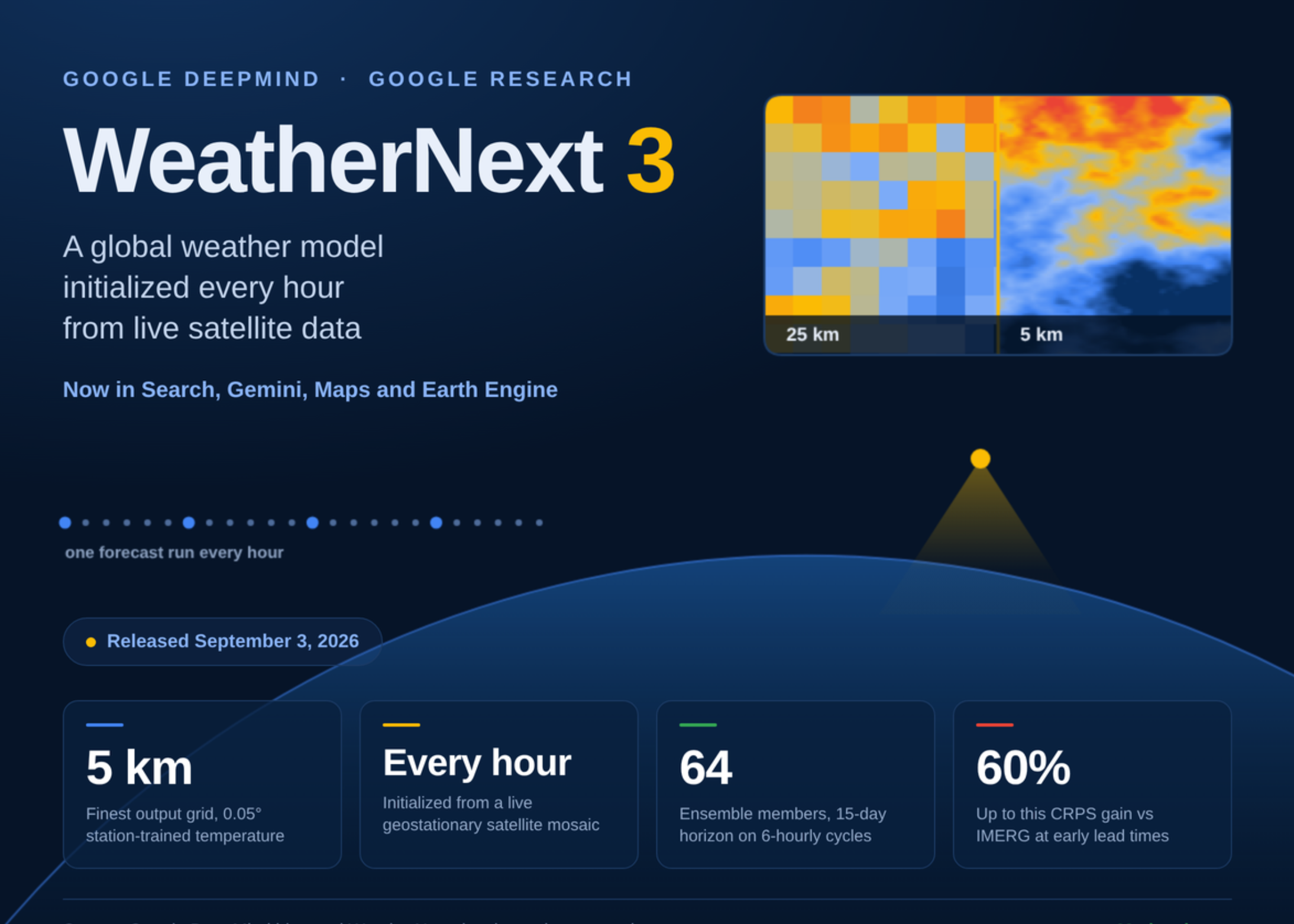
Google DeepMind’s WeatherNext 3 Trains on Weather Station Observations to Deliver 5 km Global Forecasts, Refreshed Every Hour
AI weather models have spent three years closing the gap with physics-based forecasting, but two problems stayed open: resolution too coarse for local terrain, and initialization tied to numerical weather prediction (NWP) analysis that arrives about six hours late. WeatherNext 3, released by Google DeepMind and Google Research, attacks both. It takes a live global geostationary satellite mosaic as a direct model input, re-initializes every hour, and emits forecasts down to 0.05° (~5 km) while t

OpenAI Releases GPT-6 Astra: A 1.05M-Context Computer-Use Model Gated Behind a ‘Critical’ Cyber Threshold
Today, OpenAI released GPT-6 Astra. The company calls it its most intelligent and aligned model, and positions it primarily as a computer-use system rather than a chat model. The pitch is that Astra operates software the way a person does, across browsers, spreadsheets, desktop applications and terminals, and finishes multi-step jobs instead of describing how to do them. Is it deployable? Partly, and not on your own hardware. Astra is a closed, hosted model with no released weights, so self