VibeThinker-3B: A 3B Dense Reasoning Model Built on Qwen2.5-Coder-3B With the Spectrum-to-Signal Post-Training Pipeline
While recent breakthroughs in AI reasoning have largely been driven by massive scale, pouring in billions of parameters to cross complex cognitive thresholds—VibeThinker-3B is charting a completely different path. Created by researchers from Sina Weibo Inc (China), this 3-billion-parameter model proves that efficiency can punch far above its weight class. Released under an open-source MIT license, VibeThinker-3B matches the performance of models hundreds of times its size on verifiable tasks
Make your prediction
Will VibeThinker-3B appear on the Hugging Face model hub by June 25, 2026?
Resolves by Jun 25, 2026
Your prediction
50% · 50/50 coin flip
NOYES
Get smart on it
A small AI model with 3 billion parameters, built on an existing coder model and trained with a technique called the Spectrum-to-Signal pipeline, achieves reasoning performance comparable to models hundreds of times larger on verifiable tasks like mathematics and coding. The model is designed as a specialist for problems where answers can be checked, rather than a general-knowledge system, and runs efficiently on standard hardware. It matters because it demonstrates that reasoning capability does not require massive scale, potentially making advanced reasoning accessible for cost-sensitive deployments and edge devices. The model uses supervised fine-tuning to explore multiple solution paths, reinforcement learning to strengthen correct ones, and can further improve answers at test time by having itself verify intermediate claims without adding parameters.
Related news

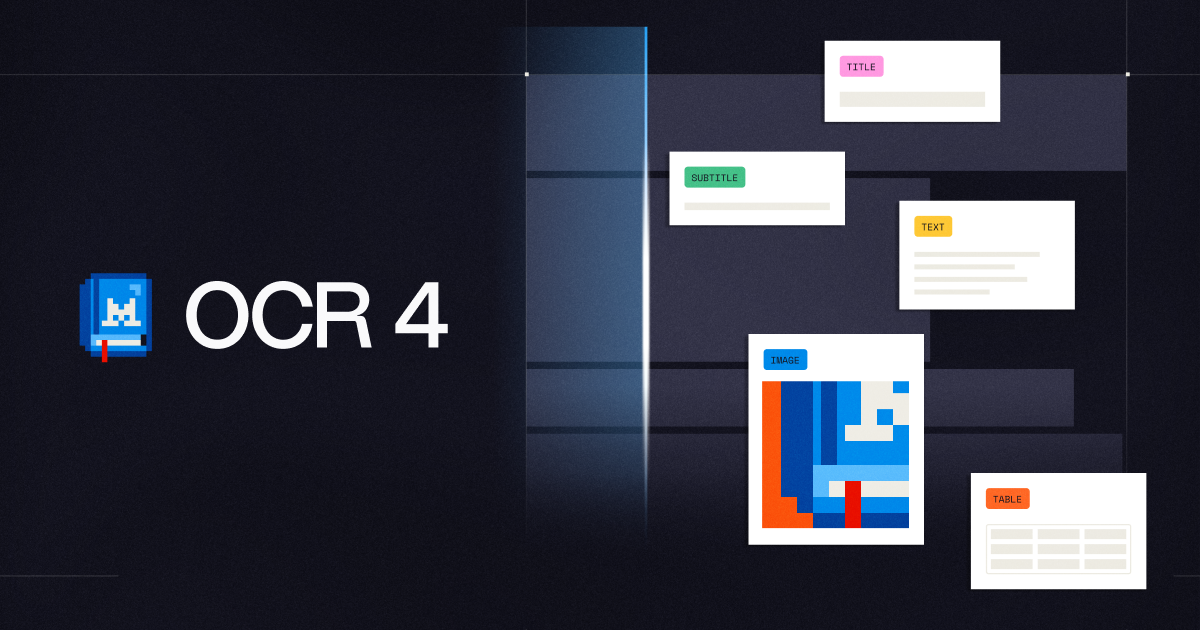
Mistral OCR 4 Brings Citation-Ready Structured Output to RAG, Agentic, and Enterprise Search Pipelines
Today, Mistral AI released OCR 4, its latest document-understanding model. This new release adds bounding boxes, block classification, and inline confidence scores alongside extracted text. It supports 170 languages across 10 language groups and runs in a single container for fully self-hosted deployments. OCR 4 also serves as an ingestion component for enterprise search, RAG, and domain-specific retrieval pipelines. TL;DR OCR 4 returns bounding boxes, typed-block labels, and per-word c

Datalab Releases lift: A 9B Open-Weights Vision Model That Extracts Structured JSON From PDFs Using Schemas
Datalab has released lift, a 9B open-weights vision model for structured extraction. You pass it a JSON schema, and it returns a JSON object that matches. The model reads PDFs and images directly, then decodes against your schema. This is Datalab’s first model built purely for extraction. The team already ships open-source OCR tools: chandra, marker, and surya. lift extends that work into schema-driven field extraction. lift scores 90.2% field accuracy on Datalab’s 225-documen