Synthetic Sciences Releases OpenScience: An Open-Source, Model-Agnostic AI Workbench for Machine Learning, Biology, Physics, and Chemistry Research
Synthetic Sciences has released OpenScience, an open-source AI workbench for scientific research. It is licensed under Apache 2.0 and runs on your own infrastructure. The research team frames it as an open alternative to Anthropic’s Claude Science, launched in late June 2026. The pitch is direct. Scientific AI tooling should not be owned by one vendor. OpenScience keeps the workflow open, the models swappable, and the data local. It is an independent project, not affiliated with or end
Get smart on it
Synthetic Sciences has released OpenScience, an open-source AI workbench designed to help researchers in machine learning, biology, physics, and chemistry conduct experiments, analyze data, and write results. The tool is model-agnostic, meaning it can work with any AI model through a user's own API keys rather than requiring a specific vendor's service, and it runs on local infrastructure with data stored locally. OpenScience was positioned as an open alternative to a proprietary competing product launched around the same time, addressing concerns that scientific AI tools should not be controlled by a single vendor. The workbench includes over 250 editable skills and access to roughly 30 scientific databases, allowing researchers to read papers, form hypotheses, write code, run experiments, and generate reports within a single continuous session.
Related news

OpenAI Releases GPT-Realtime-2.1 and GPT-Realtime-2.1-mini for Low-Latency Voice Agents in the API
OpenAI has released two new Realtime models in its API. They are named gpt-realtime-2.1 and gpt-realtime-2.1-mini. Both target low-latency voice and multimodal experiences. The mini model is the notable part of this release. It is a mini reasoning model for realtime voice. It ships at the same cost as the earlier gpt-realtime-mini. OpenAI also reduced p95 latency by at least 25% across Realtime voice models. That reduction comes from improved caching. What is GPT-Realtime-2.1-mini gpt-rea
Tencent Releases Hy3: An Open 295B Mixture-of-Experts (MoE) Model with 21B Active Parameters and 256K Context
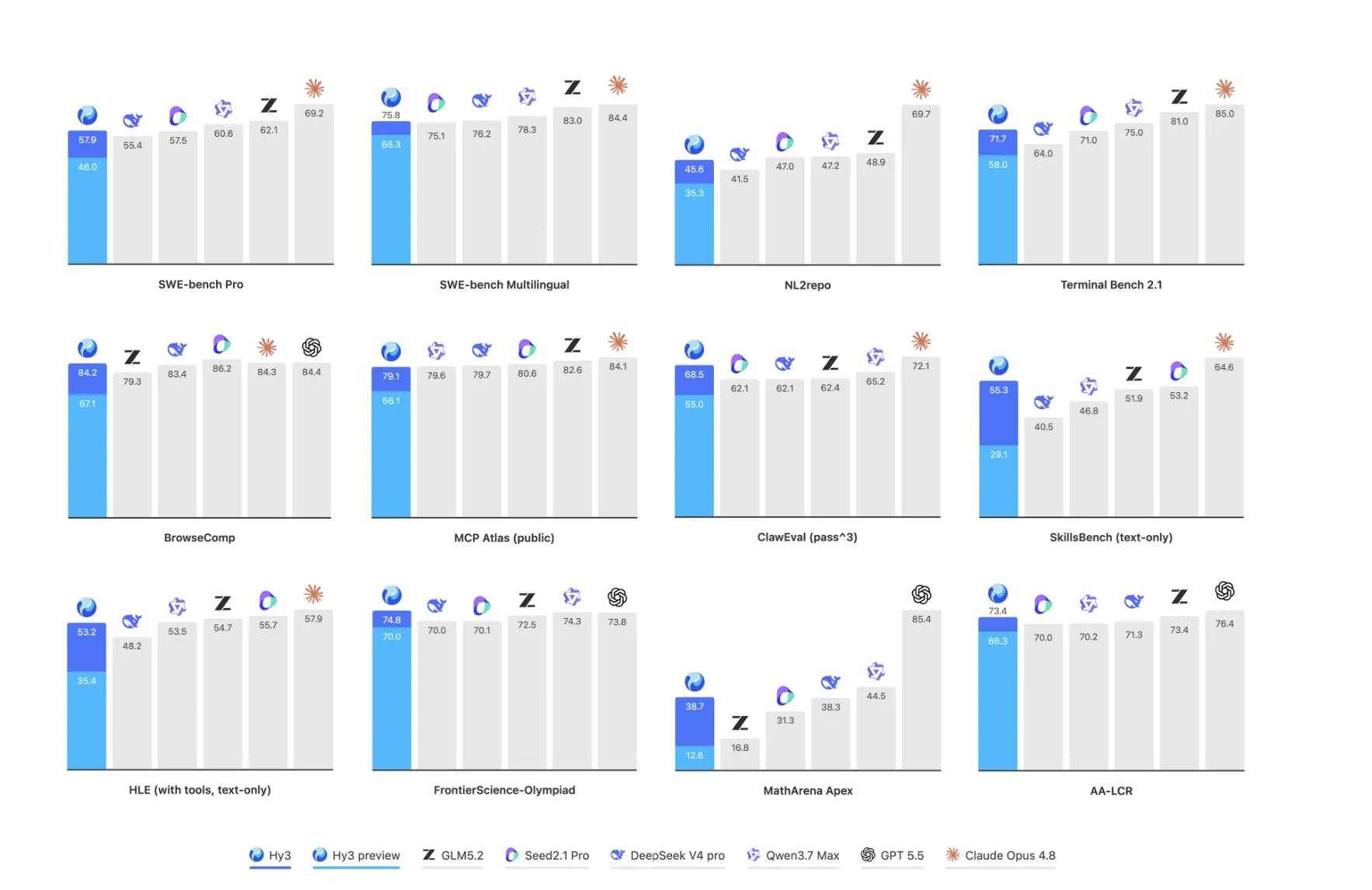
Tencent’s Hy team released Hy3. Hy3 is a 295B-parameter Mixture-of-Experts (MoE) model. It activates only 21B parameters per token. The weights ship under the Apache License 2.0. Hy3 is aimed at reasoning, agentic workflows, and long-context tasks. What is Hy3? Hy3’s architecture contains a sparse MoE with 192 experts and top-8 routing. Only 8 experts fire per token, so compute stays low. The model also uses a Multi-Token Prediction (MTP) layer. MTP predicts several tokens