
Scaled Cognition targets customer service with low-cost voice model
Enterprise customer service vendor Scaled Cognition Inc. is introducing a text-to-speech model today that it says provides more accurate pronunciation of account numbers, addresses and other details at a lower cost than competing services. The product, called Voice, is available through an application programming interface or for self-hosted deployment. It supports more than 25 languages, […] The post Scaled Cognition targets customer service with low-cost voice model appeared first on Sil
Get smart on it
Scaled Cognition has introduced a text-to-speech model called Voice designed for customer service applications that claims to accurately pronounce account numbers, addresses, and other critical details while costing less than competing services. The product addresses a gap where modern speech generation can sound natural but struggles with precise pronunciation of alphanumeric codes, dollar amounts, and street addresses, particularly in non-English languages. Voice is available through an API or for self-hosted deployment, supports more than 25 languages and voice cloning, and works with existing AI agents, contact center platforms, and older telephone systems. The company positions this as part of its broader enterprise AI platform and claims its pricing model delivers lower costs than competitors when accounting for infrastructure expenses.
Relevant courses
Want to go deeper than the news? Explore live, cohort-based AI courses taught by practitioners.
Browse AI courses on MavenRelated news

Mistral AI launches Voxtral 3, a full voice agent stack that listens, thinks, and talks in real time
Mistral AI launched Voxtral 3, a new family of language models built for real-time voice agents. The system combines speech-to-text, text-to-speech, and a voice agent SDK, supports more than 50 languages, and lets agents tap into external tools during live conversations. It can run on your own infrastructure or through EU-hosted APIs to keep data under your control. The article Mistral AI launches Voxtral 3, a full voice agent stack that listens, thinks, and talks in real time appeared

Voxtral 3
Voxtral 3: Mistral's voice agent SDK for real-time speech in 50+ languages — accurate transcription, emotional TTS, deep tool use. EU-hosted or self-deployed.
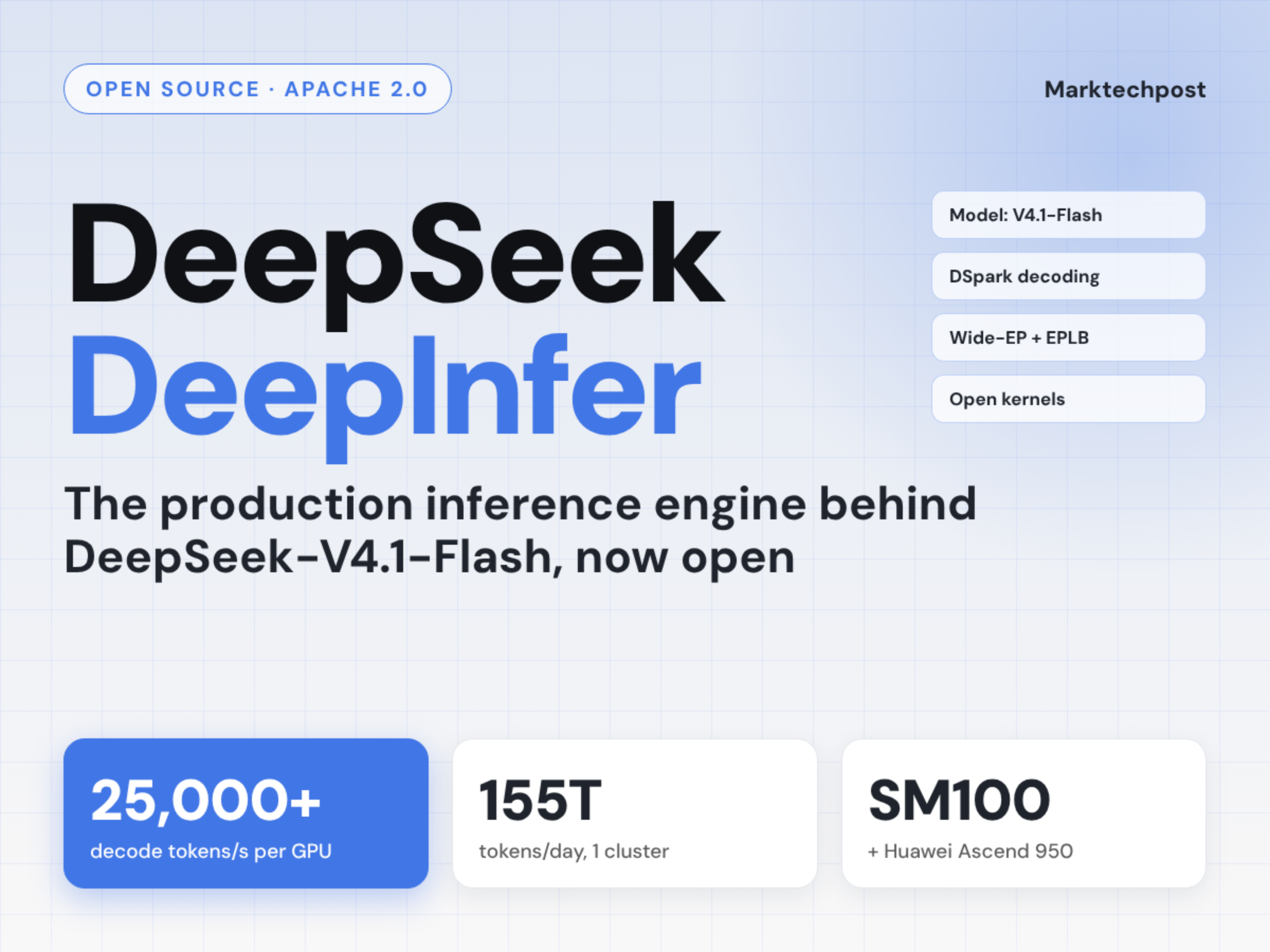
DeepSeek Open-Sources DeepInfer, the Inference Framework Behind DeepSeek-V4.1-Flash
DeepSeek has open-sourced DeepInfer, the inference framework that runs its production services. The DeepSeek DeepInfer inference framework is the engine behind DeepSeek-V4.1-Flash. It ships under the Apache 2.0 license. DeepSeek also released deepseek-recipe, its MIT-licensed token encoding and decoding layer. For developers, this is a rare look at a frontier lab’s real serving stack. TL;DR Size / scope: 1 supported model (DeepSeek-V4.1-Flash), 1M-token context window per the model
Also reported by The Decoder and SiliconANGLE

Nvidia launches new open models to run agents in the enterprise and on PCs
Nvidia is leaning hard into the trend of enterprise companies wanting to run their own open models in their own data centers and also trying to make on-device, private AI agents a thing.

Meta and Apple team up to make Muse AI models run better on Macs
The new Muse Spark Open AI model can work on M5 Ultra Mac Studios. | Photo: Amelia Holowaty Krales / The Verge Meta announced the Muse Spark Open AI model today, claiming that it's the "most capable US open-weight model to date." But the company also says that it's the "the first model in its class" that can "run on your desktop using two Apple M5 Ultra Mac Studios with the latest MLX framework." Meta and Apple, typically rivals, worked together on the launch and are publicly su
Also reported by The Decoder, TechCrunch, SiliconANGLE and MarkTechPost
Elevenlabs releases two new speech-to-speech models designed for real-time AI conversations
Elevenlabs' new Eleven Realtime speech-to-speech models combine speed and accuracy. The v1 Max variant scores 98.8 percent on the Big Bench Audio benchmark with a 0.57-second response time. Elevenlabs says no model on the Artificial Analysis leaderboard is both faster and more accurate. The article Elevenlabs releases two new speech-to-speech models designed for real-time AI conversations appeared first on The Decoder.