Reflex Open Sources XY: A Rust-Backed Super-Fast Python Charting Library That Keeps 100 Million Point Charts Interactive
Reflex AI has released XY, an Apache-2.0 Python charting library for interactive 2D visualization. Most Python charting stacks create one drawable object per row, so past a few hundred thousand points, render, hover, and zoom degrade. XY moves the work into a native Rust core, sends the browser typed binary buffers instead of JSON, and draws with WebGL2. In the terms of the benchmark, XY holds 0.071 s at 10,000 points and 0.081 s at 100 million. It ships as pip install xy and requires Python 3.
Get smart on it
XY is a Python charting library that uses a Rust backend and WebGL2 rendering to handle interactive visualizations of very large datasets, keeping charts with 100 million points responsive. Traditional Python charting libraries create one drawable object per data row, which causes performance degradation past a few hundred thousand points, but XY addresses this by sending typed binary buffers to the browser instead of JSON and keeping exact data values in Python while rendering screen-bounded representations. The library is currently in early alpha as version 0.0.1 and is best suited for internal analytics, notebooks, and shareable artifacts in fields like quantitative finance, genomics, observability, and astronomy where handling massive datasets is a bottleneck. Performance benchmarks show XY renders at approximately 0.08 seconds across the range of 10,000 to 100 million points while producing much smaller file sizes than competing libraries.
Related news

Pokee AI Releases Pokee-Isaac 28B: A 10M-Token Context Agentic Model Built to Run Inside the Customer Boundary
Long-horizon agents accumulate context faster than they resolve tasks. Every tool output, observation, and intermediate reasoning step stays in the window, and the two capabilities that matter — holding that context and staying coherent across it — have so far been available almost exclusively from cloud endpoints. That excludes regulated industries, public-sector institutions, and on-device applications, where the data is not permitted to leave the boundary at all. Pokee AI released Pokee-Isaa
Mistral AI Releases Shieldstral 1.0 3B: An Open-Weights Policy-Adaptive Multimodal Safety Classifier Matching Models 7× Its Size
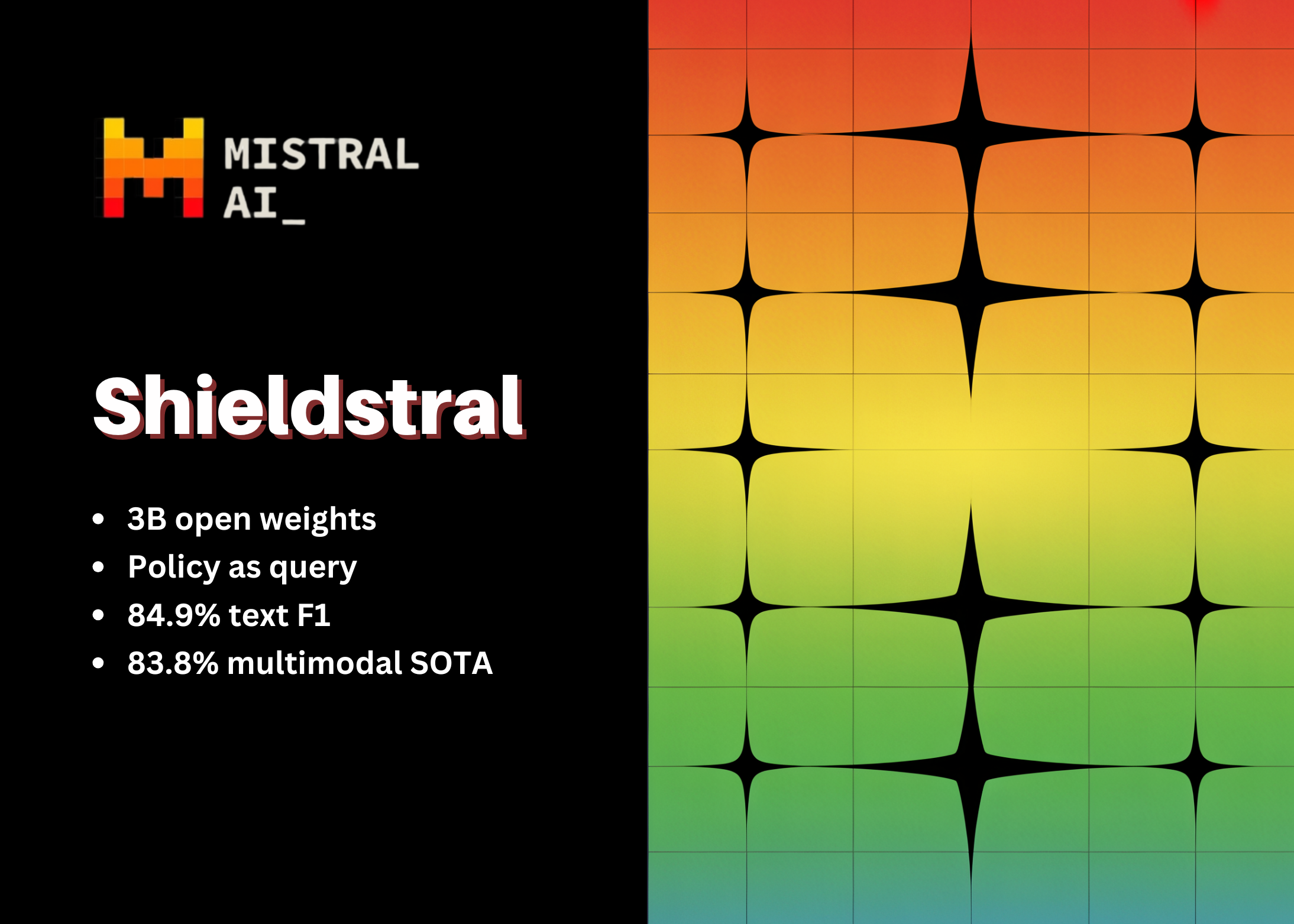
Mistral AI has released Shieldstral 1.0 3B, an open-weights, policy-adaptive multimodal safety classifier that treats content moderation as a single yes/no question rather than a fixed taxonomy of harm categories. Most guardrail models bake their category list into the weights, so re-targeting one to a new deployment context means retraining — and the same content can be acceptable on a cybersecurity research tool while being harmful on a mental-health platform. Shieldstral inverts that: operat