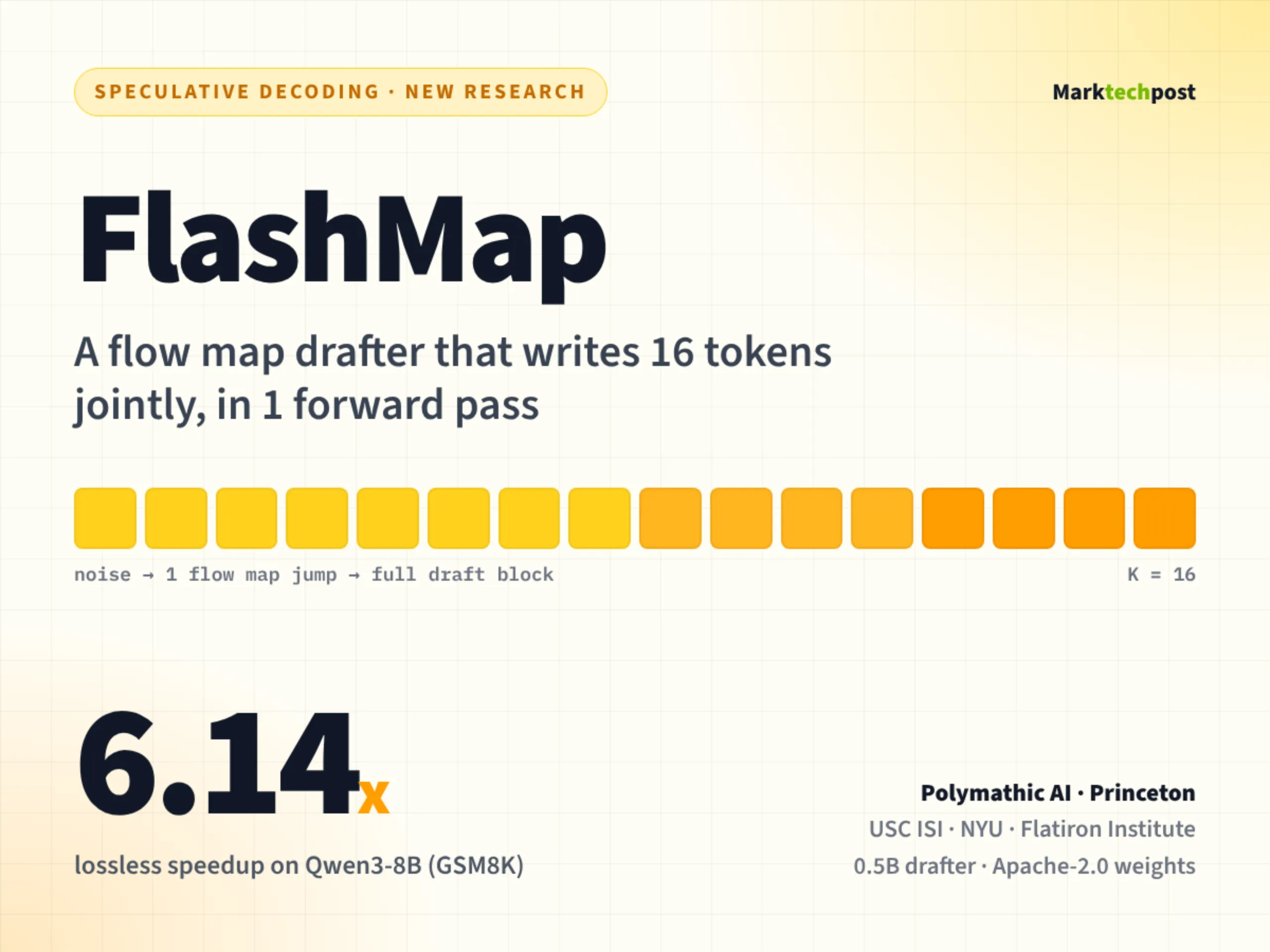
FlashMap speeds up language model decoding by 6.14x
MarkTechPost: Polymathic AI and Princeton Researchers Release FlashMap, a Flow Map Drafter for 6.14x Faster LLM Decoding
Researchers from Polymathic AI, Princeton University, USC ISI, NYU and the Flatiron Institute have released FlashMap. FlashMap speculative decoding replaces the discrete diffusion drafter with a continuous flow map. It drafts a full 16-token block in 1 forward pass. Tokens in that block stay consistent with each other. On Qwen3-8B, the research team reports up to 6.14x lossless speedup on GSM8K. Drafter weights for Qwen3-8B and Qwen3-4B are on Hugging Face, with vLLM and SGLang plugins. TL;D
Get smart on it
FlashMap is a speculative decoding drafter that speeds up large language model processing by drafting blocks of 16 tokens in a single forward pass using a continuous flow map approach, rather than predicting each token independently. The method achieves up to 6.14x faster decoding on certain benchmarks while maintaining the exact output quality of the target model, and outperforms existing drafters like DFlash across multiple tasks. Speculative decoding works by having a smaller drafter model propose multiple tokens that a larger target model then validates in parallel, keeping only the tokens the target model would have generated, so the speedup depends on how many proposed tokens are accepted and how efficiently they are drafted. The researchers have released drafter weights and plugins for popular serving frameworks, making the approach available for practical deployment.
Explainer: Why AI Is Getting Faster Without Getting Smarter: Speculative Decoding Explained
Relevant courses
Want to go deeper than the news? Explore live, cohort-based AI courses taught by practitioners.
Browse AI courses on MavenRelated news

Introducing GPT-6.1 Terra
Bringing fast and capable computer use to everyone
Also reported by SiliconANGLE, MarkTechPost and The Decoder

Genie 4: A new generation of world simulation
Genie 4: our new world model unlocking unprecedented realism in real-time simulation.
Also reported by TechCrunch, Ars Technica, SiliconANGLE and MarkTechPost

NVIDIA Nemotron 3.5 Transcribe and Granary v2: Intelligent Multilingual Transcription You Can Prompt and Adapt
Customizable transcription tools could help organizations reduce manual annotation costs while handling multiple languages simultaneously.
Also reported by TechCrunch and SiliconANGLE

Google’s next Genie AI model generates more realistic experiences
Google announced today its Genie 4 world model for generating interactive experiences using AI. The company says the model has four main updates: It allows for more realistic worlds, lets users update an experience in real time with a natural language prompt, can generate audio, and uses Gemini 3.8 Flash under the hood to help with its simulations. It also can create experiences that are about two minutes long, up from one minute for the previous Genie 3 model. Google is pitchi
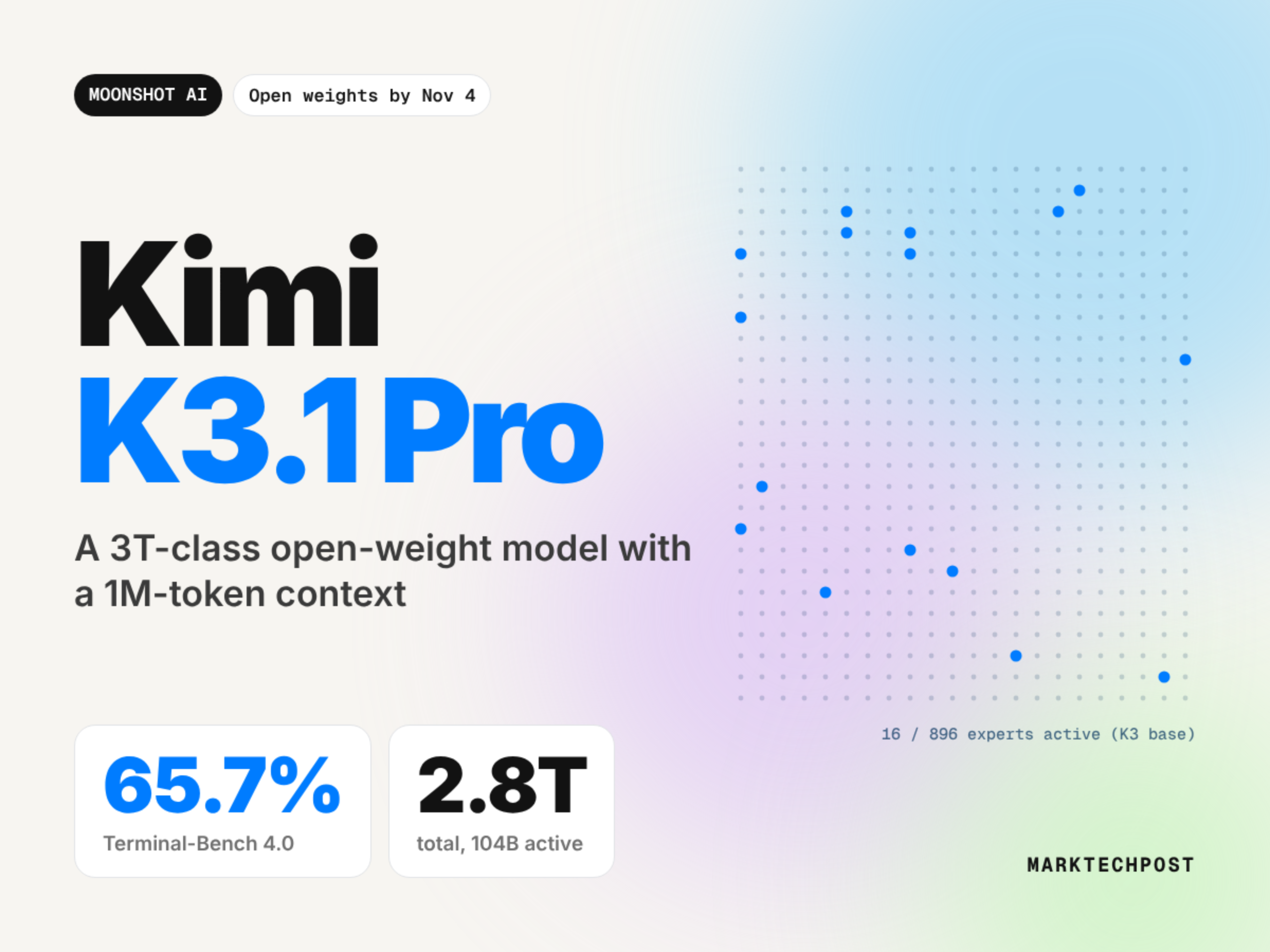
Moonshot AI Releases Kimi K3.1 Pro: A 2.8T Total/104B Active Params (MoE) Model with 1M Context
Moonshot AI has just released Kimi K3.1 Pro, the first model in its K3.1 series. Kimi K3.1 Pro is a 3T-class open-weight* model with a 1-million-token context window. Moonshot team positions it against the strongest proprietary models on coding, agentic and knowledge benchmarks. For developers, it is cheaper API pricing than K3 and open weights yet not available. *open weights are expected to release in November 2026. TL;DR Size: 2.8T total, 104B active parameters (MoE), 1M-token context
Also reported by SiliconANGLE and The Decoder
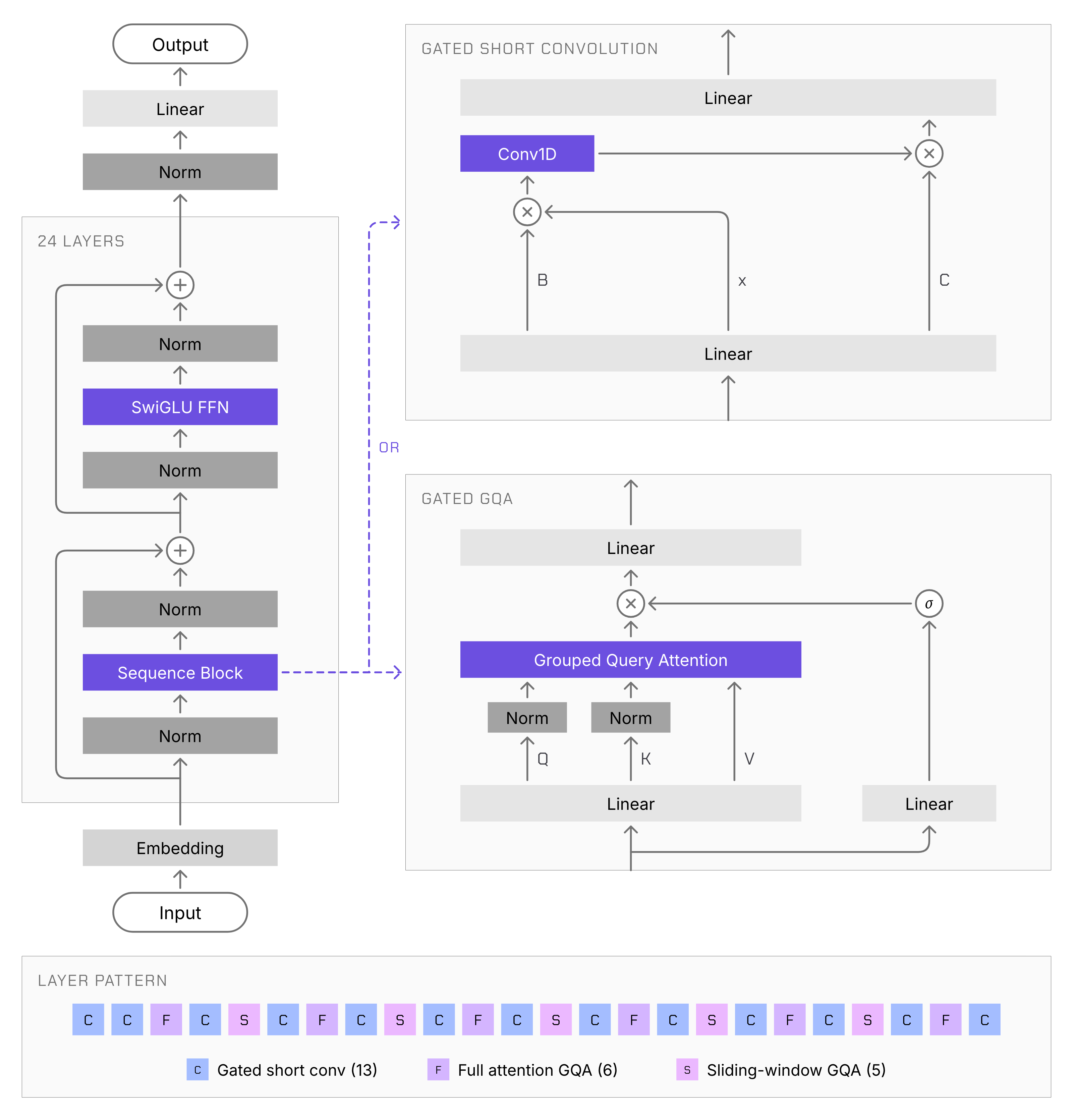
Build specialized multimodal models with LFM3
Organizations can now create custom AI systems combining text, images, and video without building from scratch, lowering barriers to deployment.
Also reported by MarkTechPost