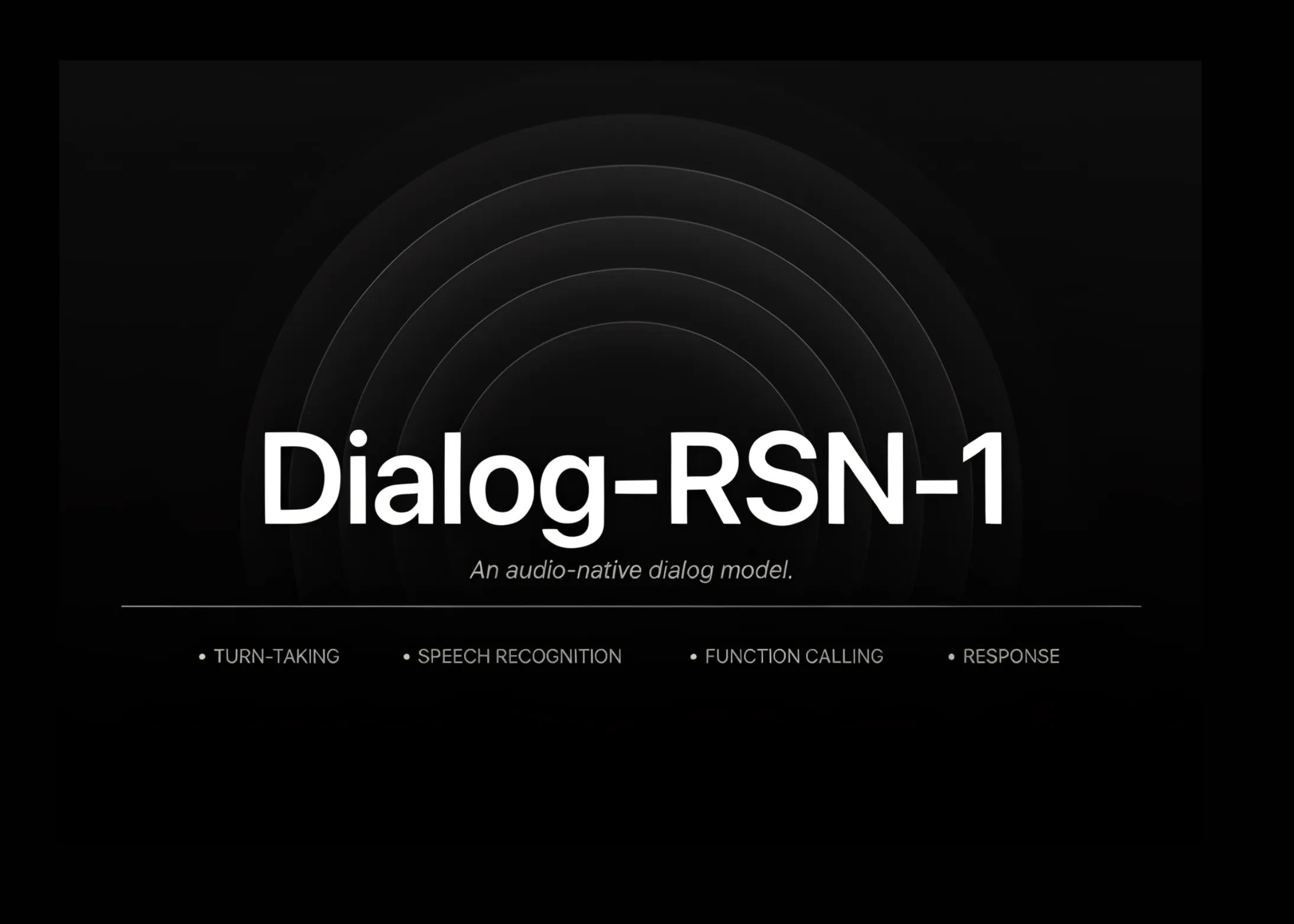
PolyAI Releases Dialog-RSN-1: An Audio-Native Dialog Model That Fuses Turn-Taking, Speech Recognition, Function Calling, And Response
PolyAI has introduced Dialog-RSN-1, a dialog model that perceives the caller’s audio directly instead of reading a transcript. It fuses turn-taking, speech recognition, function calling and response generation into one audio-native model, and is already handling live production calls. Key Takeaways Dialog-RSN-1 is audio-aware on the input side only; TTS stays separate, so the output voice remains controllable. It runs as a request-based LLM probed on demand, not an always-on str
Get smart on it
Dialog-RSN-1 is an audio-native dialog model that processes a caller's audio directly rather than relying on transcripts, combining turn-taking, speech recognition, function calling, and response generation into a single system. Unlike previous approaches that either lose audio information early in processing or bake voices into the model itself, Dialog-RSN-1 keeps audio input separate from voice output, allowing the voice to remain controllable while the model reasons over raw sound. The system is designed for enterprise use in high-call-volume industries such as restaurants, insurance, and financial services, with reported response times under 300 milliseconds and improvements in metrics like containment and latency. The model is currently available only through the company's platform for existing customers, not as open-source weights or a public API.
Related news

Pokee AI Releases Pokee-Isaac 28B: A 10M-Token Context Agentic Model Built to Run Inside the Customer Boundary
Long-horizon agents accumulate context faster than they resolve tasks. Every tool output, observation, and intermediate reasoning step stays in the window, and the two capabilities that matter — holding that context and staying coherent across it — have so far been available almost exclusively from cloud endpoints. That excludes regulated industries, public-sector institutions, and on-device applications, where the data is not permitted to leave the boundary at all. Pokee AI released Pokee-Isaa
Mistral AI Releases Shieldstral 1.0 3B: An Open-Weights Policy-Adaptive Multimodal Safety Classifier Matching Models 7× Its Size
Mistral AI has released Shieldstral 1.0 3B, an open-weights, policy-adaptive multimodal safety classifier that treats content moderation as a single yes/no question rather than a fixed taxonomy of harm categories. Most guardrail models bake their category list into the weights, so re-targeting one to a new deployment context means retraining — and the same content can be acceptable on a cybersecurity research tool while being harmful on a mental-health platform. Shieldstral inverts that: operat