Pokee AI Releases Pokee-Isaac 28B: A 10M-Token Context Agentic Model Built to Run Inside the Customer Boundary
Long-horizon agents accumulate context faster than they resolve tasks. Every tool output, observation, and intermediate reasoning step stays in the window, and the two capabilities that matter — holding that context and staying coherent across it — have so far been available almost exclusively from cloud endpoints. That excludes regulated industries, public-sector institutions, and on-device applications, where the data is not permitted to leave the boundary at all. Pokee AI released Pokee-Isaa
Get smart on it
Pokee AI released a large language model designed to process extremely long documents while running on a customer's own computers rather than cloud servers. The model can maintain coherence across a 10-million-token context window, which matters for regulated industries like healthcare, finance, and defense where data cannot leave a company's network boundary. The model performs competitively with cloud-based alternatives on benchmarks measuring both general reasoning and agentic task completion, while requiring only a single GPU to run. Deployment is licensed rather than open-source, with pricing and support for on-premises, virtual private cloud, and on-device installation.
Related news
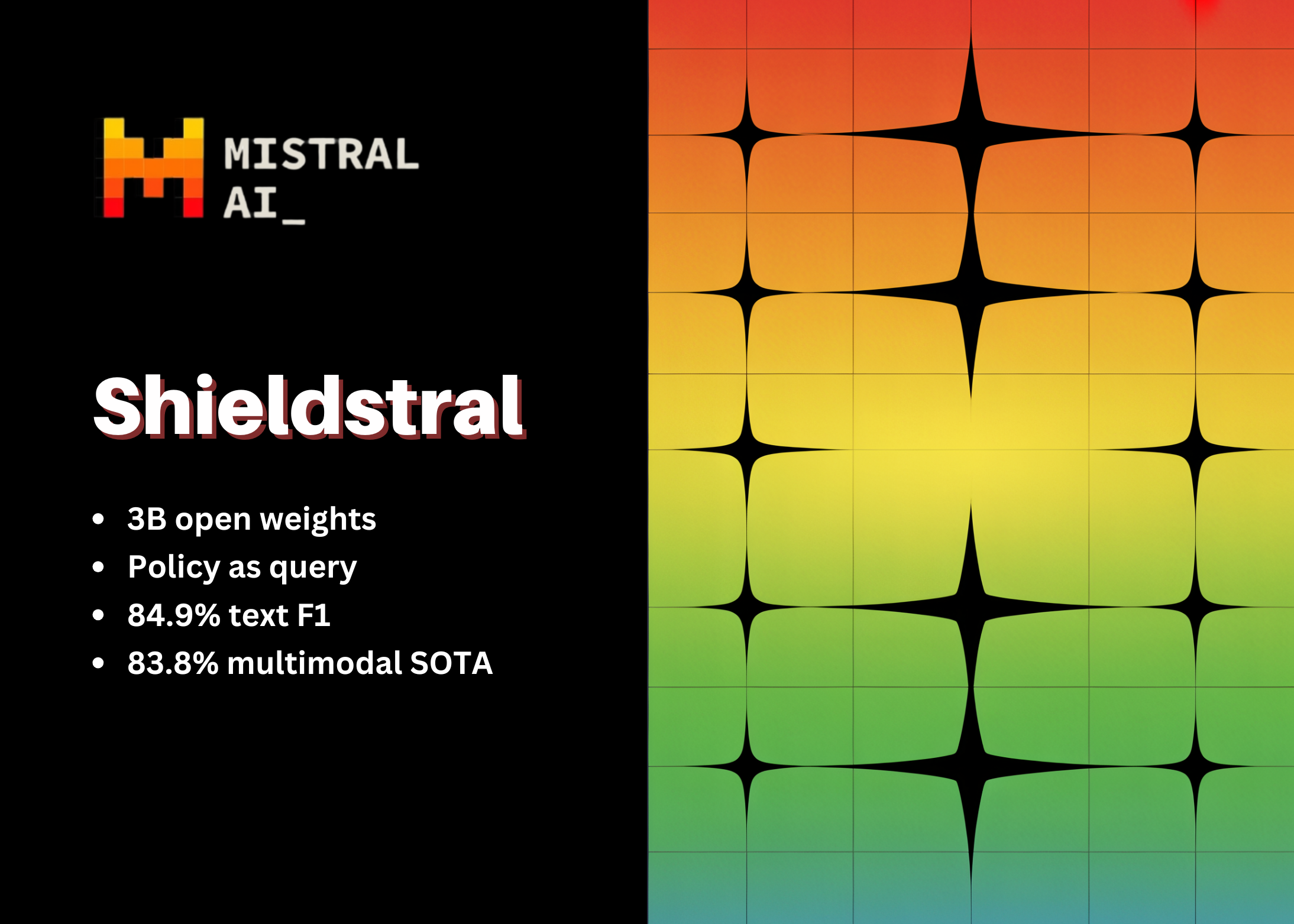
Mistral AI Releases Shieldstral 1.0 3B: An Open-Weights Policy-Adaptive Multimodal Safety Classifier Matching Models 7× Its Size
Mistral AI has released Shieldstral 1.0 3B, an open-weights, policy-adaptive multimodal safety classifier that treats content moderation as a single yes/no question rather than a fixed taxonomy of harm categories. Most guardrail models bake their category list into the weights, so re-targeting one to a new deployment context means retraining — and the same content can be acceptable on a cybersecurity research tool while being harmful on a mental-health platform. Shieldstral inverts that: operat
NVIDIA AI Releases NOOA: An Object-Oriented Python Framework That Turns an AI Agent Into a Single Python Class
NVIDIA Labs has open-sourced NOOA (NVIDIA Object-Oriented Agents), a model-agnostic Python framework for building AI agents. Agent development today is split across prompt templates, tool schemas, callback code, and workflow graphs. NOOA collapses all of it into one Python class. Methods are the actions the model can take. Fields are agent state. Docstrings are prompts. Type annotations are contracts the runtime enforces. A method whose body is ... is completed at runtime by an LLM-driven loop,