NVIDIA Releases Cosmos 3 Edge: A 4B-Parameter Open World Model That Reasons and Generates Robot Actions On-Device
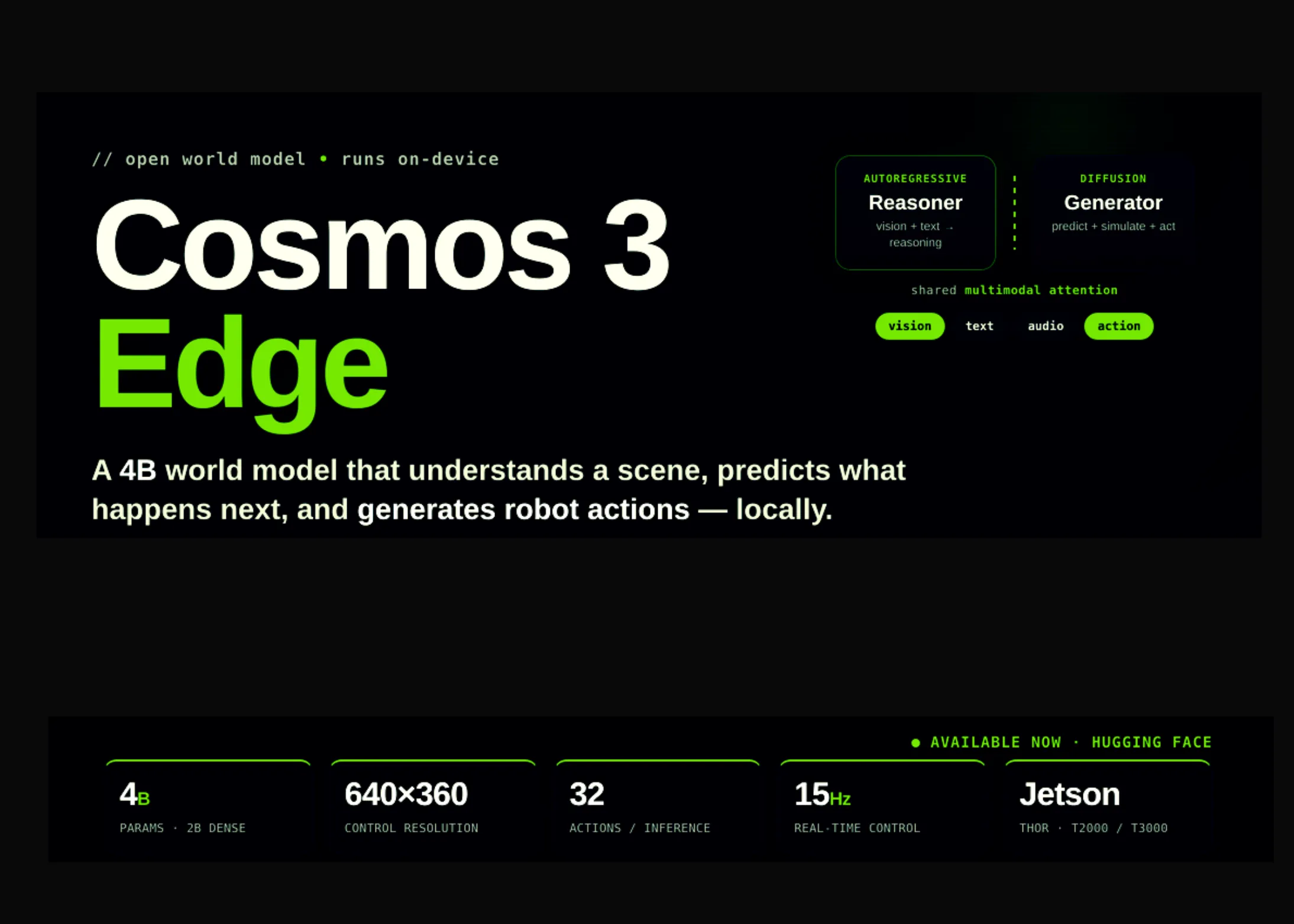
NVIDIA has released Cosmos 3 Edge, a 4-billion-parameter open world model built to run on-device. It helps robots and vision AI agents understand surroundings, reason in real time, and generate robot actions locally. The Cosmos 3 family included Cosmos 3 Nano (16B) and Cosmos 3 Super (64B) shipped on May 31, 2026 at GTC Taipei. Edge is the third and smallest tier, at roughly one-sixteenth the size of Super. The problem is specific. Machines operate at the edge in factories, warehouses, a
Get smart on it
A world model is software that learns how environments change over time by tracking objects, motion, spatial relationships, and the effects of actions. Cosmos 3 Edge is a compact 4-billion-parameter world model designed to run directly on robots and edge devices in factories, warehouses, and hospitals, enabling them to understand their surroundings, reason in real time, and generate actions locally without relying on data centers. The model uses a two-tower architecture where one tower reasons about visual and text information while another tower generates predictions and actions, with both towers sharing attention layers that align information across different types of input. This matters because machines operating at the edge need high-level performance while working with limited memory, and the model's unified action representation allows it to work across different types of physical systems like robot arms, vehicles, and humanoid robots.
Related news

FAIRChem v2 UMA for Multidomain Atomistic Simulation across Molecules, Catalysts, Materials, Vibrations, and Molecular Dynamics
In this tutorial, we explore FAIRChem v2 and the UMA universal machine-learning interatomic potential as a unified framework for atomistic simulation across molecular chemistry, catalysis, and inorganic materials. We configure an environment, authenticate with Hugging Face to access the gated UMA model weights, and initialize task-specific calculators for the omol, oc20, and omat domains. We then apply the same pretrained potential to a broad set of computational chemistry workflows, including
Induction Labs Photon-1 Simulates Desktops, Plays Checkers, and Models Billiard Physics From One Pretraining Run
Most agents that learn from video need to know what action produced each frame. Induction Labs is arguing that this requirement is the bottleneck. Last week, they released imagination models, a foundation model architecture that pretrains on raw video with no action labels at all. Their test system is Photon-1, a sparse 106B-A5B mixture-of-experts (MoE) transformer trained on 18 years of computer demonstration video. On an internal computer use benchmark, Induction Labs reports that Photon-1