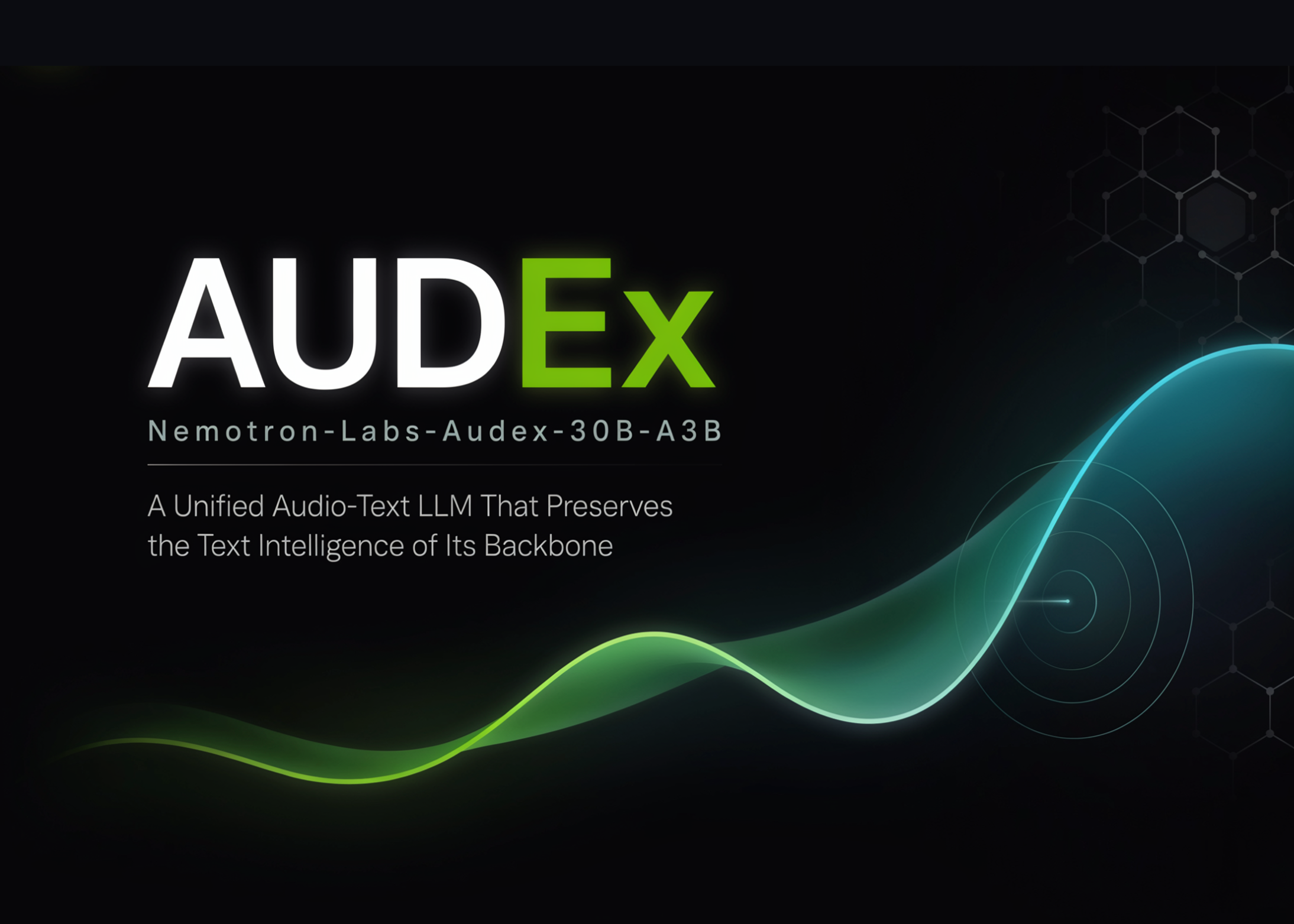
NVIDIA Releases Audex (Nemotron-Labs-Audex-30B-A3B): A Unified Audio-Text LLM That Preserves the Text Intelligence of Its Backbone
NVIDIA has released Audex (Nemotron-Labs-Audex-30B-A3B), a unified audio-text large language model. It understands and generates both audio and speech. It also keeps the text intelligence of its backbone. The checkpoints, along with a smaller Audex-2B, are released under a noncommercial license. Most multimodal models pay a text tax. When labs add audio or vision output, text benchmarks often drop. NVIDIA research team reports this even for speech-only output models. Audex is designed to avo
Make your prediction
Will a frontier audio-language model surpass Audex on the Open ASR Leaderboard by October 2026?
Resolves by Oct 8, 2026
Your prediction
50% · 50/50 coin flip
NOYES
Get smart on it
A unified audio-text language model was released that can both understand and generate audio and speech while maintaining the text performance of its underlying model. Most multimodal models experience a "text tax" where adding audio or vision capabilities causes text benchmark scores to drop, but this model was specifically designed to avoid that regression. The model uses a simple architecture that treats audio inputs and outputs similarly to text tokens, allowing it to run on standard language model software stacks. It was trained through multiple stages starting from a text-only foundation, followed by text-only reinforcement learning, which helped preserve strong text capabilities while adding audio abilities.
Related news
Ant Group’s Robbyant Open-Sources LingBot-Vision: A 1B Boundary-Centric Vision Foundation Model for Dense Spatial Perception
Robbyant, the embodied-AI company within Ant Group, has open-sourced LingBot-Vision, a family of self-supervised Vision Transformers built for dense spatial perception. The weights ship under Apache-2.0 on Hugging Face in four sizes — ViT-giant, ViT-large, ViT-base, and ViT-small — together with a technical report and inference code. Most vision foundation models are trained for semantic invariance: they learn to answer what is in an image while discarding exactly the fine-grained spatial st

Meta rolls out Muse, a new AI image generator
The new image-generating model has numerous use cases, including advertising, decorating and creator-based opportunities.