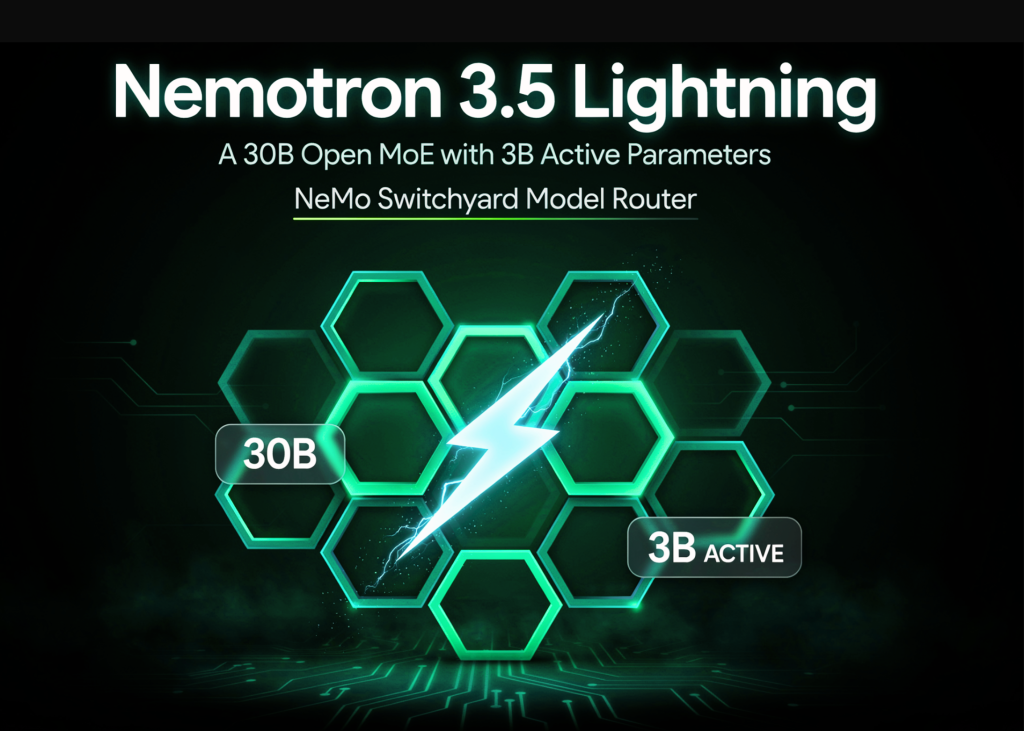
NVIDIA AI Releases Nemotron 3.5 Lightning: A 30B Open MoE with 3B Active Parameters, and NeMo Switchyard Model Router
NVIDIA introduced open technologies for building always-on AI agents from systems of specialized models. Two artifacts shipped together. Nemotron 3.5 Lightning is a lightweight, customizable open model built for high-volume agentic tasks, and NeMo Switchyard is an open source routing library that directs each step of an agent workflow to the most capable and efficient model available. The problem both address is structural: long-running agents spend most of their time on tool calls, result vali
Get smart on it
NVIDIA released two complementary technologies for building AI agents: Nemotron 3.5 Lightning, a 30-billion-parameter mixture-of-experts model with 3 billion active parameters, and NeMo Switchyard, an open-source routing library. The problem these address is that long-running agents spend most of their time on routine tasks like tool calls and result validation, and sending every step to a large reasoning model adds unnecessary cost and latency. Nemotron 3.5 Lightning achieves up to 4 times faster output speed than similar-sized models through speculative decoding and quantization techniques, while NeMo Switchyard can route tasks to different models based on capability and efficiency, reducing costs by up to 74 percent according to published benchmarks. Both technologies are available under permissive open licenses and can run on single modern GPUs, making them deployable by individual developers as well as enterprises across industries including cybersecurity, legal services, finance, and healthcare.
Related news
Fine-Tuning Tool-Calling LLMs: A Complete Guide Using XYZ-Aquila-SFT and Qwen3
In this tutorial, we implement an end-to-end supervised fine-tuning pipeline for the XYZ-Aquila-SFT dataset, Hugging Face Transformers, PyTorch, and PEFT. We stream and inspect the dataset, parse multi-turn tool-use trajectories, extract structured tool calls, analyze corpus characteristics, and preserve embedded reasoning and observation patterns. We then convert tool schemas between message-embedded and structured formats, render Qwen-compatible ChatML with assistant-only loss masking, prepar

Meta’s ‘open’ AI, and a $250M deal gone very wrong
Meta released Glimmer this week, an open-weight AI model anyone can download and run on their own hardware — a contrast to Muse Spark, the company’s more powerful model that stays locked behind its own APIs. The release landed alongside a letter from Mark Zuckerberg arguing AI should be “for everyone” rather than controlled by a handful of labs, but as Equity’s […]