Microsoft’s SkillOpt Shows Optimized Agent Skill Artifacts Transfer Across Model Scales and Between Codex and Claude Code Harnesses
SkillOpt is a text-space optimizer developed by a team of researchers from Microsoft, Shanghai Jiao Tong University, Tongji University, and Fudan University. SkillOpt trains a single natural-language skill document while the target model stays frozen. An optimizer model reads scored rollouts and proposes bounded add/delete/replace edits. A held-out selection split accepts an edit only when the score strictly improves. The exported artifact is one file, best_skill.md. The transfer tables
Get smart on it
SkillOpt is a text-space optimizer that trains natural-language skill documents for AI agents while keeping the target model frozen, generating portable instruction files that can transfer across different AI models and code execution environments. The research demonstrates that skills trained on one model or harness can retain significant performance gains when deployed elsewhere, with one cross-harness transfer even exceeding the performance of training a skill from scratch in the target environment. This matters for deployment because training costs are paid once offline, and if a skill transfers successfully, that cost spreads across multiple environments, while the resulting artifact remains a readable text file that practitioners can audit and trace. The portability appears strongest for procedural skills that describe how to inspect, verify, and format outputs, rather than reasoning-heavy skills that seem more tied to their training environment.
Related news

Pokee AI Releases Pokee-Isaac 28B: A 10M-Token Context Agentic Model Built to Run Inside the Customer Boundary
Long-horizon agents accumulate context faster than they resolve tasks. Every tool output, observation, and intermediate reasoning step stays in the window, and the two capabilities that matter — holding that context and staying coherent across it — have so far been available almost exclusively from cloud endpoints. That excludes regulated industries, public-sector institutions, and on-device applications, where the data is not permitted to leave the boundary at all. Pokee AI released Pokee-Isaa
Mistral AI Releases Shieldstral 1.0 3B: An Open-Weights Policy-Adaptive Multimodal Safety Classifier Matching Models 7× Its Size
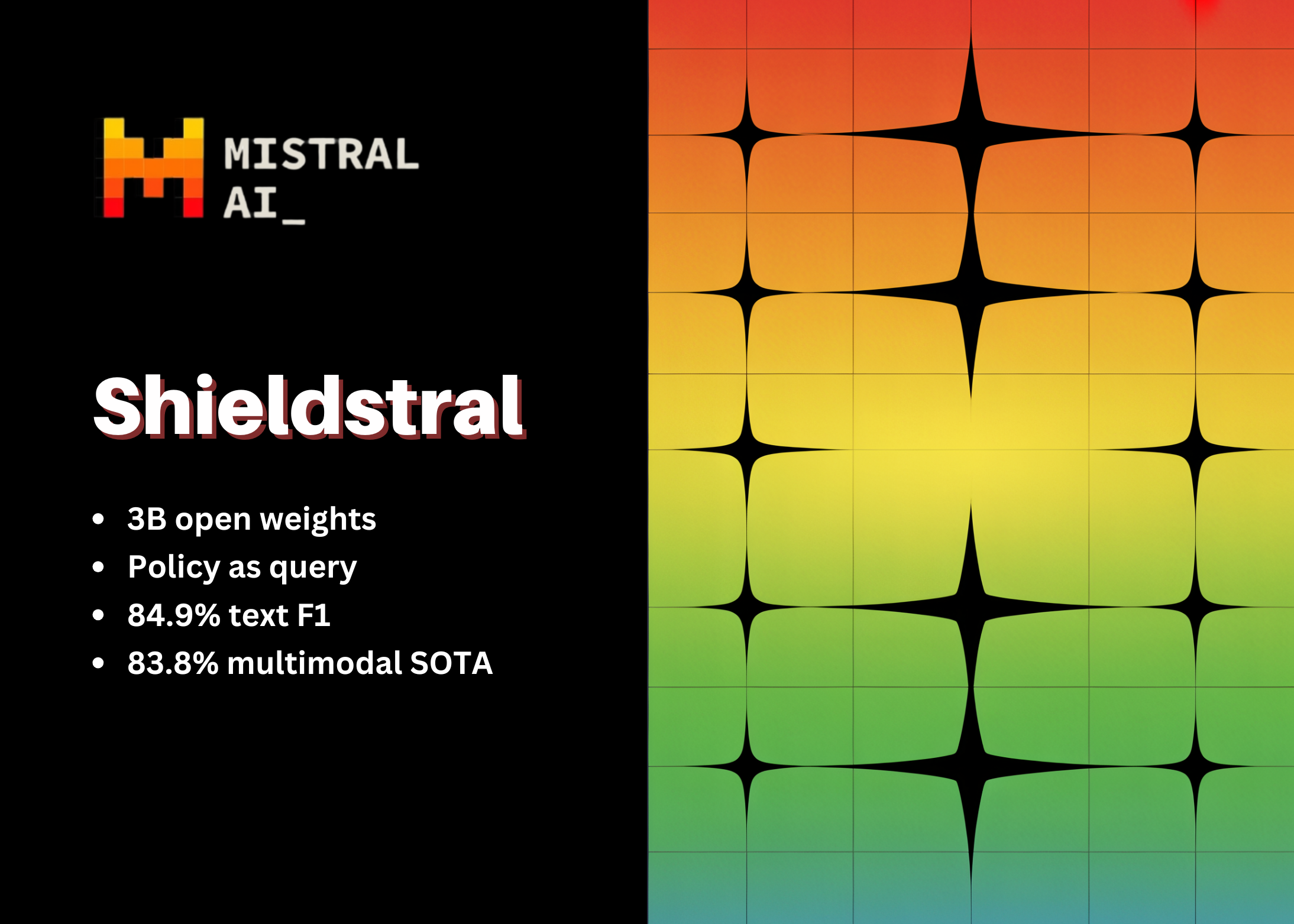
Mistral AI has released Shieldstral 1.0 3B, an open-weights, policy-adaptive multimodal safety classifier that treats content moderation as a single yes/no question rather than a fixed taxonomy of harm categories. Most guardrail models bake their category list into the weights, so re-targeting one to a new deployment context means retraining — and the same content can be acceptable on a cybersecurity research tool while being harmful on a mental-health platform. Shieldstral inverts that: operat