Meta Superintelligence Labs Releases Muse Voice Transcribe: One Real-Time Model for Streaming ASR, Diarization, and Endpointing
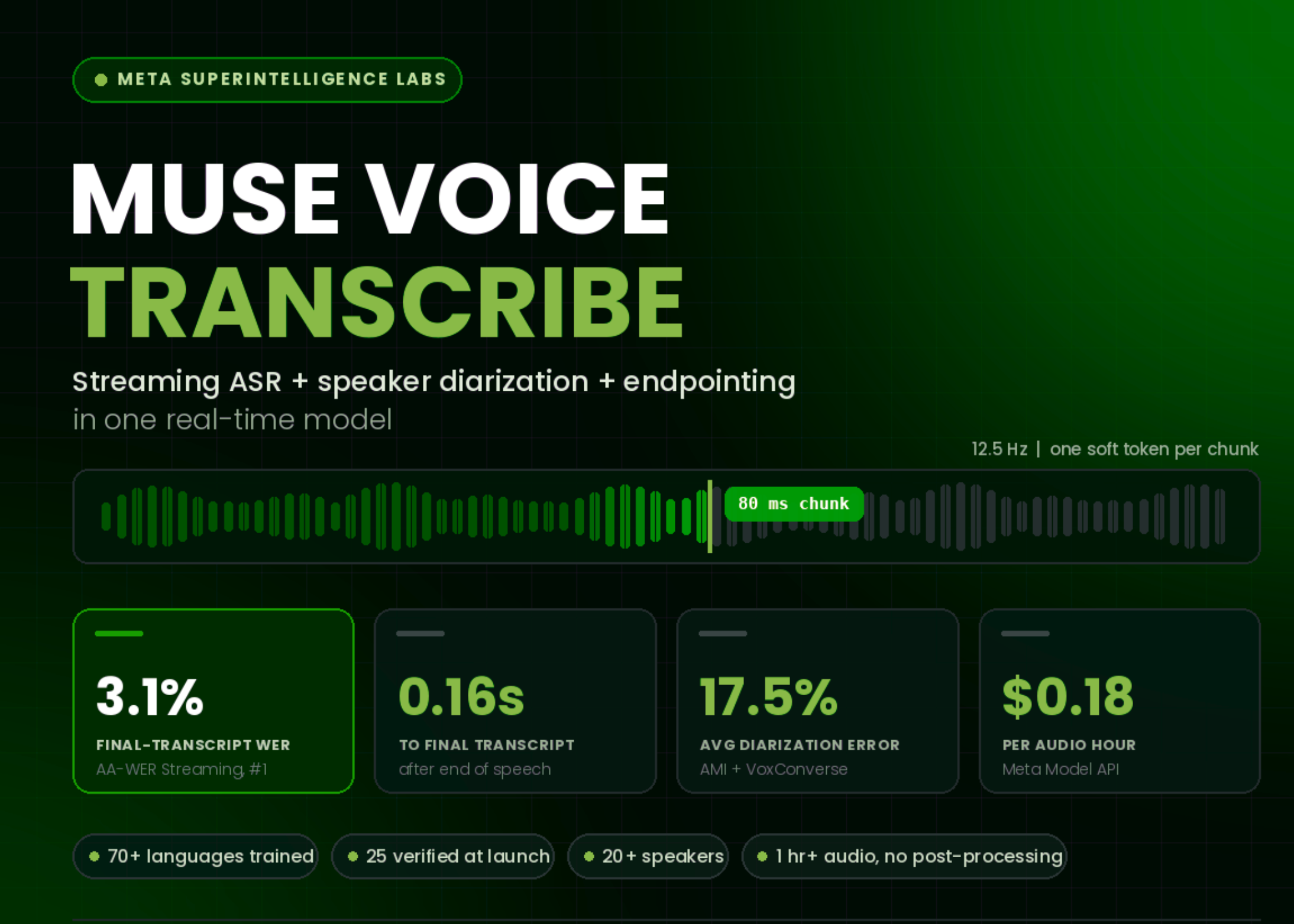
Most production voice stacks are three systems stitched together. One model transcribes, a second separates speakers, and a detector decides when the user stopped talking. Each hand-off adds latency and a new failure mode. Muse Voice Transcribe, announced by Meta Superintelligence Labs this week, collapses those three jobs into a single autoregressive model. Meta calls it its first real-time audio perception model. It performs streaming ASR, speaker diarization for 20+ speakers, and endpoint
Get smart on it
Most voice transcription systems require three separate models working in sequence: one to transcribe speech to text, another to identify which speaker is talking, and a third to detect when someone stops speaking. Each handoff between these systems adds delays and potential errors. Meta Superintelligence Labs released a single model that combines all three tasks into one, performing real-time transcription, speaker identification for over 20 speakers, and speech detection simultaneously without needing additional processing steps. The model uses reinforcement learning to adaptively balance accuracy against speed on a word-by-word basis, and it supports over 70 languages with native code-switching for bilingual speakers. It is available only as a paid API service at $0.18 per audio hour, with no publicly released weights for self-hosted use.
Related news
Google DeepMind’s WeatherNext 3 Trains on Weather Station Observations to Deliver 5 km Global Forecasts, Refreshed Every Hour
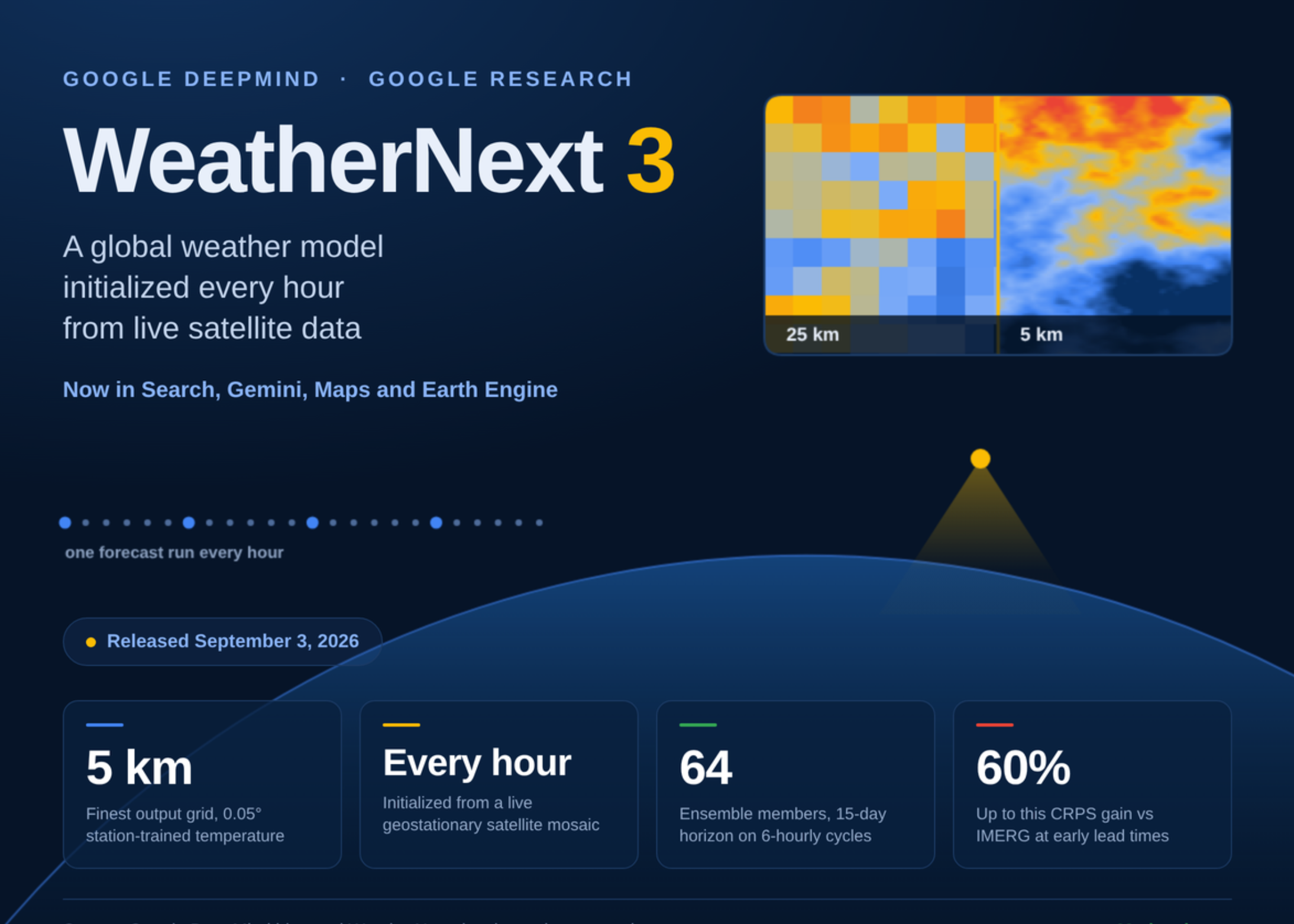
AI weather models have spent three years closing the gap with physics-based forecasting, but two problems stayed open: resolution too coarse for local terrain, and initialization tied to numerical weather prediction (NWP) analysis that arrives about six hours late. WeatherNext 3, released by Google DeepMind and Google Research, attacks both. It takes a live global geostationary satellite mosaic as a direct model input, re-initializes every hour, and emits forecasts down to 0.05° (~5 km) while t

OpenAI Releases GPT-6 Astra: A 1.05M-Context Computer-Use Model Gated Behind a ‘Critical’ Cyber Threshold
Today, OpenAI released GPT-6 Astra. The company calls it its most intelligent and aligned model, and positions it primarily as a computer-use system rather than a chat model. The pitch is that Astra operates software the way a person does, across browsers, spreadsheets, desktop applications and terminals, and finishes multi-step jobs instead of describing how to do them. Is it deployable? Partly, and not on your own hardware. Astra is a closed, hosted model with no released weights, so self