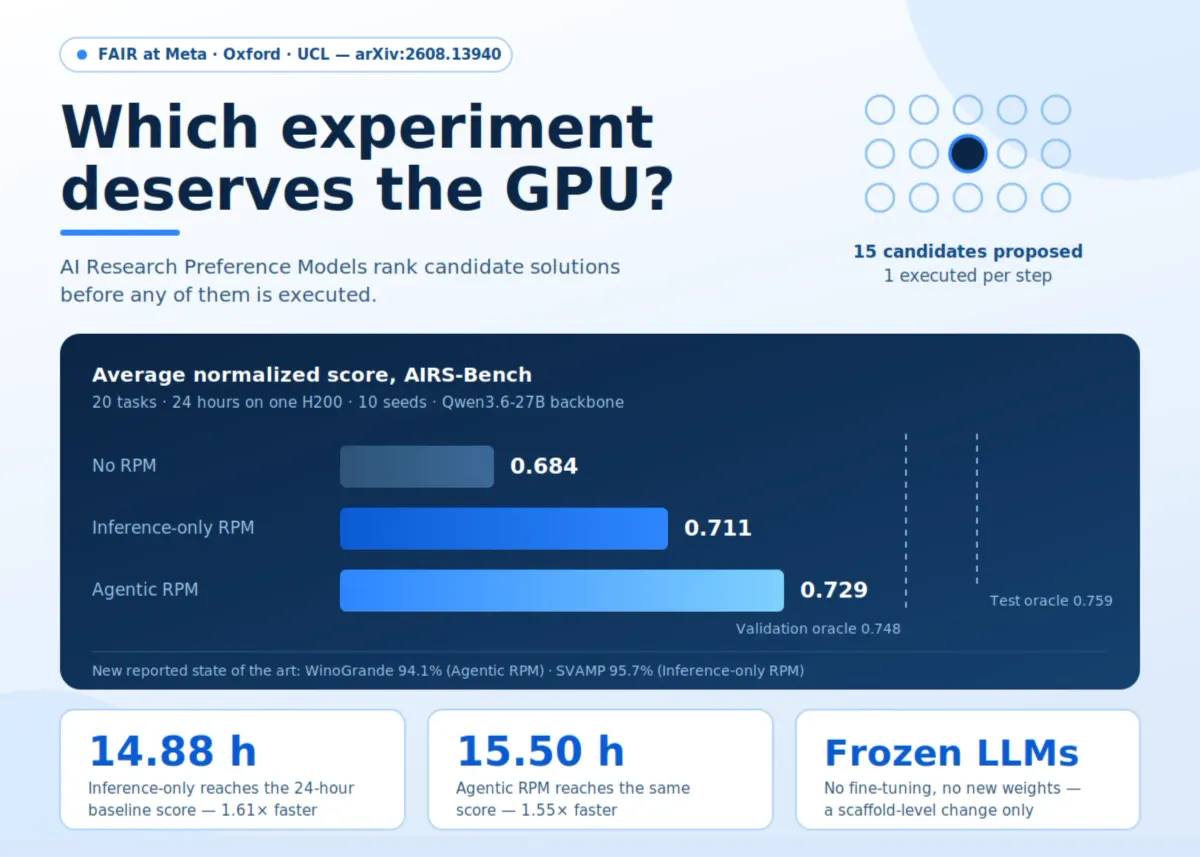
Meta FAIR Introduces AI Research Preference Models (RPMs): Ranking ML Experiments Before Spending GPU Hours
AI research agents can already propose, implement and score their own machine learning experiments. Idea generation is cheap; verification is not. Training one candidate can consume hours to days of GPU time, so an agent proposes far more candidates than it can afford to run. Which ones get run is the real lever on research progress. A research team from FAIR at Meta, the University of Oxford and University College London formalizes that lever as research preference and introduces AI Researc
AI research agents can propose and implement machine learning experiments, but training candidates consumes many hours of GPU time, making it impractical to run all proposed ideas. Researchers have introduced Research Preference Models, which rank unexecuted experiment candidates to select only the most promising ones for execution, without attempting to predict absolute performance scores. Two variants were tested: an inference-only version that judges candidates based on their code and context, and an agentic version that runs small-scale pilot experiments before deciding which candidate to execute. On benchmark testing, both variants achieved the baseline results in roughly 1.5 to 1.6 times faster than random selection, while also reaching new state-of-the-art scores on certain tasks.
One short email a day with the stories that matter. Free. Unsubscribe with one click.
Want to go deeper than the news? Explore live, cohort-based AI courses taught by practitioners.
Browse AI courses on Maven
Anthropic releases new Mythos and Fable models amid RSI concerns
Anthropic says the new models "show improvements in areas like coding, reasoning, and vision," as well as in communicating more clearly with users.
Also reported by The Verge, SiliconANGLE and MarkTechPost
Runway’s Praxis-1 world action model for robotics is now available
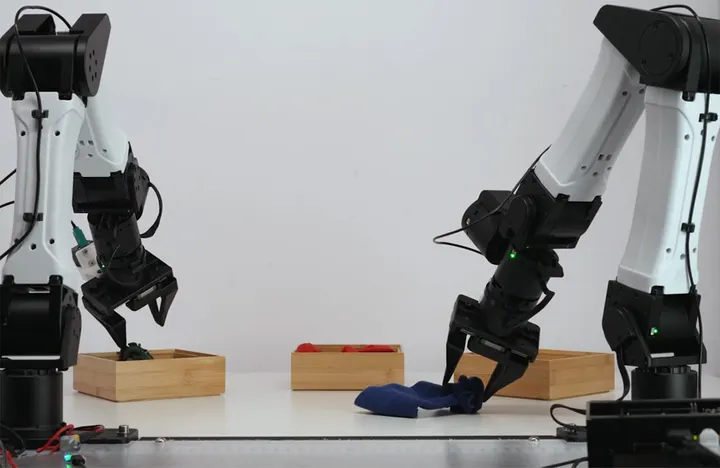
Praxis-1 builds on Runway’s work as a founding member of the Cosmos Coalition, advancing open world models for physical AI. | Source: Runway Runway AI Inc. yesterday released Praxis-1, its world action model for robotics. The model is now available to developers with open weights under the Apache 2.0 license. Runway first announced Praxis-1 in September with launch partners including Noble Machines, Standard Bots, and Ultra. Since then, these companies have been running the model on their own ha

Google releases Gemini 4 Carbon with agent ‘swarm’ feature
Google is rolling out its latest AI model, Gemini 4 Carbon, to the general public after releasing it to a select group of "cybersecurity defenders" two weeks ago. Google claims Carbon is its "strongest model" yet, and capable of competing with the very best systems from Anthropic and OpenAI. Google says Gemini 4 Carbon "pushes the frontier even further" than Argon, referring to the company's other frontier model that launched only last month. The company said Argon will likely

Gemini 4 Carbon is now available
The latest version aims to deliver improved performance while reducing the computational resources and energy required for AI operations.
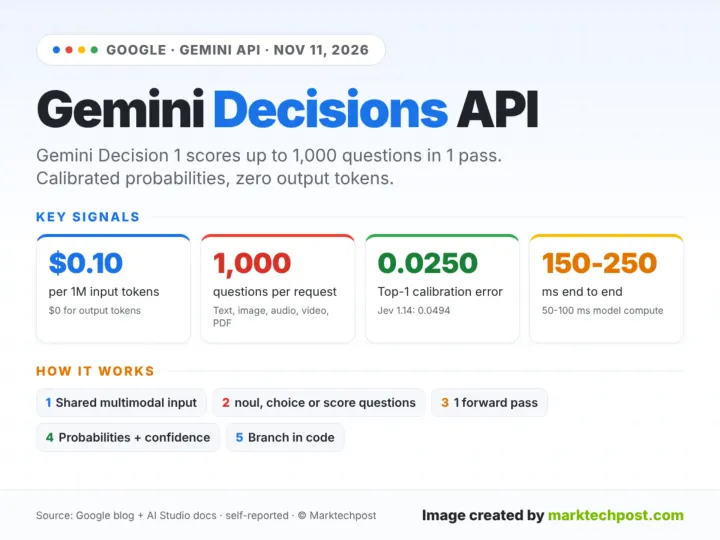
Google Launches Gemini Decisions API With Gemini Decision 1 at $0.10/M Tokens
Google has launched the Gemini Decisions API, powered by a new model, Gemini Decision 1 (gemini-decision-1). The Gemini Decisions API does not generate text. It scores up to 1,000 typed questions against one shared input and returns calibrated probabilities. For developers, this targets the small branching calls inside agents: routing, policy checks, tool selection and grading. Google prices it at $0.10 per 1M input tokens, with zero output tokens billed. TL;DR Size: Context is 262,144 t
Also reported by SiliconANGLE

Introducing AlphaProof Code: a breakthrough in verifying complex software at depth
AlphaProof Code agents wrote three million lines of proofs in Lean to verify Signal’s core encryption.