Meituan Releases LongCat-2.0: A 1.6T-Parameter Open MoE Model with Native 1M Context and LongCat Sparse Attention
Meituan has released LongCat-2.0, a large-scale Mixture-of-Experts (MoE) language model. It carries 1.6 trillion total parameters and activates about 48 billion per token. The model targets agentic coding: code understanding, generation, and execution inside agent workflows. Two facts stand out. First, LongCat-2.0 supports a native 1-million-token context window. Second, both training and serving ran entirely on domestic AI ASIC superpods. What is LongCat-2.0? LongCat-2.0 is Meituan&#
Make your prediction
Will LongCat-2.0 appear on the Hugging Face model hub by July 13, 2026?
Resolves by Jul 13, 2026
Your prediction
50% · 50/50 coin flip
NOYES
Get smart on it
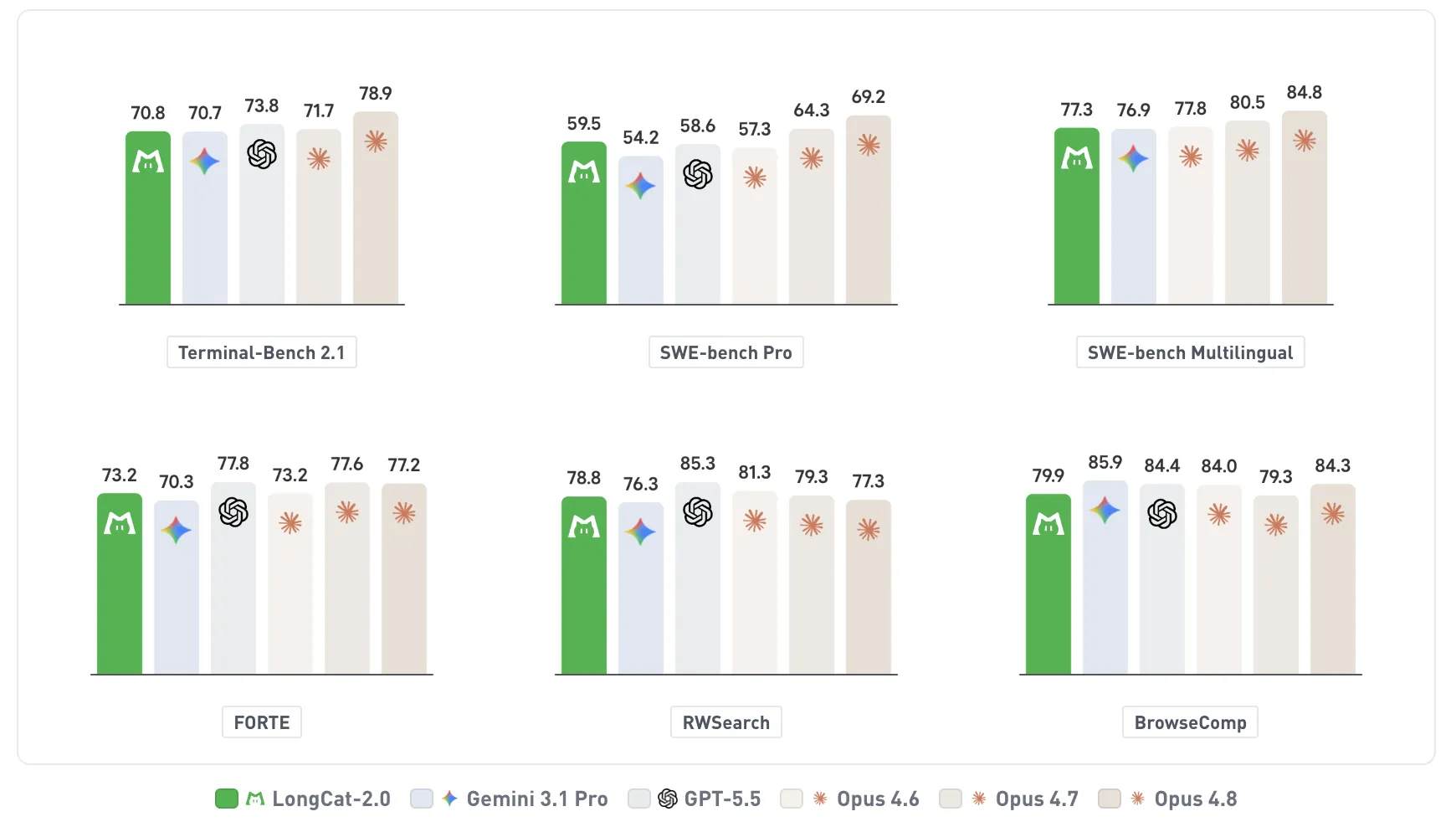
A company released an open large language model with 1.6 trillion total parameters designed specifically for software engineering tasks like code generation and debugging. The model can process 1 million tokens of context at once through a technique called sparse attention that reduces computational cost from quadratic to linear scaling. Training and serving happened entirely on domestic AI chips rather than Nvidia hardware, demonstrating capability on non-standard infrastructure. According to vendor benchmarks, it scores 59.5 on real-world software engineering tasks and 70.8 on shell execution benchmarks, positioning it as competitive with other frontier models in coding-focused work.
Related news
Mistral AI Releases Leanstral 1.5: An Apache-2.0 Lean 4 Code Agent Model Solving 587 of 672 PutnamBench Problems
Today, Mistral AI released Leanstral 1.5. It is a code agent model built for Lean 4. The release targets automated theorem proving and proof engineering. Weights are open under Apache 2.0. A free API endpoint, leanstral-1-5, is now live. Leanstral 1.5 updates the earlier Leanstral-2603 model. It belongs to the Mistral Small 4 family. What is Leanstral 1.5 Leanstral 1.5 is a code agent model for Lean 4, a proof assistant. A proof assistant checks every logical step mechanically. Lean 4
Leanstral 1.5: Proof Abundance for All
The release aims to democratize access to high-quality model capabilities across different use cases and budgets.