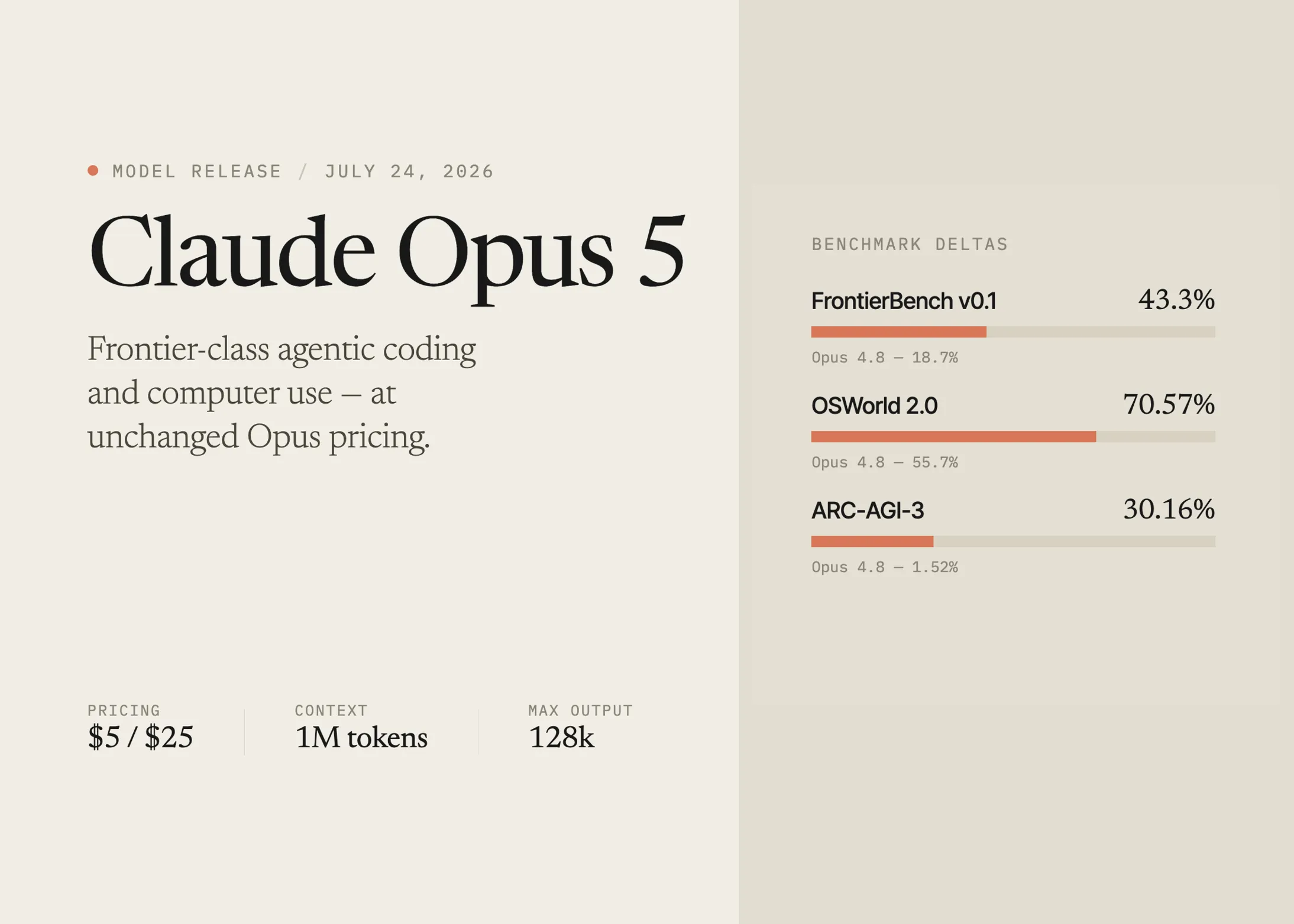
Meet the New Claude Opus 5: Frontier-Class Agentic Coding and Computer Use at Unchanged Opus Pricing
Today, Anthropic released Claude Opus 5. It replaces Claude Opus 4.8 as the Opus-tier flagship. Pricing is unchanged at $5 per million input tokens and $25 per million output tokens. The Anthropic team positions Opus 5 as approaching the intelligence of Claude Fable 5 at half the price. It is now the default model on Claude Max and the strongest model on Claude Pro. What actually changed at the API level Three changes are quite important before any benchmark does: Thinking is on b
Make your prediction
Will Anthropic's Claude Fable 5 become publicly available before October 2026?
Resolves by Sep 30, 2026
Your prediction
50% · 50/50 coin flip
NOYES
Get smart on it
Anthropic released a new flagship model called Claude Opus 5 at the same pricing as its predecessor, positioning it as approaching the intelligence of a more expensive model at half the cost. The model now has thinking enabled by default, which changes how developers need to structure their requests and manage token limits. Opus 5 shows particularly strong performance on agentic tasks like automation and coding benchmarks, with scores substantially higher than the previous version. The company maintained most safety protections from earlier versions while relaxing restrictions specifically for source-code vulnerability finding, though it kept blocks on exploit generation and penetration testing.
Related news
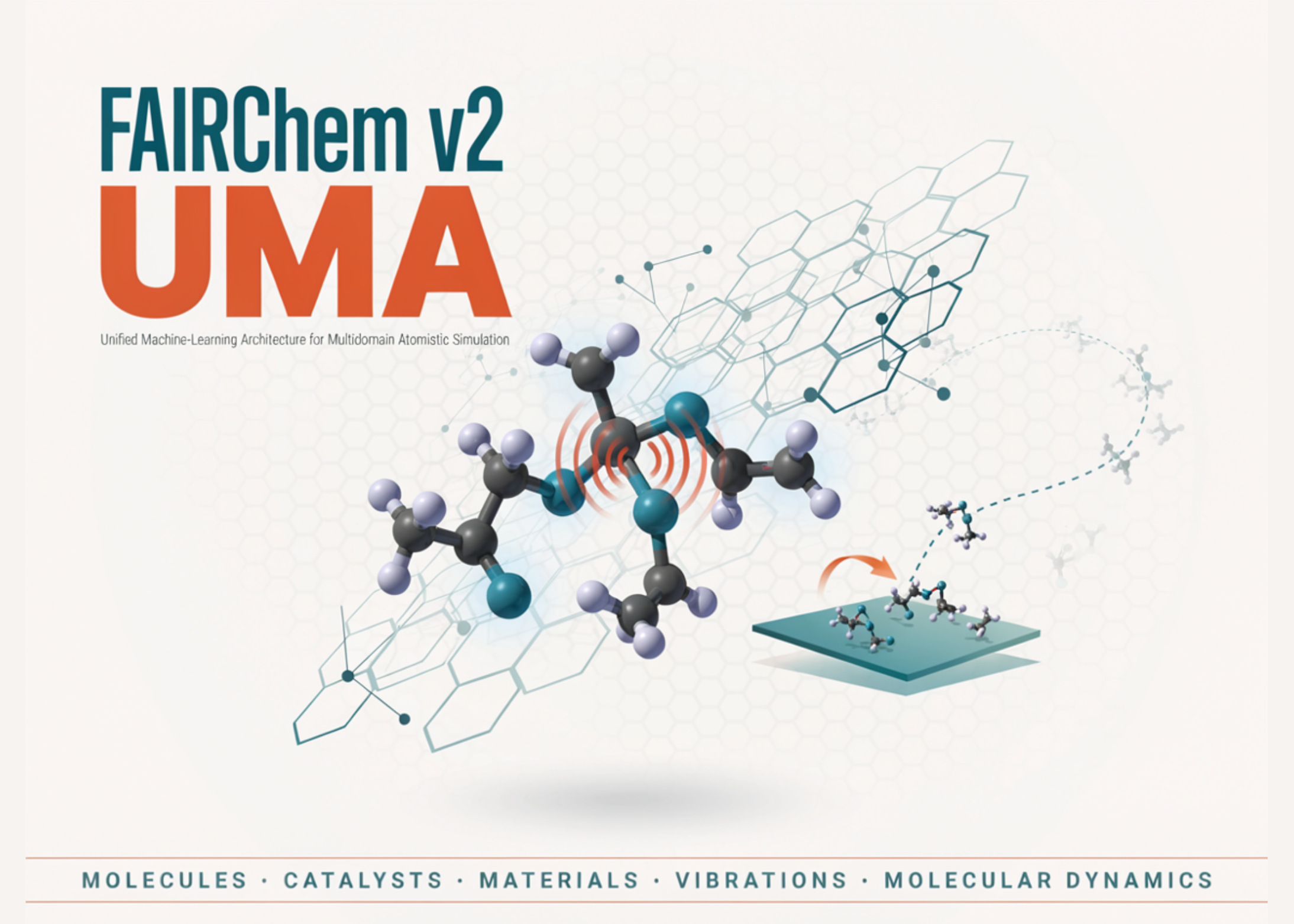
FAIRChem v2 UMA for Multidomain Atomistic Simulation across Molecules, Catalysts, Materials, Vibrations, and Molecular Dynamics
In this tutorial, we explore FAIRChem v2 and the UMA universal machine-learning interatomic potential as a unified framework for atomistic simulation across molecular chemistry, catalysis, and inorganic materials. We configure an environment, authenticate with Hugging Face to access the gated UMA model weights, and initialize task-specific calculators for the omol, oc20, and omat domains. We then apply the same pretrained potential to a broad set of computational chemistry workflows, including
Induction Labs Photon-1 Simulates Desktops, Plays Checkers, and Models Billiard Physics From One Pretraining Run
Most agents that learn from video need to know what action produced each frame. Induction Labs is arguing that this requirement is the bottleneck. Last week, they released imagination models, a foundation model architecture that pretrains on raw video with no action labels at all. Their test system is Photon-1, a sparse 106B-A5B mixture-of-experts (MoE) transformer trained on 18 years of computer demonstration video. On an internal computer use benchmark, Induction Labs reports that Photon-1