llama.cpp reaches version 1.0.0 milestone
Hugging Face: llama.cpp v1.0.0 : A stronger foundation for the local AI ecosystem
Local AI inference tools gain stability and broader compatibility, potentially lowering barriers for developers building offline applications.
llama.cpp is a software tool that enables running AI language models on various types of computers, from personal devices to enterprise servers, using techniques like quantization and optimized code to make AI processing more accessible. The project has reached version 1.0.0, a milestone marking its maturity and signaling to developers who depend on it that the software will now follow strict versioning rules, changing major version numbers only when making breaking changes to its programming interfaces. Since its inception 3.5 years ago, many downstream applications have come to rely on llama.cpp, making a stable and predictable API important as local AI and privacy become more significant concerns. The release reflects the project's commitment to supporting over 150 model architecture variants and maintaining compatibility across multiple hardware platforms through dedicated backend implementations.
One short email a day with the stories that matter. Free. Unsubscribe with one click.
Want to go deeper than the news? Explore live, cohort-based AI courses taught by practitioners.
Browse AI courses on Maven
Introducing Gemini 4 Neon
Google's latest model aims to compete with rival systems in reasoning and multimodal capabilities as the AI arms race intensifies.
Also reported by SiliconANGLE and MarkTechPost

NVIDIA Releases Alpamayo 2 Edge: A 2B Reasoning VLA for DRIVE Thor
NVIDIA has released Alpamayo 2 Edge, a compact reasoning vision-language-action (VLA) model for autonomous driving. Alpamayo 2 Edge is a 2B-parameter model that plans trajectories and explains them inside the vehicle. It targets NVIDIA DRIVE AGX Thor, not a datacenter GPU. The goal: reasoning-based planning within onboard compute and latency budgets. You can check the deployment options and specs here through our GPULeaderboard.com chrome extension. TL;DR Size: 2B-class. Card breakdown:
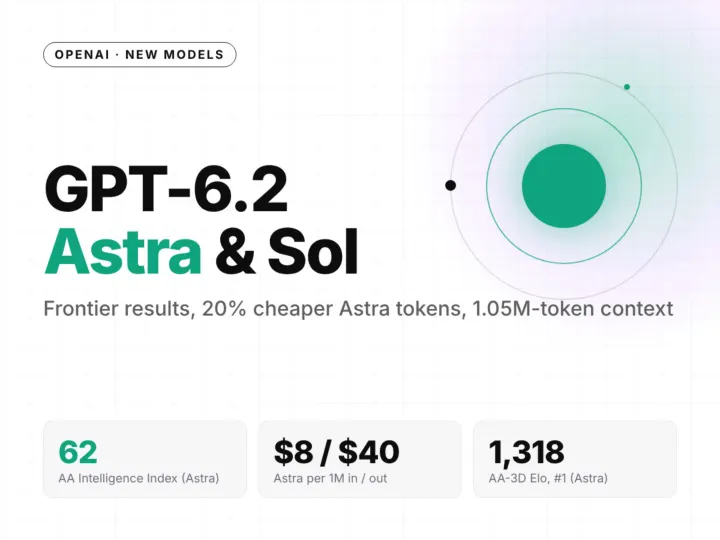
OpenAI Releases GPT-6.2 Astra and Sol With a 20% Cheaper Astra API
OpenAI has released GPT-6.2 Astra and GPT-6.2 Sol, twp closed models aimed at professional and agentic work. The GPT-6.2 Astra model is the new frontier tier for hard, long-horizon tasks. GPT-6.2 Sol is the efficient everyday tier. For developers, the key point is cost per task. Astra’s token prices fall 20%, and OpenAI says both models finish tasks with fewer output tokens. Both are live in the OpenAI API as gpt-6.2-astra and gpt-6.2-sol. TL;DR Size: 1,050,000-token context window
Also reported by SiliconANGLE

Welcome Inkling 2 Mini, Cutting-edge Performance for your Local Setup
Smaller models that run on personal devices could democratize access to advanced AI capabilities beyond cloud-dependent alternatives.
Also reported by MarkTechPost
OpenAI Ships GPT-Live-1.1 for Voice Agents, Cuts Idle Cost to $0.02/Min
OpenAI has made GPT-Live-1.1 available in its API under the model ID gpt-live-1.1. The GPT-Live-1.1 voice model is a full-duplex model for multilingual conversations. It can listen while it speaks. OpenAI team states that it speaks with more natural and consistent accents across languages and completes tasks more reliably. The release also adds standby, a cheaper billing state for idle sessions. For teams running voice agents, idle time on a call now costs less. You can check the deployment opt

Rumble-2-Flash: an open 0.5B speech model for 40+ languages
Smaller open-source speech models could democratize voice AI for developers working with languages beyond English and major European tongues.
Also reported by SiliconANGLE