
Inkling 2 Mini brings advanced AI to local computers
Hugging Face: Welcome Inkling 2 Mini, Cutting-edge Performance for your Local Setup
Smaller models that run on personal devices could democratize access to advanced AI capabilities beyond cloud-dependent alternatives.
Thinking Machines Lab released Inkling 2 Mini, an open-weight AI model with 26.4 billion total parameters designed to run on personal devices. The model uses layer looping, where middle layers are reused multiple times per token, reducing the checkpoint size to around 20GB while maintaining performance. It supports 1 million token context size, accepts both images and text, and runs on consumer hardware like a 32GB Mac.
- Hugging Face ↗: According to benchmark testing, the model performs comparably to larger models in its performance class across coding, reasoning, and vision tasks.
- MarkTechPost ↗: The model is optimized for coding tasks and shows weaker performance on knowledge recall and multi-turn conversation tasks.
Smaller models that run on personal devices could democratize access to advanced AI capabilities beyond cloud-dependent alternatives. The design makes advanced AI accessible for local development without requiring large data centers.
Inkling 2 Mini is a new multimodal AI model designed for local computer setups that uses a looping transformer architecture to achieve high performance with fewer total parameters. The model contains 24 physical decoder layers, with the middle 12 layers executed three times in a loop, creating the effect of 48 logical layers while reducing memory requirements. It supports 1 million token context size, accepts both images and text, and is available in multiple inference frameworks including transformers, llama.cpp, MLX, and SGLang. According to benchmark testing across various categories including coding, reasoning, and vision tasks, the model performs comparably to larger models in its performance class.
One short email a day with the stories that matter. Free. Unsubscribe with one click.
Want to go deeper than the news? Explore live, cohort-based AI courses taught by practitioners.
Browse AI courses on Maven
Introducing Gemini 4 Neon
Google's latest model aims to compete with rival systems in reasoning and multimodal capabilities as the AI arms race intensifies.
Also reported by SiliconANGLE and MarkTechPost
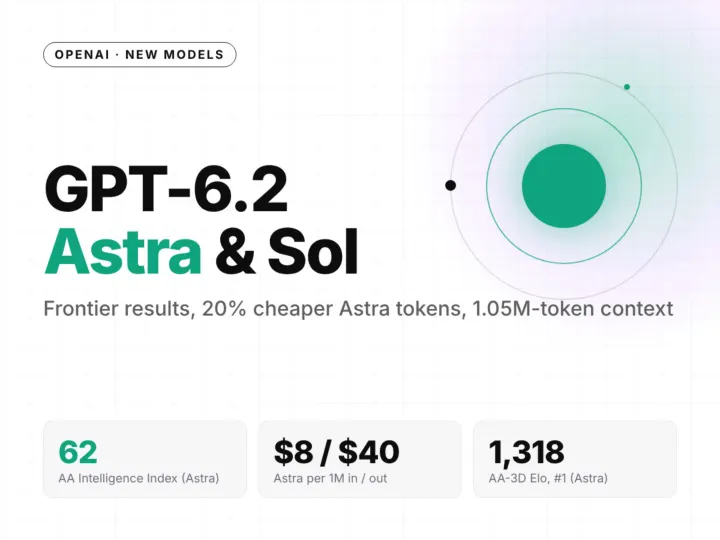
OpenAI Releases GPT-6.2 Astra and Sol With a 20% Cheaper Astra API
OpenAI has released GPT-6.2 Astra and GPT-6.2 Sol, twp closed models aimed at professional and agentic work. The GPT-6.2 Astra model is the new frontier tier for hard, long-horizon tasks. GPT-6.2 Sol is the efficient everyday tier. For developers, the key point is cost per task. Astra’s token prices fall 20%, and OpenAI says both models finish tasks with fewer output tokens. Both are live in the OpenAI API as gpt-6.2-astra and gpt-6.2-sol. TL;DR Size: 1,050,000-token context window
Also reported by SiliconANGLE

NVIDIA Releases Alpamayo 2 Edge: A 2B Reasoning VLA for DRIVE Thor
NVIDIA has released Alpamayo 2 Edge, a compact reasoning vision-language-action (VLA) model for autonomous driving. Alpamayo 2 Edge is a 2B-parameter model that plans trajectories and explains them inside the vehicle. It targets NVIDIA DRIVE AGX Thor, not a datacenter GPU. The goal: reasoning-based planning within onboard compute and latency budgets. You can check the deployment options and specs here through our GPULeaderboard.com chrome extension. TL;DR Size: 2B-class. Card breakdown:
OpenAI Ships GPT-Live-1.1 for Voice Agents, Cuts Idle Cost to $0.02/Min
OpenAI has made GPT-Live-1.1 available in its API under the model ID gpt-live-1.1. The GPT-Live-1.1 voice model is a full-duplex model for multilingual conversations. It can listen while it speaks. OpenAI team states that it speaks with more natural and consistent accents across languages and completes tasks more reliably. The release also adds standby, a cheaper billing state for idle sessions. For teams running voice agents, idle time on a call now costs less. You can check the deployment opt

Rumble-2-Flash: an open 0.5B speech model for 40+ languages
Smaller open-source speech models could democratize voice AI for developers working with languages beyond English and major European tongues.
Also reported by SiliconANGLE
RadixArk Ships DaisyRose-27B, a 27B Agentic Coding Model Trained With Reinforcement Learning Only
This week RadixArk released DaisyRose-27B, its first open-weight model. DaisyRose-27B is an agentic coding model from RadixArk, post-trained from Qwen3.8-27B with reinforcement learning (RL). The model card page states that it used RL only, with no SFT or distillation. It ships under Apache 2.0 as a drop-in replacement for the base model. The main result: Terminal Bench 4.1 pass@1 rises from 5.6 to 12.0. You can check the deployment options and specs here through our GPULeaderboard.com chrome e