Liquid AI Releases LFM2.5-Encoder-230M and LFM2.5-Encoder-350M: Bidirectional Encoders That Stay Fast at 8K Context on CPU
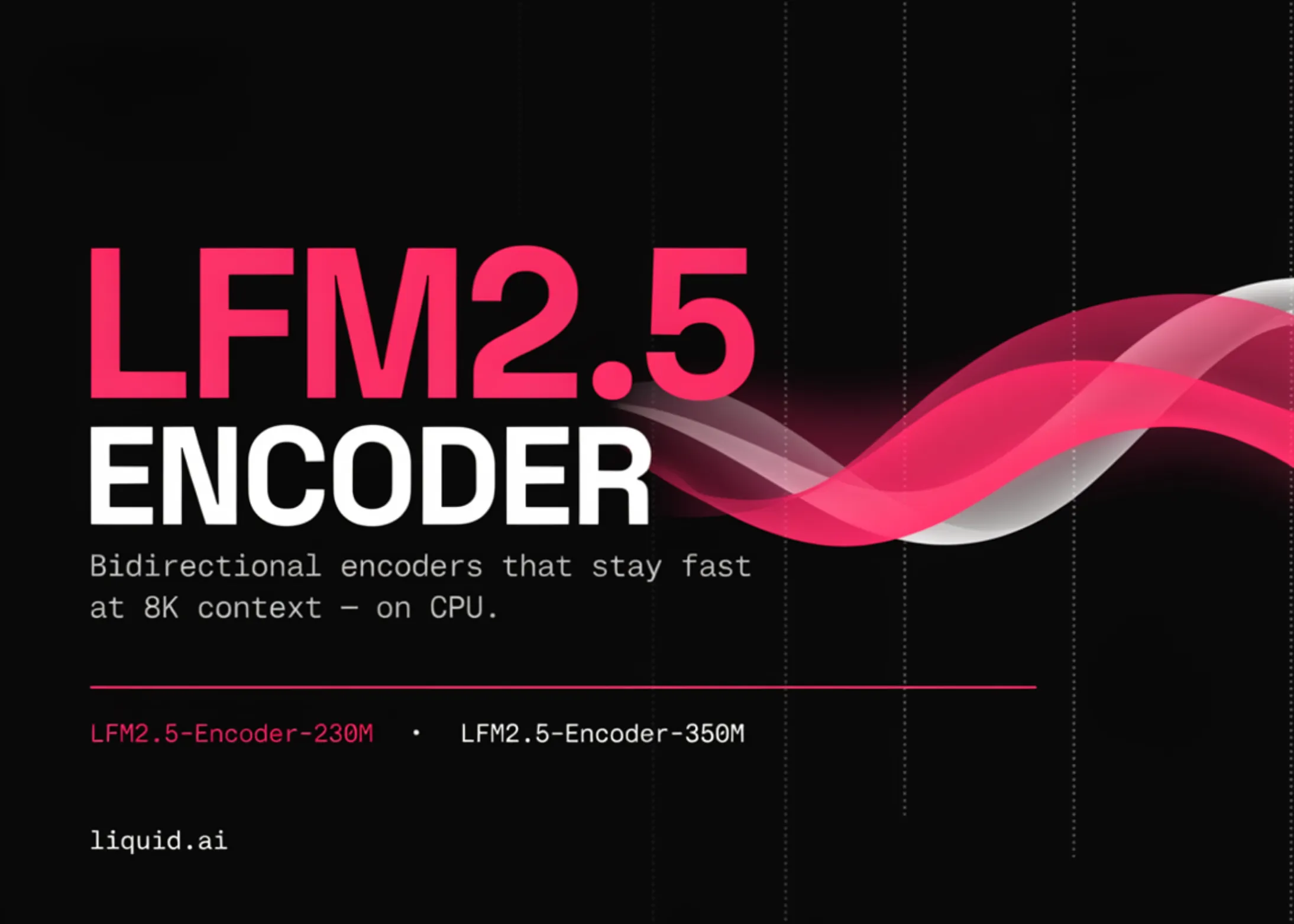
Liquid AI has released two open-weight bidirectional encoders, LFM2.5-Encoder-230M and LFM2.5-Encoder-350M. Both are masked language models built on the LFM2 hybrid backbone. Both carry an 8,192-token context. Encoders sit underneath classifiers, intent routers, safety filters, and PII detectors. Those jobs run continuously, usually without a GPU, and increasingly on longer inputs. BERT established the class. ModernBERT pushed its accuracy, speed, and context. Liquid AI’s argument is
Get smart on it
Liquid AI released two open-weight bidirectional encoder models that process text in both directions and can handle 8,192-token contexts while running efficiently on CPUs without GPUs. These encoders are built from decoder backbones that were modified with bidirectional attention masks and a masked language modeling training approach, making them suitable for tasks like document classification, safety filtering, and personally identifiable information detection. The models were evaluated against 14 competing models on 17 benchmark tasks, with the larger 350M version ranking fourth overall and outperforming several established competitors on classification accuracy. The release targets deployment scenarios where GPU resources are unavailable or undesirable, including edge devices, regulated industries with sensitive data, and cost-sensitive processing pipelines that need efficient initial screening before larger models.
Related news

Pokee AI Releases Pokee-Isaac 28B: A 10M-Token Context Agentic Model Built to Run Inside the Customer Boundary
Long-horizon agents accumulate context faster than they resolve tasks. Every tool output, observation, and intermediate reasoning step stays in the window, and the two capabilities that matter — holding that context and staying coherent across it — have so far been available almost exclusively from cloud endpoints. That excludes regulated industries, public-sector institutions, and on-device applications, where the data is not permitted to leave the boundary at all. Pokee AI released Pokee-Isaa
Mistral AI Releases Shieldstral 1.0 3B: An Open-Weights Policy-Adaptive Multimodal Safety Classifier Matching Models 7× Its Size
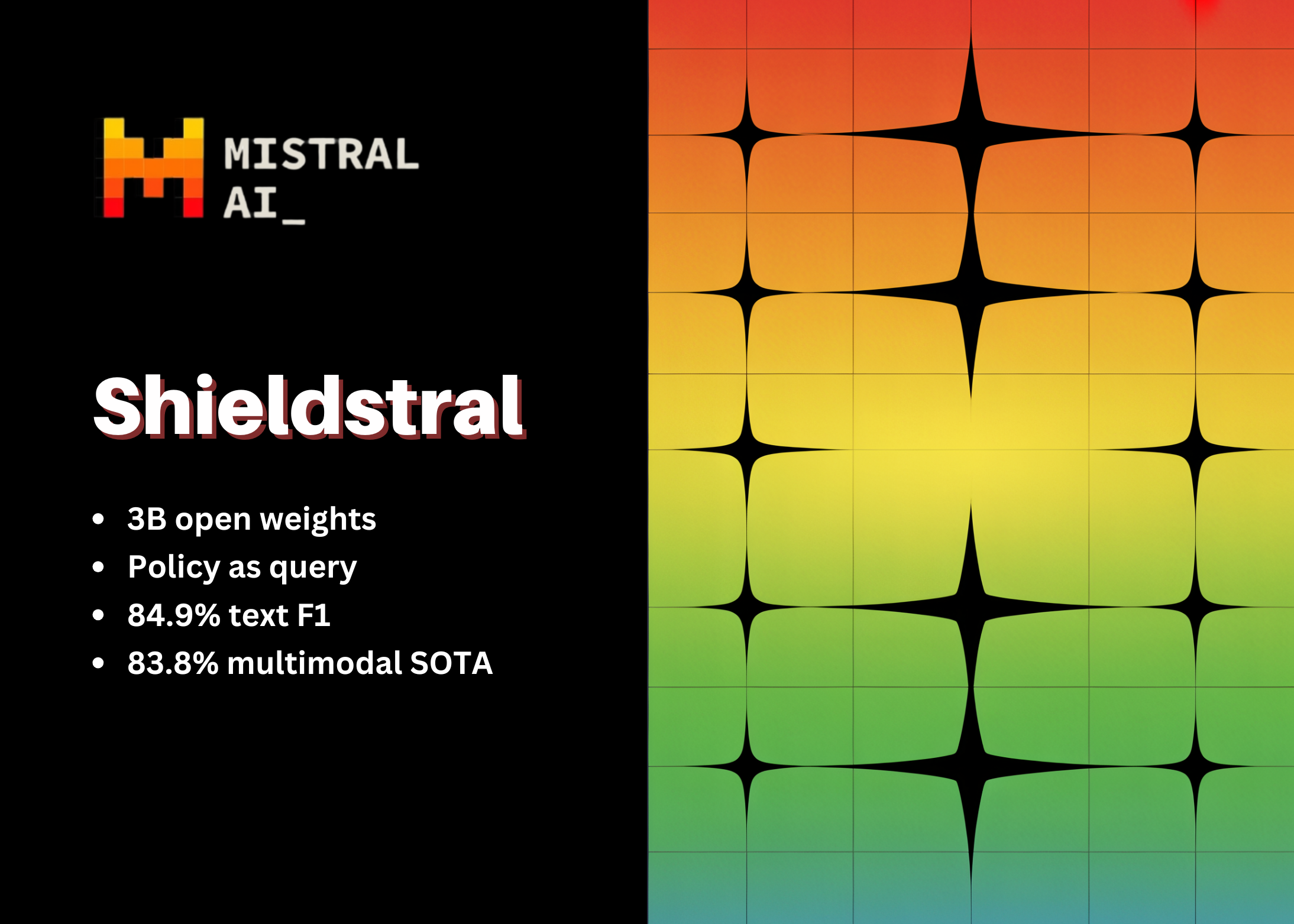
Mistral AI has released Shieldstral 1.0 3B, an open-weights, policy-adaptive multimodal safety classifier that treats content moderation as a single yes/no question rather than a fixed taxonomy of harm categories. Most guardrail models bake their category list into the weights, so re-targeting one to a new deployment context means retraining — and the same content can be acceptable on a cybersecurity research tool while being harmful on a mental-health platform. Shieldstral inverts that: operat