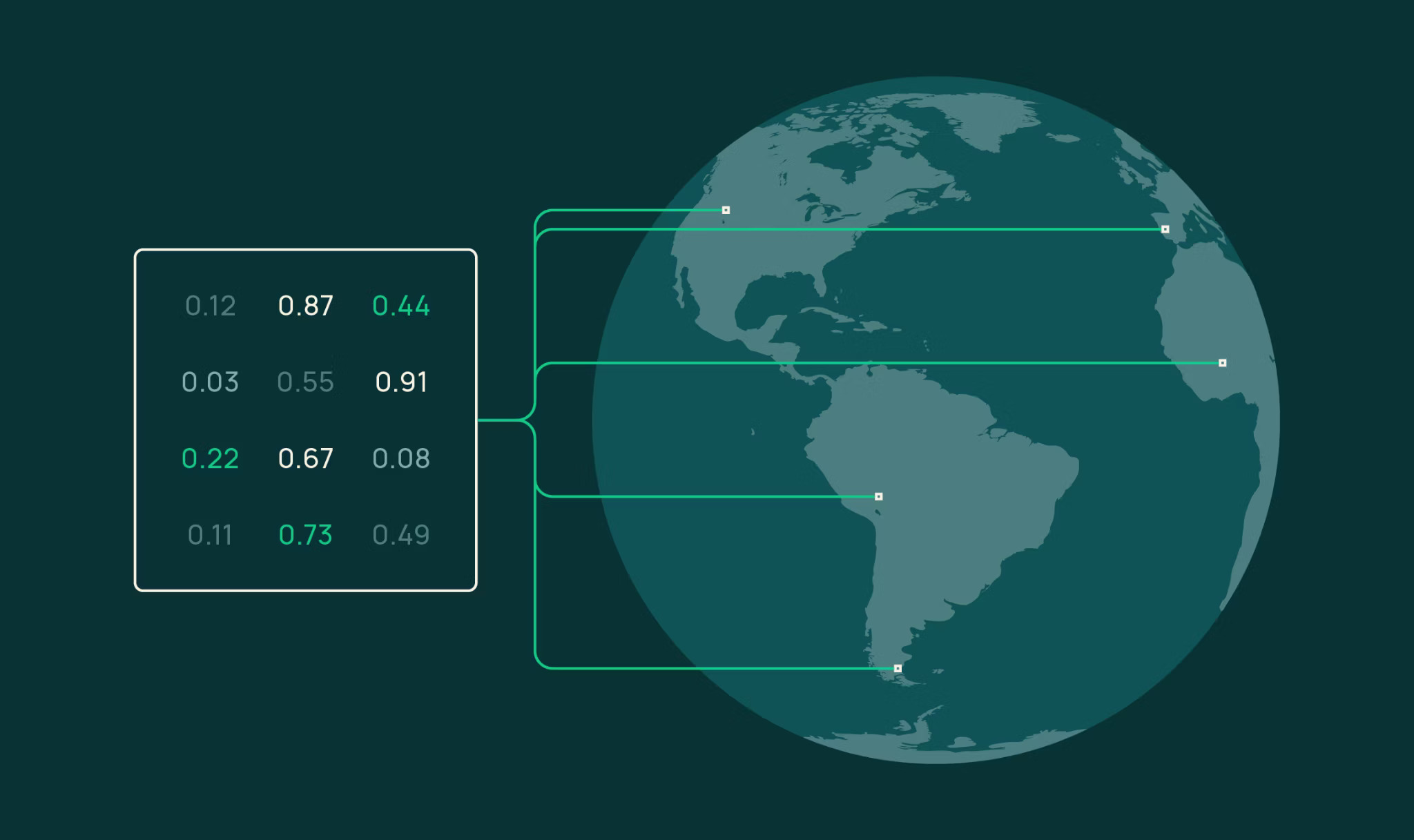
Introducing OlmoEarth embeddings: Custom embedding exports from OlmoEarth Studio for downstream analysis
Organizations can now extract specialized vector representations from satellite imagery data, enabling integration into their own analysis pipelines without relying on external services.
Get smart on it
OlmoEarth Studio, a platform for building Earth observation models, now allows users to compute and export embedding vectors, which are compact numerical representations of Earth-observation data. These embeddings support downstream tasks including similarity search, segmentation, and unsupervised exploration, with locations having similar surface characteristics producing similar vectors. The embeddings are exported as lightweight Cloud-Optimized GeoTIFFs that users can customize by area of interest, time range, encoder variant, resolution, and imagery sources. Because embeddings are generated on demand rather than pulled from pre-computed archives, they reflect exactly the conditions of interest and can capture seasonal dynamics through monthly generation rather than just annual snapshots.
Related news
Fine-Tuning Tool-Calling LLMs: A Complete Guide Using XYZ-Aquila-SFT and Qwen3
In this tutorial, we implement an end-to-end supervised fine-tuning pipeline for the XYZ-Aquila-SFT dataset, Hugging Face Transformers, PyTorch, and PEFT. We stream and inspect the dataset, parse multi-turn tool-use trajectories, extract structured tool calls, analyze corpus characteristics, and preserve embedded reasoning and observation patterns. We then convert tool schemas between message-embedded and structured formats, render Qwen-compatible ChatML with assistant-only loss masking, prepar

Meta’s ‘open’ AI, and a $250M deal gone very wrong
Meta released Glimmer this week, an open-weight AI model anyone can download and run on their own hardware — a contrast to Muse Spark, the company’s more powerful model that stays locked behind its own APIs. The release landed alongside a letter from Mark Zuckerberg arguing AI should be “for everyone” rather than controlled by a handful of labs, but as Equity’s […]