Introducing @huggingface/kernels: 200+ WebGPU Kernels for Local AI
Running machine learning directly in browsers could reduce dependence on cloud servers and improve privacy for web-based AI applications.
Get smart on it
Hugging Face has released a library of over 200 optimized WebGPU kernels, which are the individual GPU operations that underpin machine learning models running in web browsers. Each kernel is published as a complete package on the Hub with documentation, correctness tests, benchmark cases, and shader code, rather than as isolated files. The release matters because browser-based AI inference speed depends fundamentally on how efficiently these low-level operations execute across different devices and browsers, making optimized kernels a foundational requirement for fast inference. The company also launched Fleet, a browser-based tool that crowdsources performance and correctness testing data from real-world GPUs to identify failures and guide further kernel improvements.
Related news
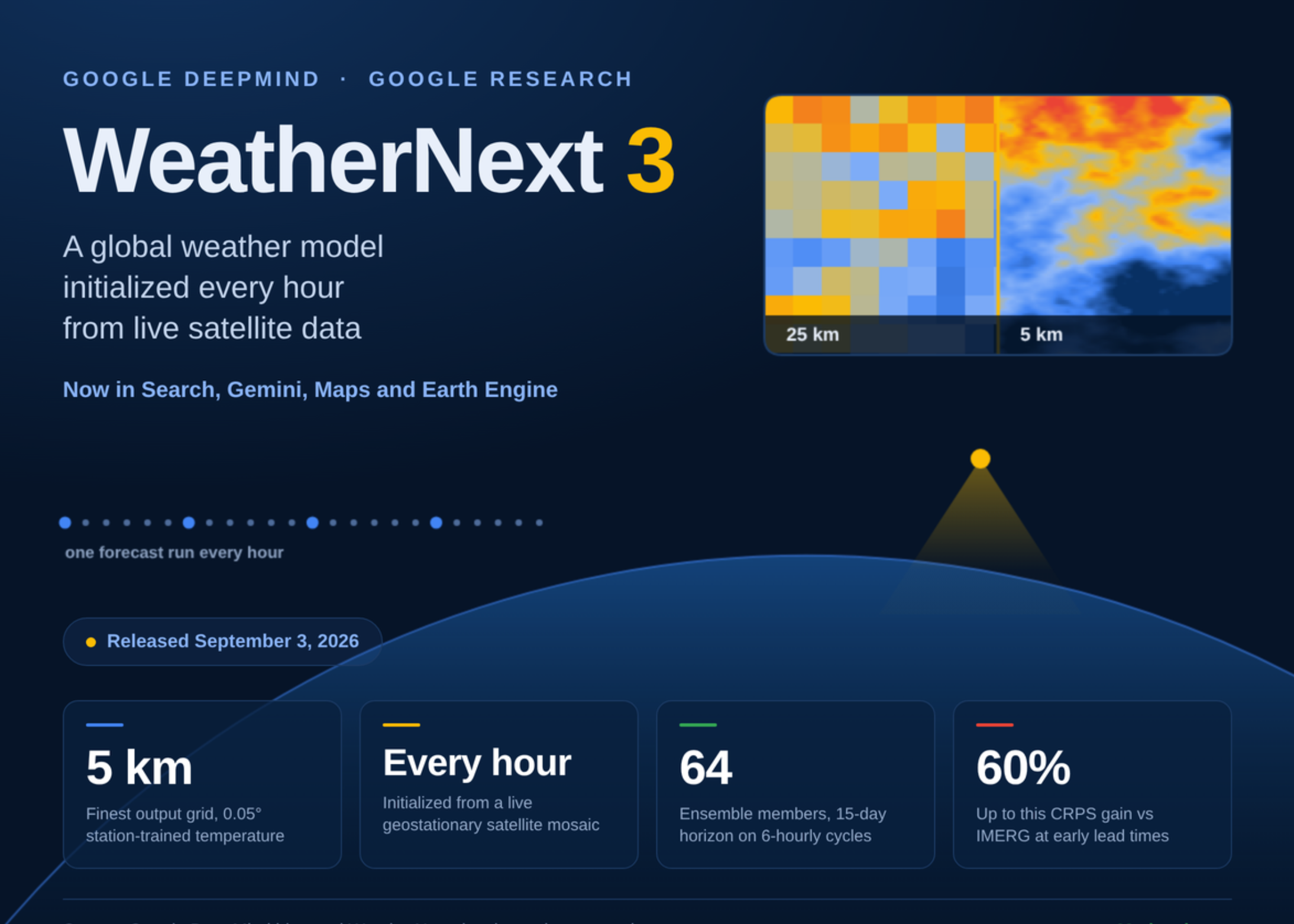
Google DeepMind’s WeatherNext 3 Trains on Weather Station Observations to Deliver 5 km Global Forecasts, Refreshed Every Hour
AI weather models have spent three years closing the gap with physics-based forecasting, but two problems stayed open: resolution too coarse for local terrain, and initialization tied to numerical weather prediction (NWP) analysis that arrives about six hours late. WeatherNext 3, released by Google DeepMind and Google Research, attacks both. It takes a live global geostationary satellite mosaic as a direct model input, re-initializes every hour, and emits forecasts down to 0.05° (~5 km) while t

OpenAI Releases GPT-6 Astra: A 1.05M-Context Computer-Use Model Gated Behind a ‘Critical’ Cyber Threshold
Today, OpenAI released GPT-6 Astra. The company calls it its most intelligent and aligned model, and positions it primarily as a computer-use system rather than a chat model. The pitch is that Astra operates software the way a person does, across browsers, spreadsheets, desktop applications and terminals, and finishes multi-step jobs instead of describing how to do them. Is it deployable? Partly, and not on your own hardware. Astra is a closed, hosted model with no released weights, so self