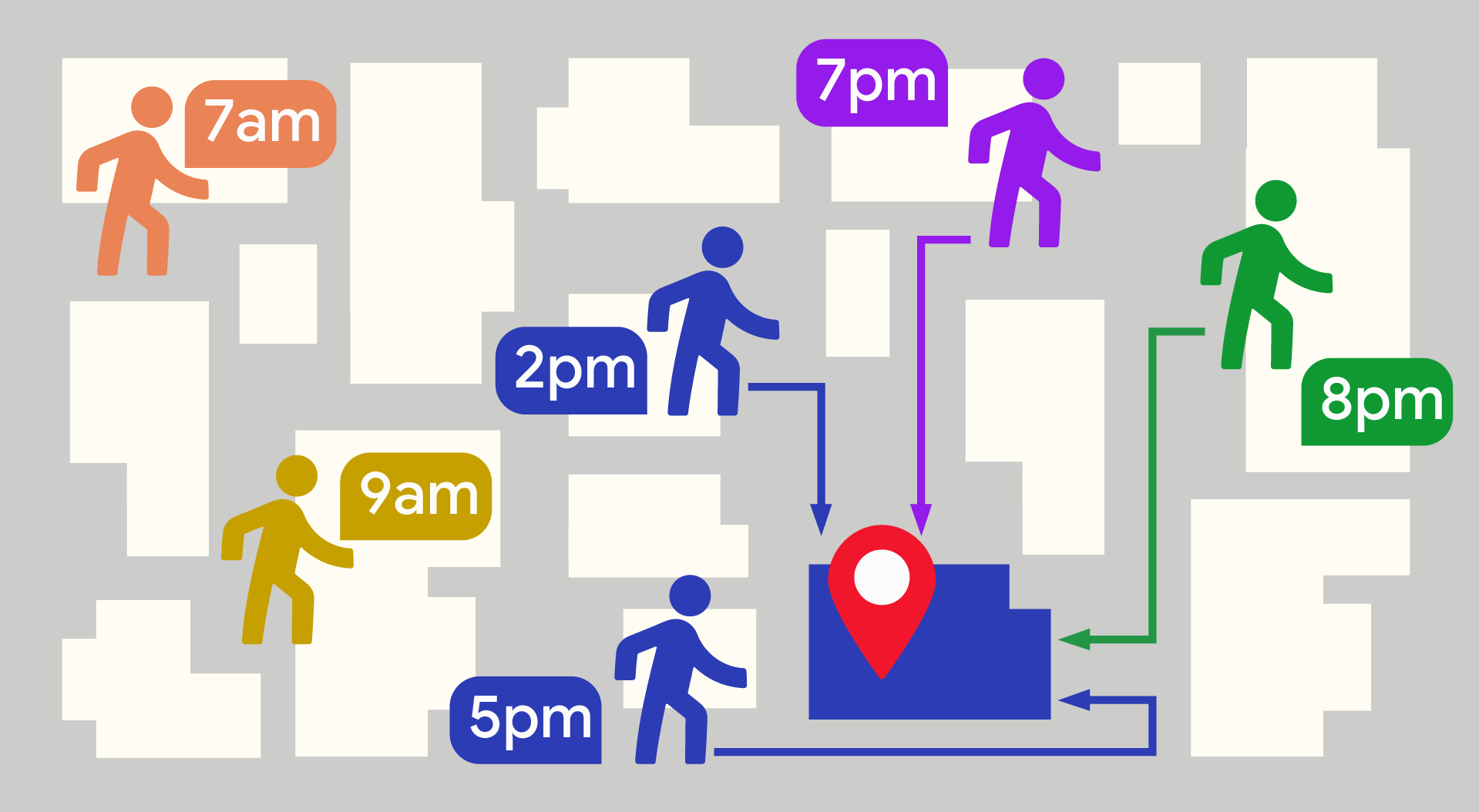
How mobility gives language models a deeper understanding of place
Algorithms & Theory
Make your prediction
Will Google publish a peer-reviewed paper on mobility-enhanced language models by November 30, 2026?
Resolves by Nov 30, 2026
Your prediction
50% · 50/50 coin flip
NOYES
Get smart on it
Language models traditionally understand places using only static information like addresses and business categories, but researchers have developed a framework called Mobility-Embedded POIs that adds dynamic mobility data such as arrival times and visit patterns to create richer representations of how places actually function. This approach matters because it significantly improves AI predictions about real-world attributes, including opening hours, price levels, and busyness, with some tasks showing improvements of up to 81.9 percent. The framework solves a particular problem in geospatial data where small businesses have few recorded visits by using information from busier neighboring locations to make intelligent predictions. By blending text descriptions with aggregated anonymized mobility patterns, the model captures both what a place is and how it operates throughout the day and week.
Related news
IBM's new Granite 4.2 models ride the wave of interest in local LLMs
IBM has rolled out the newest models in its family of open-weight large language models designed to be downloaded and self-hosted. The newly launched Granite 4.2 comes in 3B, 8B, and 30B parameter variants. Like previous versions, IBM is taking a decoder-only approach here. These new releases offer a 128,000-token context window natively. The 8B and 30B variants (not the 3B one) also go through an agentic reinforcement learning block; they were trained for expanded capabilities like using the t
IBM Releases Granite 4.2: Bringing Native Reasoning and Agentic RL to Open Enterprise Models
IBM has released Granite 4.2, a family of open reasoning language models in 3B, 8B, and 30B parameter sizes. Unlike earlier Granite releases, which were instruction-following assistants, Granite 4.2 is built around explicit reasoning. Every model can emit a chain of thought before answering, and every model exposes a thinking / non-thinking switch plus a low-effort mode that spends a short reasoning budget on easy questions. The models are decoder-only dense transformers, pre-trained from scrat