Harvey Introduces Harvey Tenet: A Kimi K3 Base Post-Trained with Fireworks for Long-Horizon Legal Agent Work
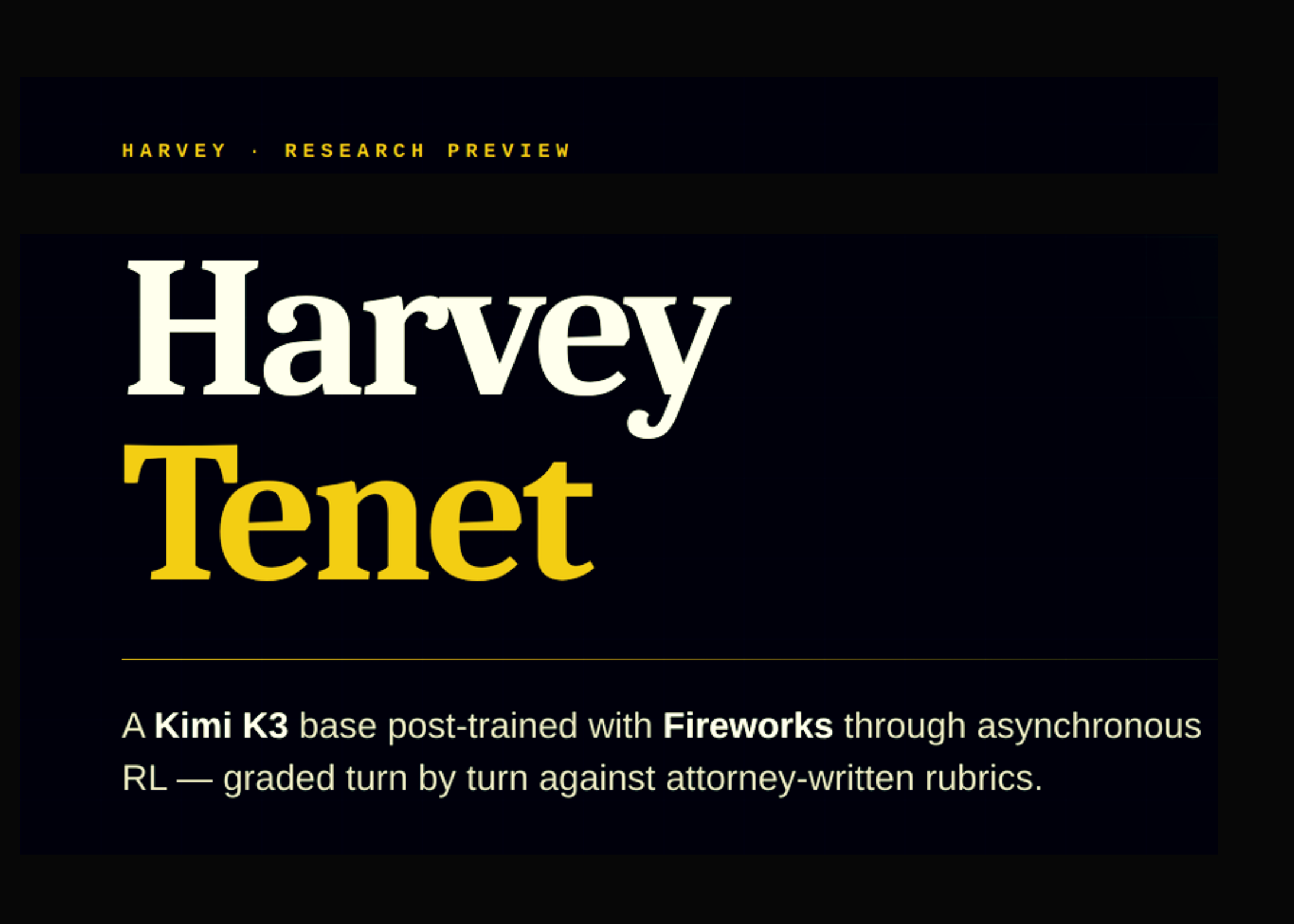
Harvey has released Harvey Tenet, its first post-trained model, as a research preview as of today. Tenet is a Kimi K3 base post-trained with Fireworks through asynchronous reinforcement learning on long-horizon legal work. The training corpus combined synthetic data, publicly available legal data, and human expert data. Harvey states no customer data was used. Against the base K3 model, Tenet completes almost twice as many held-out tasks on Harvey’s Legal Agent Benchmark (LAB) and 20% mor
Make your prediction
Will Harvey Tenet appear as a listed model on Hugging Face by August 31?
Resolves by Aug 31, 2026
Your prediction
50% · 50/50 coin flip
NOYES
Get smart on it
Harvey has released a specialized legal AI model called Harvey Tenet, which is based on an existing model and has been further trained using reinforcement learning on legal tasks. The model performs significantly better than its base version on legal benchmarks, completing nearly twice as many tasks on one benchmark and showing 20 percent improvement on contract-related tasks. The model is currently available as a research preview only and has not yet been deployed as a commercial product, though Harvey plans to move it from research to production within its platform over time. The release is aimed at helping law firms build their own specialized AI models for tasks like contract review, due diligence, and document analysis.
Related news
IBM's new Granite 4.2 models ride the wave of interest in local LLMs
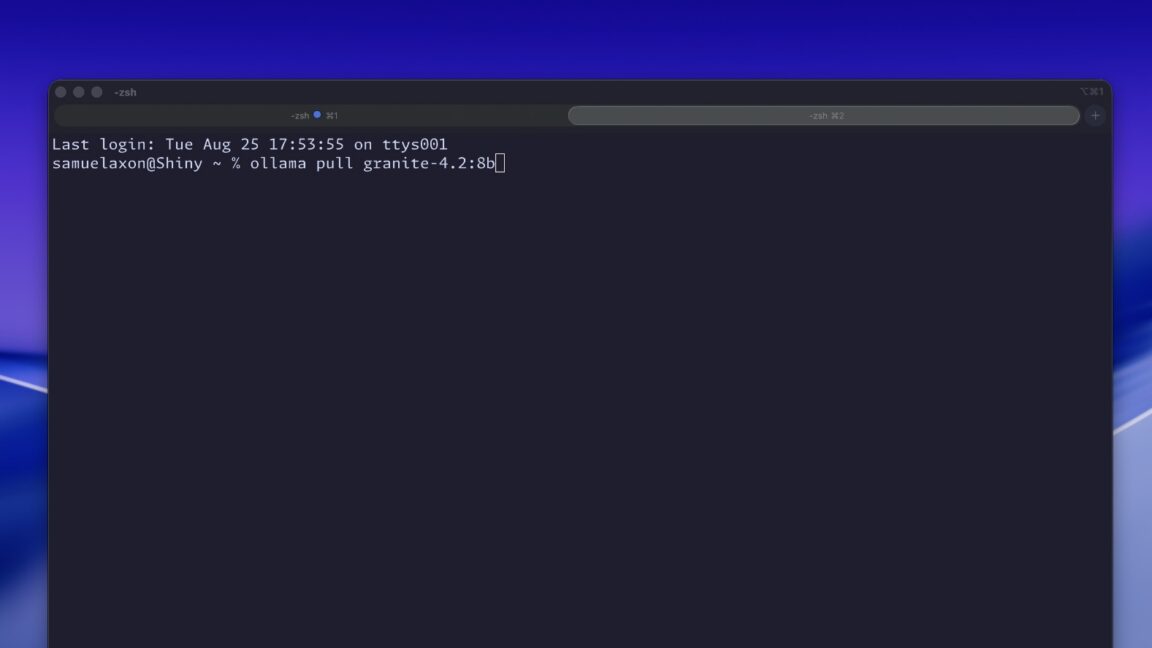
IBM has rolled out the newest models in its family of open-weight large language models designed to be downloaded and self-hosted. The newly launched Granite 4.2 comes in 3B, 8B, and 30B parameter variants. Like previous versions, IBM is taking a decoder-only approach here. These new releases offer a 128,000-token context window natively. The 8B and 30B variants (not the 3B one) also go through an agentic reinforcement learning block; they were trained for expanded capabilities like using the t
IBM Releases Granite 4.2: Bringing Native Reasoning and Agentic RL to Open Enterprise Models
IBM has released Granite 4.2, a family of open reasoning language models in 3B, 8B, and 30B parameter sizes. Unlike earlier Granite releases, which were instruction-following assistants, Granite 4.2 is built around explicit reasoning. Every model can emit a chain of thought before answering, and every model exposes a thinking / non-thinking switch plus a low-effort mode that spends a short reasoning budget on easy questions. The models are decoder-only dense transformers, pre-trained from scrat