H Company Releases Holo4: Open-Weight Computer-Use Models That Click, Code and Call Tools Across Desktop, Web, Android and APIs
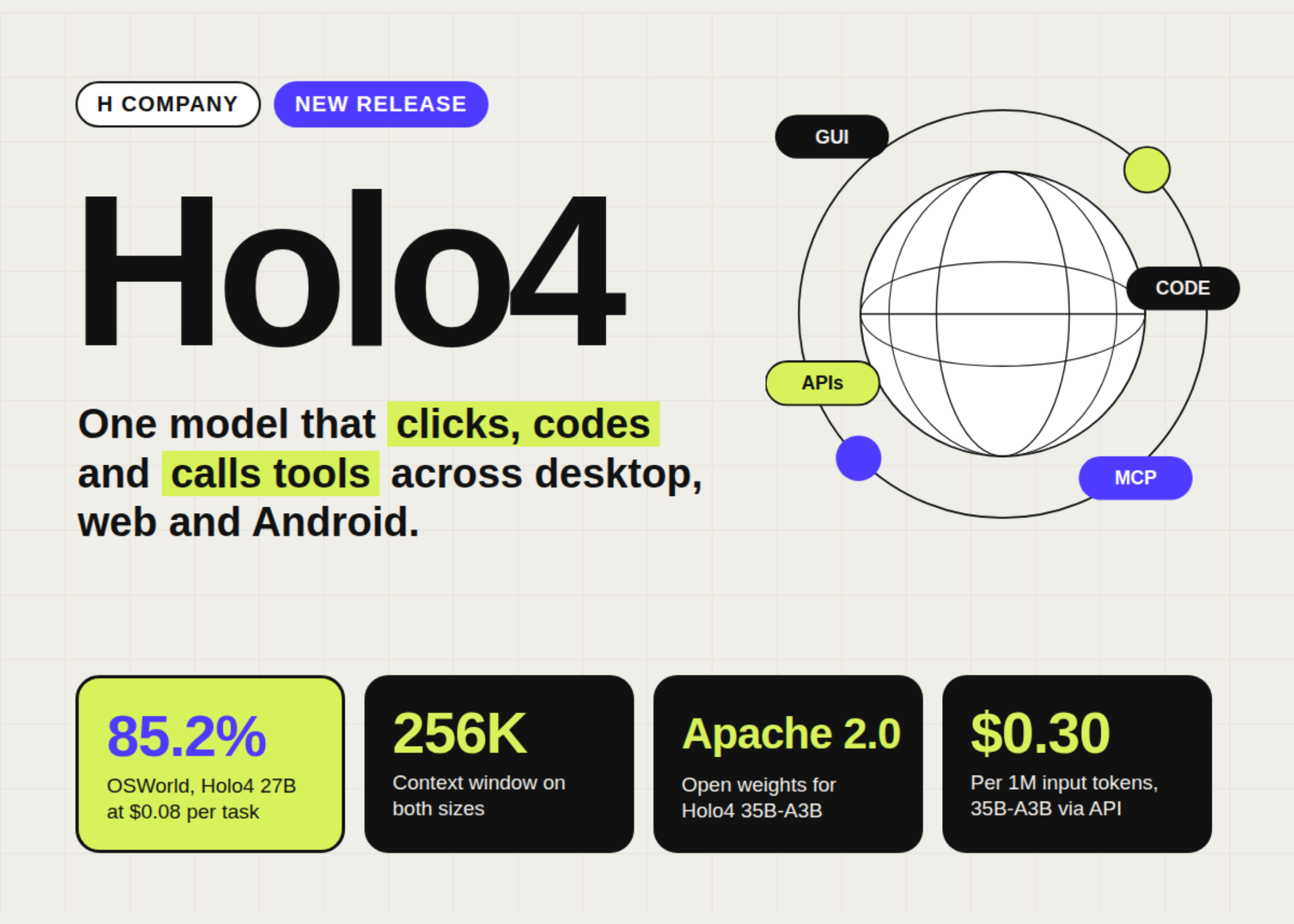
H Company has released Holo4, a family of generalist computer-use models for AI agents. One set of weights clicks and types on screens. It also writes code and calls MCP or API tools. Holo4 ships in 2 sizes: Holo4 27B (dense) and Holo4 35B-A3B (Mixture of Experts, 3B active). Both serve a 256K context on the H Models API. Is it deployable? Yes. Holo4 35B-A3B ships Apache 2.0 weights for commercial self-hosting. Holo4 27B weights are CC BY-NC 4.0, so commercial use of 27B runs through the H M
Get smart on it
H Company released Holo4, a family of open-weight computer-use models designed to work as AI agents that can click on screens, write code, and call tools across different platforms including desktop, web, Android, and APIs. The models come in two sizes with different licensing options: a smaller version available under a non-commercial license and a larger version available under an Apache 2.0 license for commercial self-hosting. Holo4 addresses a gap where existing AI agents either fail without visual screens or get stuck when applications lack APIs, by using a single model that works consistently across all these different interfaces. On benchmark tests, Holo4 27B achieves 85.2% performance on OSWorld at a cost of $0.08 per task, significantly cheaper than competing models like Claude Opus 5.5, though those models still score higher on longer, more complex workflows.
Related news
OpenAI Releases GPT-6.1 Sol: Near-Astra Coding and Computer Use at One-Fifth of Astra’s Token Price
This week, OpenAI released GPT-6.1 Sol. It upgrades GPT-6 Sol, the mid-tier model in the GPT-6 family. OpenAI’s claim is specific: near-Astra results on agentic coding, computer use, and professional work. The price is one-fifth of GPT-6 Astra’s standard input and output rates. Cached input drops to $0.10 per million tokens, 50% below GPT-6 Sol. Is it deployable? Yes, as a hosted model. It is live today in the OpenAI API as gpt-6.1-sol, and in ChatGPT Work and Codex. Where So
Google DeepMind Unveils Gemini 4 Argon with 1M Output Tokens for Coding, Knowledge Work and Cyber Defense
Google DeepMind has just announced Gemini 4 Argon, its new frontier model and the first model of the Gemini 4 generation. It targets long-horizon software engineering, enterprise knowledge work in legal and finance, and cybersecurity defense. The biggest technical change is output length. Argon can generate up to 1M tokens in a single response, up from 64K on earlier Gemini models. What Google Announced Google DeepMind described Argon as built for complex workflows across coding, enterpri