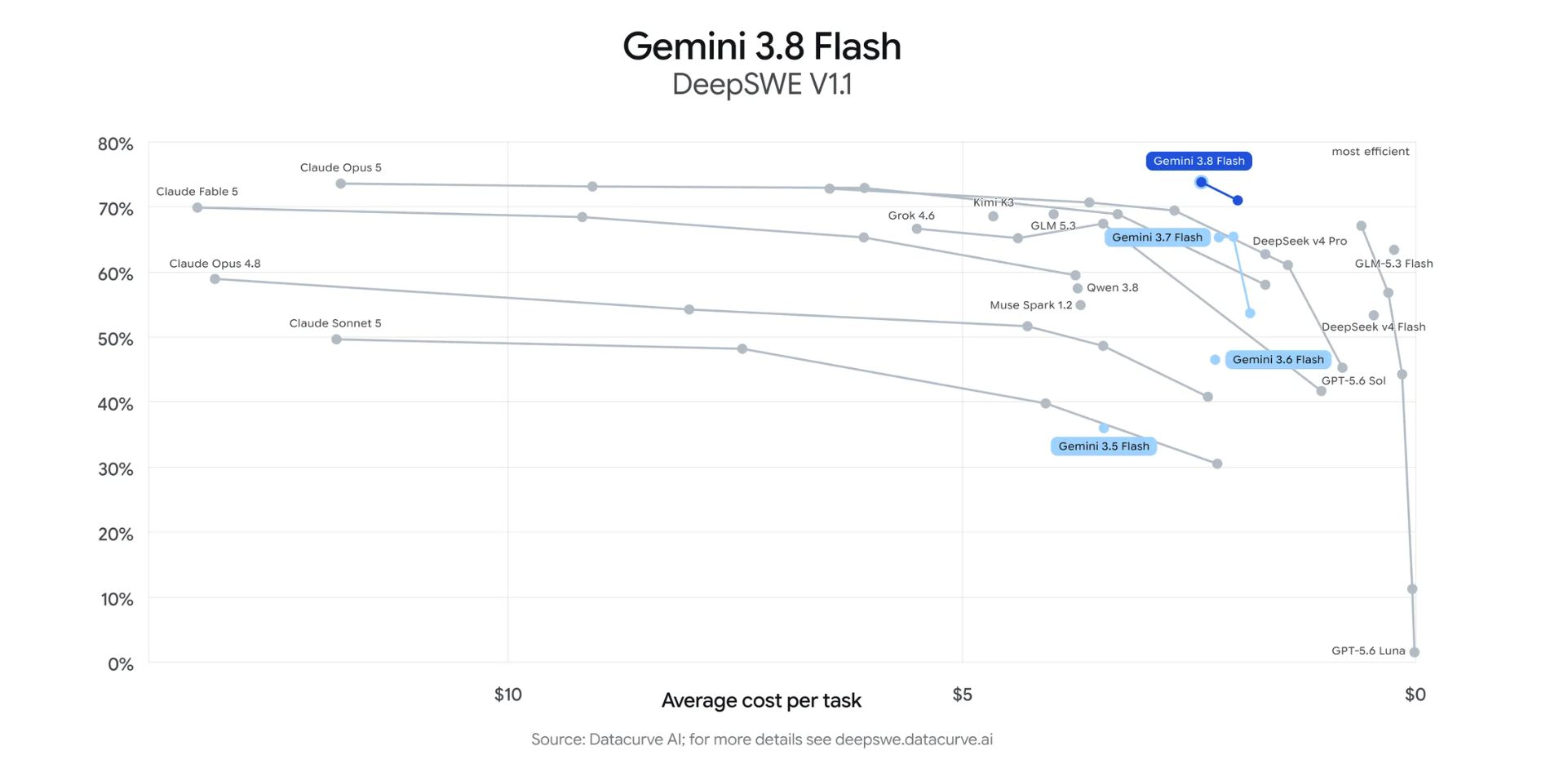
Google DeepMind Releases Gemini 3.8 Flash and Gemini 3.8 Flash Cyber: One Core Model, Two Access Envelopes
Google just announced Gemini 3.8 Flash and Gemini 3.8 Flash Cyber, three weeks after Gemini 3.7 Flash and marking the third Flash release in six weeks. Both variants run on the same foundational intelligence, refined through long-running agentic loops that recursively evaluate the underlying models. What separates them is not architecture, it is the safety envelope and who is allowed through it. Is it deployable? Gemini 3.8 Flash is generally available today through the Gemini API, Google AI
Make your prediction
Will Gemini 3.8 Flash appear on the Google AI Studio model list by September 7?
Resolves by Sep 7, 2026
Your prediction
50% · 50/50 coin flip
NOYES
Get smart on it
Google DeepMind released two variants of the same foundational AI model that differ only in their safety restrictions rather than their underlying architecture. The standard version is available through multiple platforms for general use, while the specialized cybersecurity version is restricted to vetted defenders such as government authorities and infrastructure operators through a gated access program. The new model executes additional reasoning steps and tool calls on complex tasks, which improves accuracy but increases token consumption compared to its predecessor. Performance improvements are demonstrated through benchmarks in software engineering, vulnerability discovery, and patch generation, with the cybersecurity variant positioned as cost-competitive with larger models on defensive security tasks.
Related news
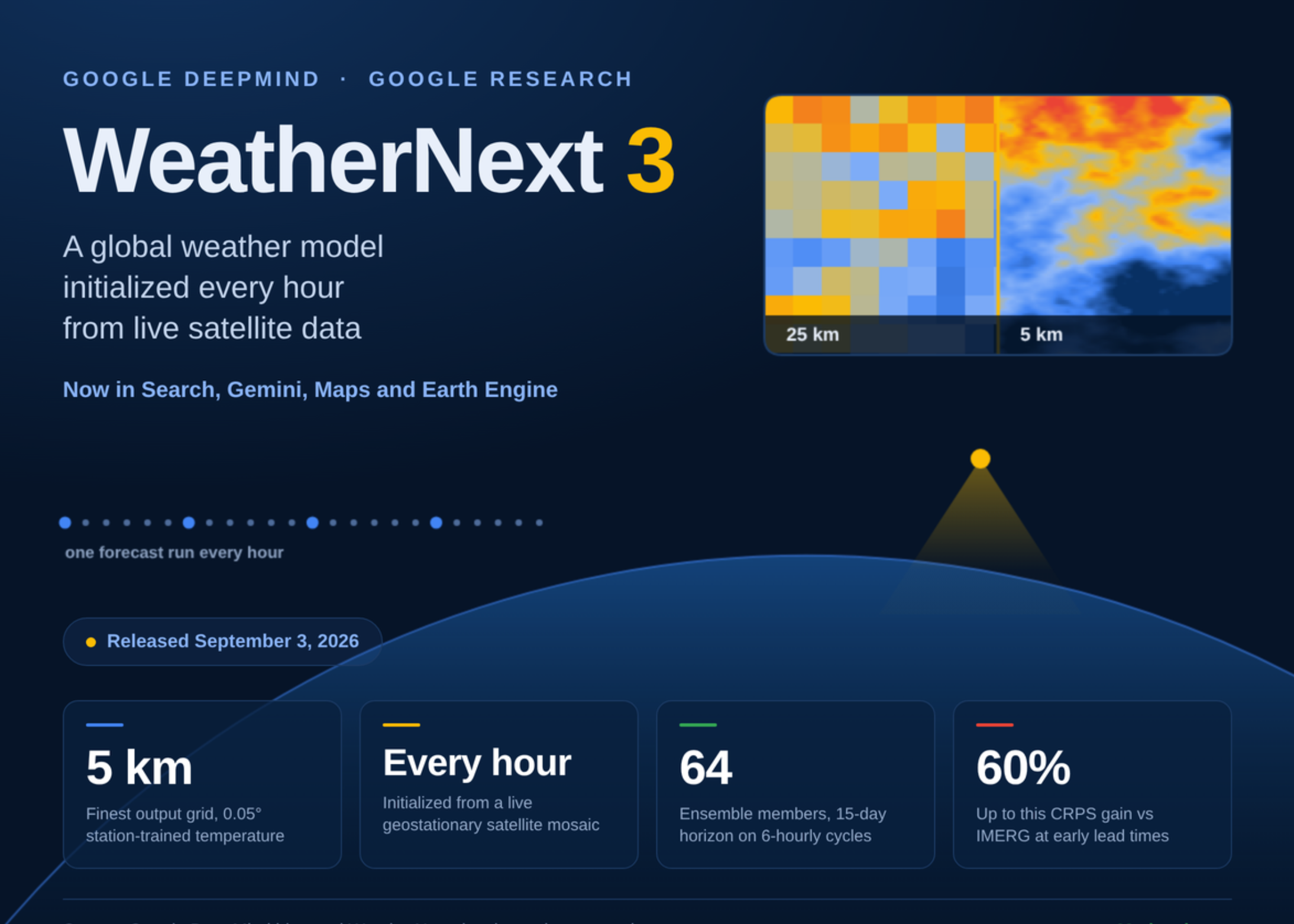
Google DeepMind’s WeatherNext 3 Trains on Weather Station Observations to Deliver 5 km Global Forecasts, Refreshed Every Hour
AI weather models have spent three years closing the gap with physics-based forecasting, but two problems stayed open: resolution too coarse for local terrain, and initialization tied to numerical weather prediction (NWP) analysis that arrives about six hours late. WeatherNext 3, released by Google DeepMind and Google Research, attacks both. It takes a live global geostationary satellite mosaic as a direct model input, re-initializes every hour, and emits forecasts down to 0.05° (~5 km) while t

OpenAI Releases GPT-6 Astra: A 1.05M-Context Computer-Use Model Gated Behind a ‘Critical’ Cyber Threshold
Today, OpenAI released GPT-6 Astra. The company calls it its most intelligent and aligned model, and positions it primarily as a computer-use system rather than a chat model. The pitch is that Astra operates software the way a person does, across browsers, spreadsheets, desktop applications and terminals, and finishes multi-step jobs instead of describing how to do them. Is it deployable? Partly, and not on your own hardware. Astra is a closed, hosted model with no released weights, so self