Google’s latest AI weather model gives you no excuse to forget your umbrella
Scientists at Google Deepmind and Google Research released a new artificial intelligence model for weather forecasting today that sees our changing atmosphere more clearly and predicts its behavior more often. WeatherNext 3 is the latest wave of a sea change in meteorology brought out by deep learning techniques, and Google says it will start feeding […]
Get smart on it
Google has released a new artificial intelligence weather forecasting model that predicts atmospheric behavior more accurately and frequently than previous AI models and traditional government weather forecasts. The model improves upon earlier versions by predicting at higher resolution, performing better at forecasting rain, and generating hourly predictions instead of six-hour intervals by ingesting raw satellite data in real time. This advancement matters because AI weather forecasting is faster and cheaper than traditional government supercomputer-based systems, potentially bringing accurate forecasts to poorer regions and improving outcomes like crop yields and renewable energy reliability. The model will be integrated into Google's search, Maps, and Gemini products, continuing a broader shift in meteorology toward deep learning techniques replacing traditional physics-based forecasting methods.
Related news
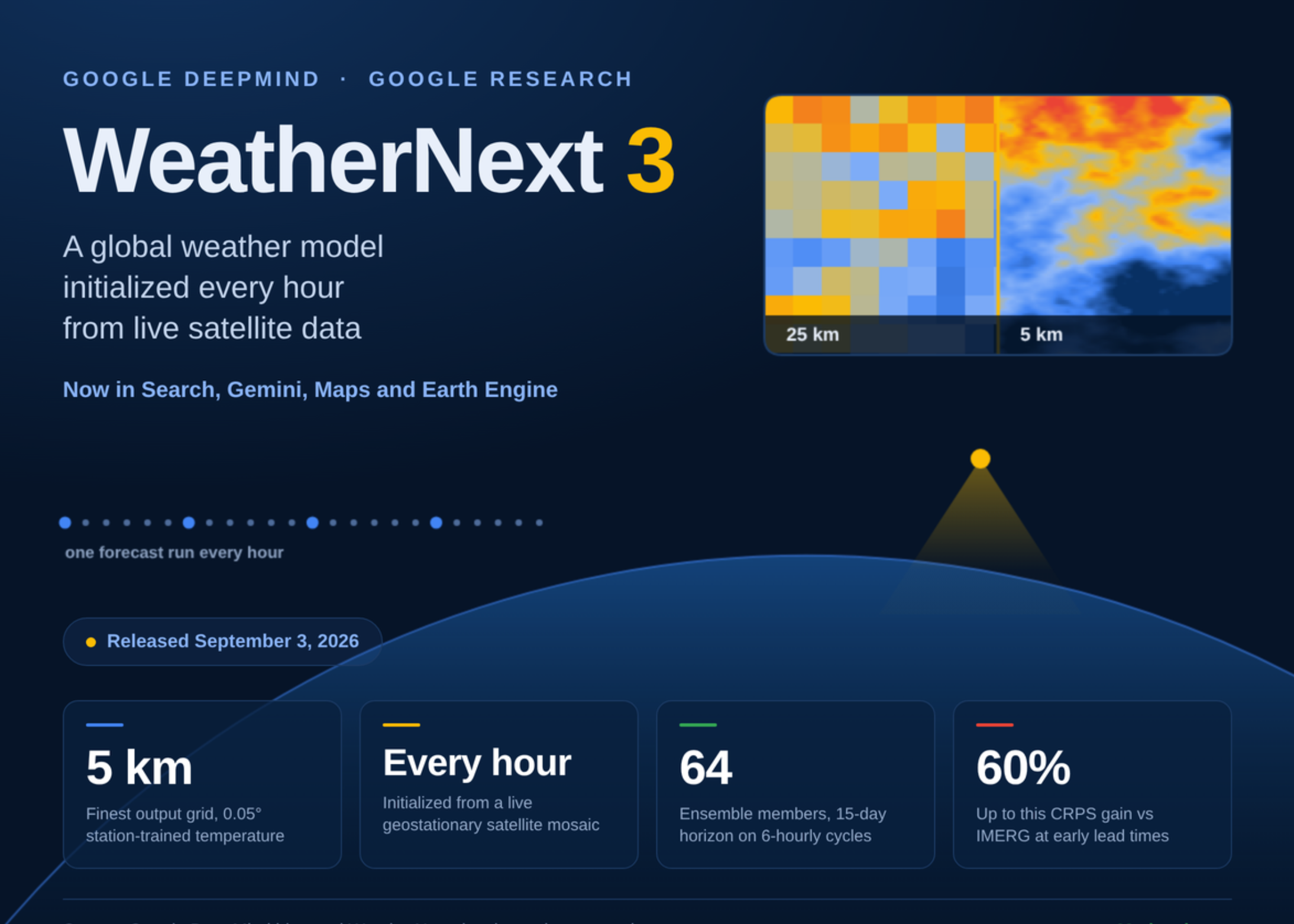
Google DeepMind’s WeatherNext 3 Trains on Weather Station Observations to Deliver 5 km Global Forecasts, Refreshed Every Hour
AI weather models have spent three years closing the gap with physics-based forecasting, but two problems stayed open: resolution too coarse for local terrain, and initialization tied to numerical weather prediction (NWP) analysis that arrives about six hours late. WeatherNext 3, released by Google DeepMind and Google Research, attacks both. It takes a live global geostationary satellite mosaic as a direct model input, re-initializes every hour, and emits forecasts down to 0.05° (~5 km) while t

OpenAI Releases GPT-6 Astra: A 1.05M-Context Computer-Use Model Gated Behind a ‘Critical’ Cyber Threshold
Today, OpenAI released GPT-6 Astra. The company calls it its most intelligent and aligned model, and positions it primarily as a computer-use system rather than a chat model. The pitch is that Astra operates software the way a person does, across browsers, spreadsheets, desktop applications and terminals, and finishes multi-step jobs instead of describing how to do them. Is it deployable? Partly, and not on your own hardware. Astra is a closed, hosted model with no released weights, so self