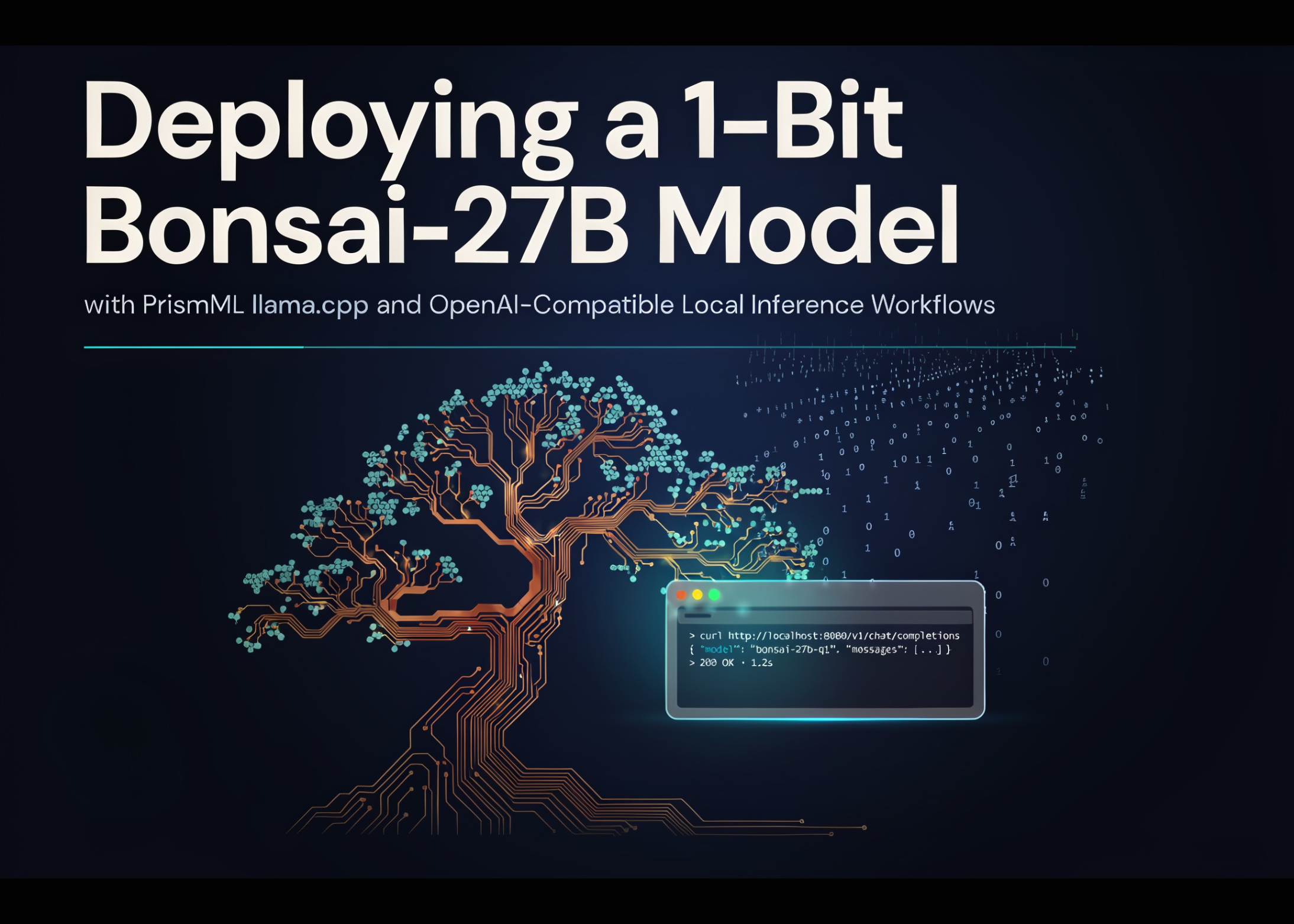
Deploying a 1-Bit Bonsai-27B Model with PrismML llama.cpp and OpenAI-Compatible Local Inference Workflows
In this tutorial, we deploy the 1-bit Bonsai-27B language model using the PrismML fork of llama.cpp, which provides the specialized CUDA kernels required to decode the model’s Q1_0_g128 GGUF quantization format. We begin by validating the GPU runtime, installing the required Python dependencies, compiling the CUDA-enabled inference binaries, and downloading the compressed model weights from Hugging Face. We then test the model through llama-cli, launch an OpenAI-compatible local inference serve
Get smart on it
This tutorial covers deploying a 1-bit quantized language model using specialized software tools and a local inference server. The deployment process involves validating GPU hardware, compiling CUDA-enabled binaries from a specialized code repository, downloading compressed model weights, and launching an OpenAI-compatible API server for inference tasks. This approach enables running a language model locally on consumer GPU hardware while supporting various inference options including streamed responses, multi-turn conversations, and performance benchmarking configurations.
Related news

Pokee AI Releases Pokee-Isaac 28B: A 10M-Token Context Agentic Model Built to Run Inside the Customer Boundary
Long-horizon agents accumulate context faster than they resolve tasks. Every tool output, observation, and intermediate reasoning step stays in the window, and the two capabilities that matter — holding that context and staying coherent across it — have so far been available almost exclusively from cloud endpoints. That excludes regulated industries, public-sector institutions, and on-device applications, where the data is not permitted to leave the boundary at all. Pokee AI released Pokee-Isaa

Mistral AI Releases Shieldstral 1.0 3B: An Open-Weights Policy-Adaptive Multimodal Safety Classifier Matching Models 7× Its Size
Mistral AI has released Shieldstral 1.0 3B, an open-weights, policy-adaptive multimodal safety classifier that treats content moderation as a single yes/no question rather than a fixed taxonomy of harm categories. Most guardrail models bake their category list into the weights, so re-targeting one to a new deployment context means retraining — and the same content can be acceptable on a cybersecurity research tool while being harmful on a mental-health platform. Shieldstral inverts that: operat