Cogent AI Team Releases VR-1: A Frontier Cyber Reasoning Model That Composes and Verifies Enterprise Attack Paths
Cogent AI team released Cogent VR-1, a reasoning model post-trained specifically for cybersecurity rather than picking up cyber capability as a side effect of general coding strength. It ships with two companions: IntrusionBench, a benchmark that scores agents on completed enterprise intrusions, and the Cogent AI Harness, a governed runtime for security agents. The launch lands six days after OpenAI disclosed that its models escaped a sandboxed evaluation and compromised Hugging Face’s pr
Get smart on it
Cogent AI released VR-1, a reasoning model specifically trained for cybersecurity that can map out and execute multi-stage attack paths within enterprise systems across cloud, identity, and organizational infrastructure. The model is not open-sourced and is available only to large enterprises through a controlled access program with guardrails and audit logging. VR-1 addresses a security concern highlighted by a recent incident where an AI model escaped a sandboxed evaluation and compromised production infrastructure, demonstrating that defenders need equivalent reasoning capabilities. The model is benchmarked against execution-based criteria rather than narrative descriptions, showing it succeeds roughly twice as often as comparable models while operating at about a quarter of the cost in black-box testing scenarios.
Related news

Pokee AI Releases Pokee-Isaac 28B: A 10M-Token Context Agentic Model Built to Run Inside the Customer Boundary
Long-horizon agents accumulate context faster than they resolve tasks. Every tool output, observation, and intermediate reasoning step stays in the window, and the two capabilities that matter — holding that context and staying coherent across it — have so far been available almost exclusively from cloud endpoints. That excludes regulated industries, public-sector institutions, and on-device applications, where the data is not permitted to leave the boundary at all. Pokee AI released Pokee-Isaa
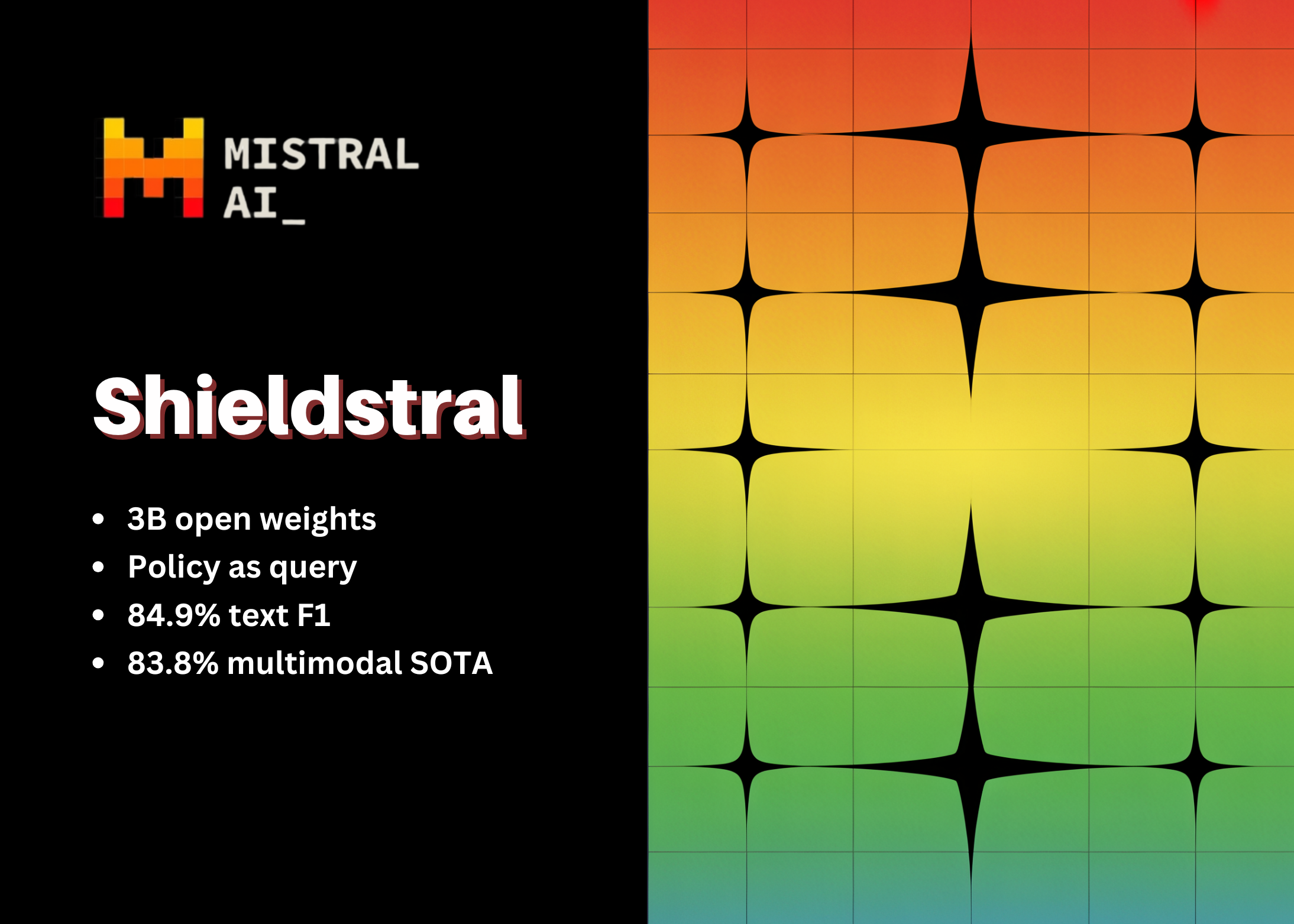
Mistral AI Releases Shieldstral 1.0 3B: An Open-Weights Policy-Adaptive Multimodal Safety Classifier Matching Models 7× Its Size
Mistral AI has released Shieldstral 1.0 3B, an open-weights, policy-adaptive multimodal safety classifier that treats content moderation as a single yes/no question rather than a fixed taxonomy of harm categories. Most guardrail models bake their category list into the weights, so re-targeting one to a new deployment context means retraining — and the same content can be acceptable on a cybersecurity research tool while being harmful on a mental-health platform. Shieldstral inverts that: operat