Cisco Foundation AI Releases Antares: 350M and 1B Open-Weight Models That Localize Known Vulnerabilities Inside Real Codebases
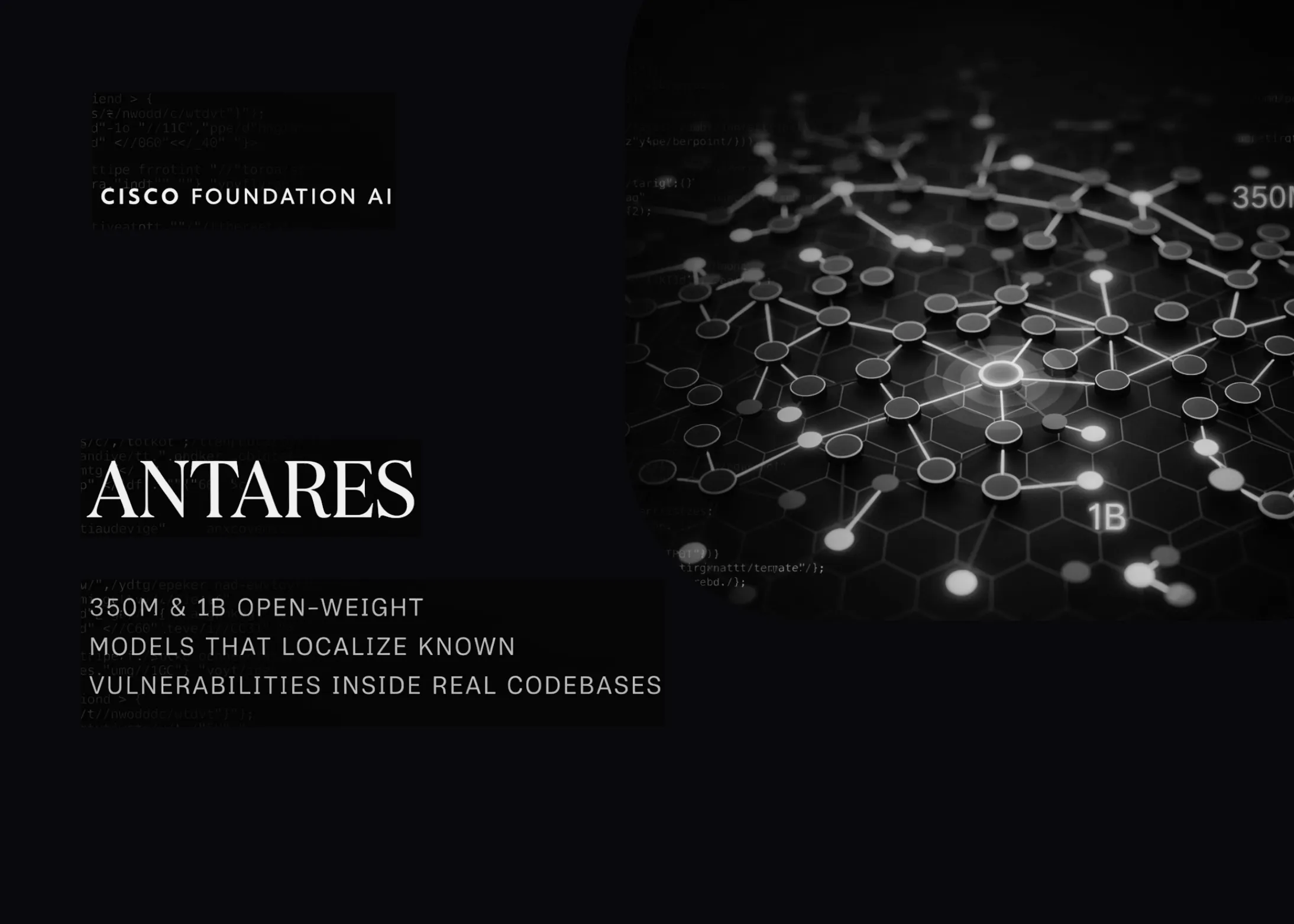
Cisco Foundation AI has released Antares, a family of security small language models (SLMs) built for one narrow security task. The task is vulnerability localization. Given a vulnerability description and a repository, find the files containing the flaw. Two models are open-weight and available now on Hugging Face, Antares-350M and Antares-1B. Both are Apache 2.0. Cisco team also shipped the Vulnerability Localization Benchmark (VLoc Bench), a 500-task agentic evaluation, under the same lic
Get smart on it
Cisco Foundation AI has released Antares, a family of small language models designed to identify the specific files in a codebase that contain known security vulnerabilities. The models are trained to receive a vulnerability description and search through a repository to locate the affected files, automating a task that currently requires developers to manually search unfamiliar code and trace dependencies. The smaller 1 billion parameter model reaches performance comparable to much larger systems, demonstrating that task-specific training on security data is more effective than raw model size. Antares is positioned as a first triage step to reduce the cost of connecting external vulnerability information to internal source code, though it does not replace existing security tools like dependency scanners or dynamic testing.
Related news

FAIRChem v2 UMA for Multidomain Atomistic Simulation across Molecules, Catalysts, Materials, Vibrations, and Molecular Dynamics
In this tutorial, we explore FAIRChem v2 and the UMA universal machine-learning interatomic potential as a unified framework for atomistic simulation across molecular chemistry, catalysis, and inorganic materials. We configure an environment, authenticate with Hugging Face to access the gated UMA model weights, and initialize task-specific calculators for the omol, oc20, and omat domains. We then apply the same pretrained potential to a broad set of computational chemistry workflows, including
Induction Labs Photon-1 Simulates Desktops, Plays Checkers, and Models Billiard Physics From One Pretraining Run
Most agents that learn from video need to know what action produced each frame. Induction Labs is arguing that this requirement is the bottleneck. Last week, they released imagination models, a foundation model architecture that pretrains on raw video with no action labels at all. Their test system is Photon-1, a sparse 106B-A5B mixture-of-experts (MoE) transformer trained on 18 years of computer demonstration video. On an internal computer use benchmark, Induction Labs reports that Photon-1