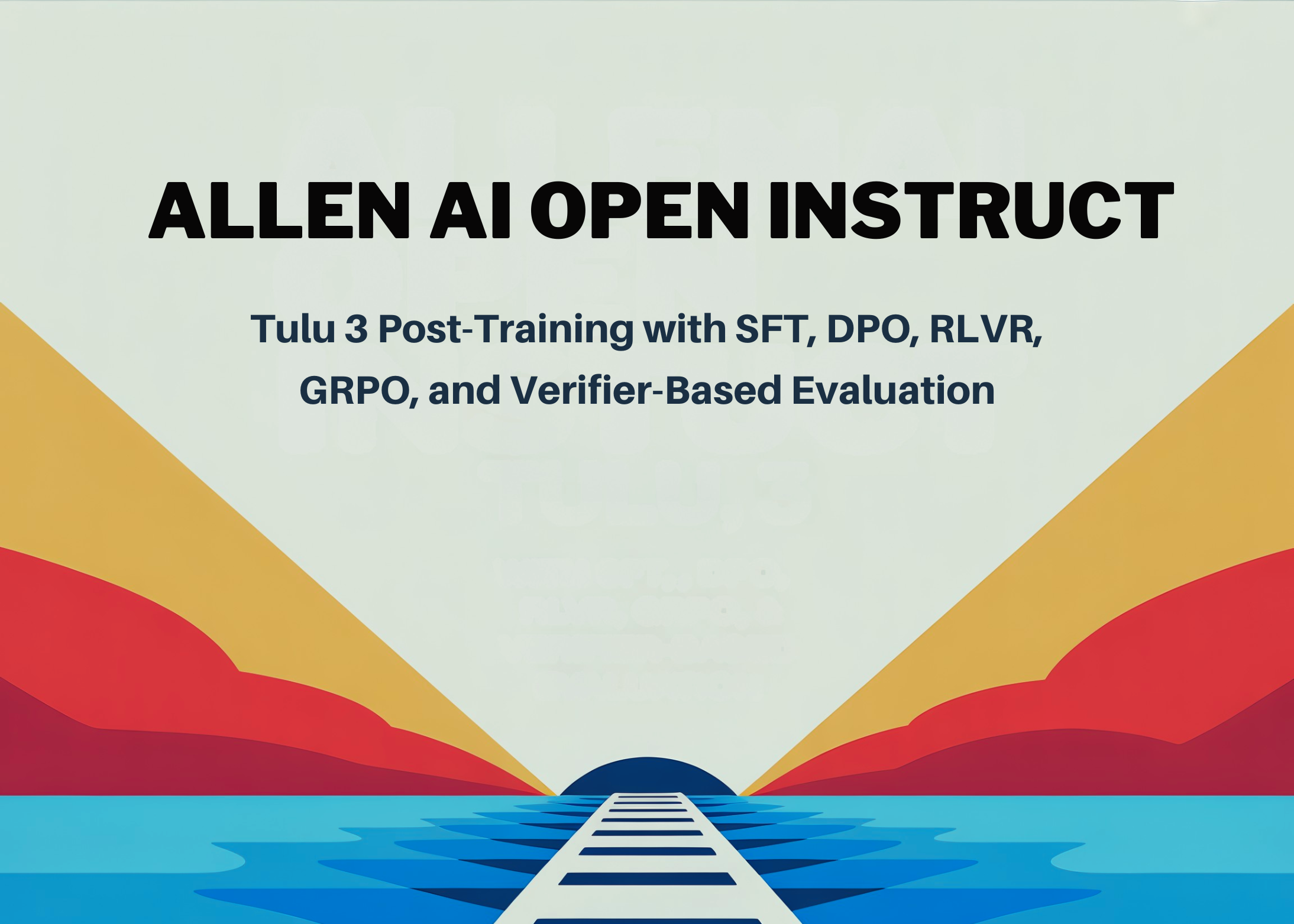
AllenAI Open Instruct Tulu 3 Post-Training with SFT, DPO, RLVR, GRPO, and Verifier-Based Evaluation
In this tutorial, we build an end-to-end post-training pipeline for a compact instruction-tuned language model using AllenAI’s Open Instruct framework. We move through three major training stages: Supervised Fine-Tuning, Direct Preference Optimization, and Reinforcement Learning with Verifiable Rewards using GRPO, while adapting the original multi-GPU Tulu 3 stack to fit within a 16 GB runtime. We clone the Open Instruct repository, selectively load its native loss and utility functions, config
Get smart on it
This is a tutorial demonstrating how to build a post-training pipeline for a compact instruction-tuned language model using AllenAI's Open Instruct framework. The pipeline progresses through three major training stages: Supervised Fine-Tuning, Direct Preference Optimization, and Reinforcement Learning with Verifiable Rewards using GRPO, adapted to run on limited hardware. The tutorial matters because it shows how to preserve the core optimization logic of Open Instruct while replacing its distributed components with lightweight implementations suitable for resource-constrained environments. Understanding this requires knowing that the workflow uses mathematical answer verification to evaluate model outputs and configures training parameters like learning rates, batch sizes, and iteration counts for each stage.
Related news
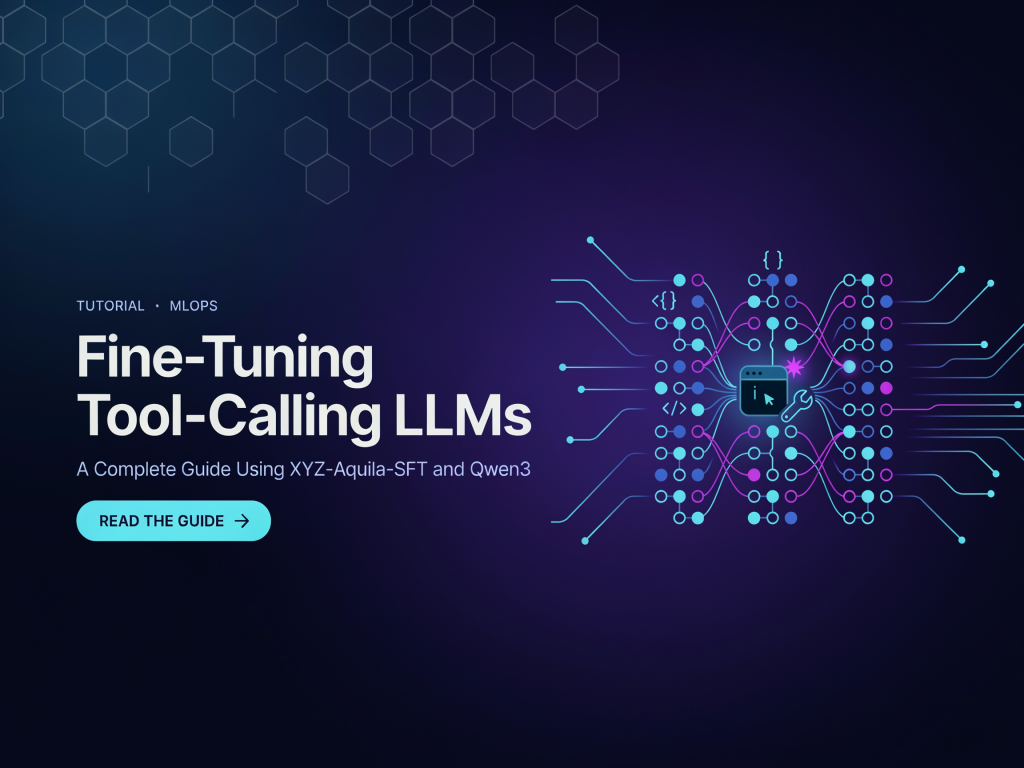
Fine-Tuning Tool-Calling LLMs: A Complete Guide Using XYZ-Aquila-SFT and Qwen3
In this tutorial, we implement an end-to-end supervised fine-tuning pipeline for the XYZ-Aquila-SFT dataset, Hugging Face Transformers, PyTorch, and PEFT. We stream and inspect the dataset, parse multi-turn tool-use trajectories, extract structured tool calls, analyze corpus characteristics, and preserve embedded reasoning and observation patterns. We then convert tool schemas between message-embedded and structured formats, render Qwen-compatible ChatML with assistant-only loss masking, prepar

Meta’s ‘open’ AI, and a $250M deal gone very wrong
Meta released Glimmer this week, an open-weight AI model anyone can download and run on their own hardware — a contrast to Muse Spark, the company’s more powerful model that stays locked behind its own APIs. The release landed alongside a letter from Mark Zuckerberg arguing AI should be “for everyone” rather than controlled by a handful of labs, but as Equity’s […]