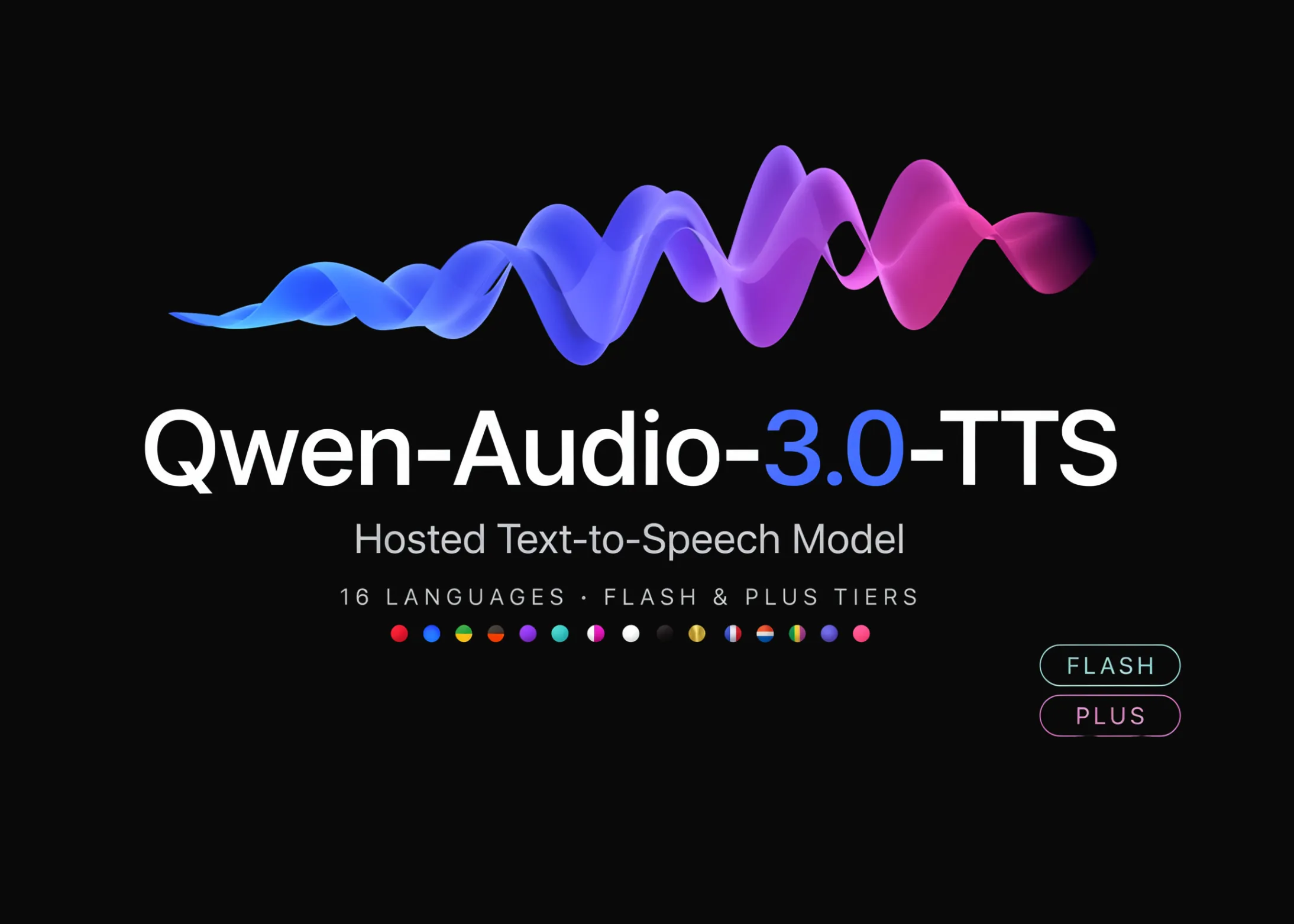
Alibaba’s Tongyi Lab Releases Qwen-Audio-3.0-TTS, a Hosted Text-to-Speech Model in Flash and Plus Tiers Across 16 Languages
Alibaba’s Tongyi Lab has released Qwen-Audio-3.0-TTS, a production-oriented text-to-speech (TTS) system. The model ships in two variants from the same lineage. Flash targets real-time interaction. Plus targets high-quality generation. Both are delivered as hosted models through Alibaba Cloud Model Studio, not as downloadable weights. The release focuses on four things developers hit in production: broader language coverage, natural-language style control, fine-grained tag control, and
Get smart on it
Alibaba's Tongyi Lab has released a text-to-speech model available in two performance tiers: Flash for real-time conversations with low latency, and Plus for higher quality output. The model supports 16 languages and uses fine-grained inline tags to control vocal effects like laughter and emotion, offering developers natural-language style control alongside technical precision. Plus ranks first on the independent Artificial Analysis Text-to-Speech leaderboard while priced significantly lower than competing services, though it is delivered only as a hosted service through Alibaba Cloud rather than as downloadable weights. The early reception highlights the achievement of a non-Western model reaching top performance at competitive pricing, though some developers note concerns about hosting-only availability and throughput speed compared to alternatives.
Related news
FAIRChem v2 UMA for Multidomain Atomistic Simulation across Molecules, Catalysts, Materials, Vibrations, and Molecular Dynamics
In this tutorial, we explore FAIRChem v2 and the UMA universal machine-learning interatomic potential as a unified framework for atomistic simulation across molecular chemistry, catalysis, and inorganic materials. We configure an environment, authenticate with Hugging Face to access the gated UMA model weights, and initialize task-specific calculators for the omol, oc20, and omat domains. We then apply the same pretrained potential to a broad set of computational chemistry workflows, including
Induction Labs Photon-1 Simulates Desktops, Plays Checkers, and Models Billiard Physics From One Pretraining Run
Most agents that learn from video need to know what action produced each frame. Induction Labs is arguing that this requirement is the bottleneck. Last week, they released imagination models, a foundation model architecture that pretrains on raw video with no action labels at all. Their test system is Photon-1, a sparse 106B-A5B mixture-of-experts (MoE) transformer trained on 18 years of computer demonstration video. On an internal computer use benchmark, Induction Labs reports that Photon-1