
Urban Data Centers: Who Needs Them and Where to Find Them
Urban data centers deliver low-latency performance and rich interconnection for metro workloads. Learn when they make sense, key trade-offs, and how to find the right provider.
Urban data centers are facilities located in metropolitan cores, typically in downtown districts, that prioritize proximity to major population centers and network interconnection points over the large capacity offered by traditional standalone data centers. These facilities matter because they deliver low-latency performance and rich interconnection for organizations requiring a local IT presence in densely populated areas, particularly for latency-sensitive workloads such as trading, gaming, and real-time analytics. Urban data centers offer advantages including reduced data round-trip time, access to extensive fiber-optic infrastructure, and simplified operational access for customer teams and technicians, though they come with trade-offs including higher real estate costs, space constraints, and higher taxes and permitting costs compared to outlying facilities. Urban facilities typically support 10 MW or less of capacity, in contrast to the 100+ MW capacity of hyperscale data centers built outside cities.
One short email a day with the stories that matter. Free. Unsubscribe with one click.
Want to go deeper than the news? Explore live, cohort-based AI courses taught by practitioners.
Browse AI courses on Maven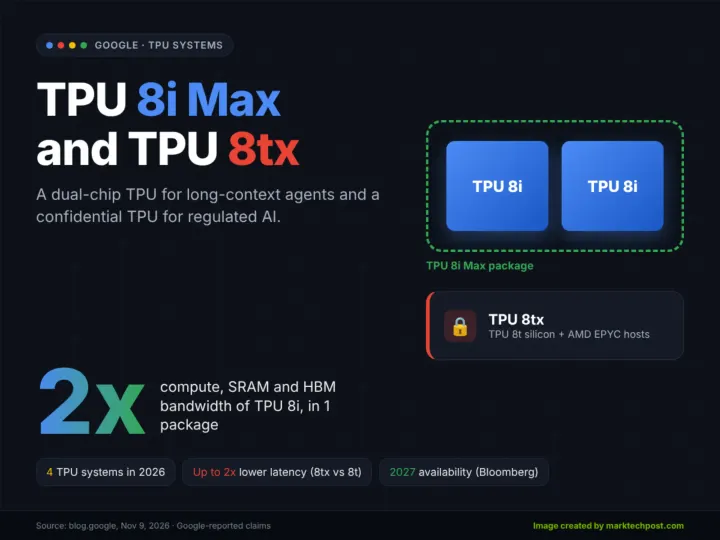
Google Unveils TPU 8i Max and TPU 8tx: A Dual-Chip TPU and a Confidential TPU
Google has added two new systems to its eighth-generation TPU lineup. TPU 8i Max targets massive context windows and rack density. TPU 8tx targets secure, confidential inference. Google TPU 8i Max is a dual-chip package built from 2 TPU 8i chips. Both arrive alongside TPU 8t and TPU 8i, announced in April. TL;DR Size: TPU 8i Max = 2 TPU 8i chips in 1 package. TPU 8tx = TPU 8t silicon plus 5th Gen AMD EPYC hosts. Runs on: Google Cloud TPU systems. Performance: 8i Max doubles TPU 8
Also reported by Data Center Knowledge
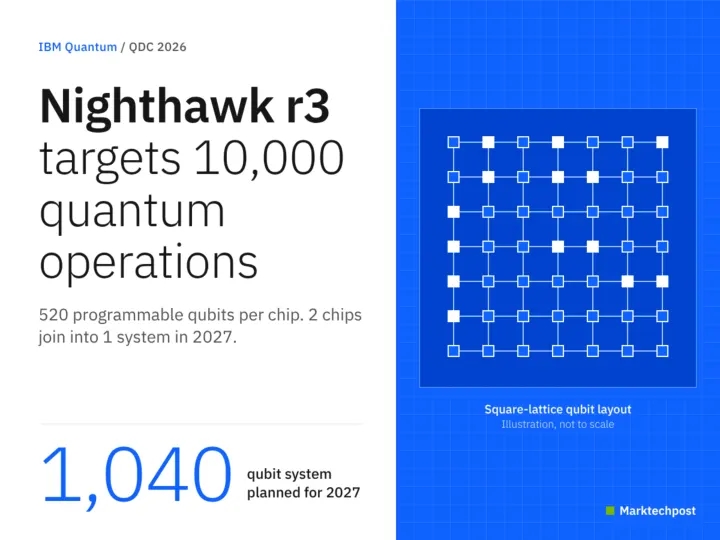
IBM Announces IBM Quantum Nighthawk r3: A New Processor to Support 10k Quantum Operations on 520 Programmable Qubits
IBM has announced IBM Quantum Nighthawk r3, its next superconducting quantum processor. It is designed to run 10,000 quantum operations accurately across 520 programmable qubits. In 2027, IBM plans to link 2 r3 chips into a single 1,040-qubit system. For developers, the announcement is speed. The current Nighthawk r2 already runs workloads up to 19x faster than IBM’s earlier processors. TL;DR Size: Nighthawk r3: 520 programmable qubits, 2,034 physical qubits, 10 l-couplers. Nightha

Why the data center you dread might never even be built
The data center boom is running into serious real-world obstacles, from widespread local opposition and permitting delays to a scramble for electricity. Before those challenges even come into play, though, there’s a more basic problem: A lot of the projects being announced may never get built in the first place. With billions of dollars in AI infrastructure […]

How backlash and red tape continue to slow data centers post-Blue Wave
The data center boom is running into serious real-world obstacles, from widespread local opposition and permitting delays to a scramble for electricity. Before those challenges even come into play, though, there’s a more basic problem: A lot of the projects being announced may never get built in the first place. With billions of dollars in AI infrastructure […]

AMD Launches Epyc SP7, Helion as AI Rack Demand Rises
AMD has begun shipping sixth-gen Epyc servers and is rolling out Helion AI racks, signaling a bigger push into enterprise and agentic AI infrastructure.

Google broadens its AI hardware portfolio with two new specialized chips
Google's new tensor processing units (TPUs) broaden its chip portfolio to more use cases: confidential model training and more memory capacity.