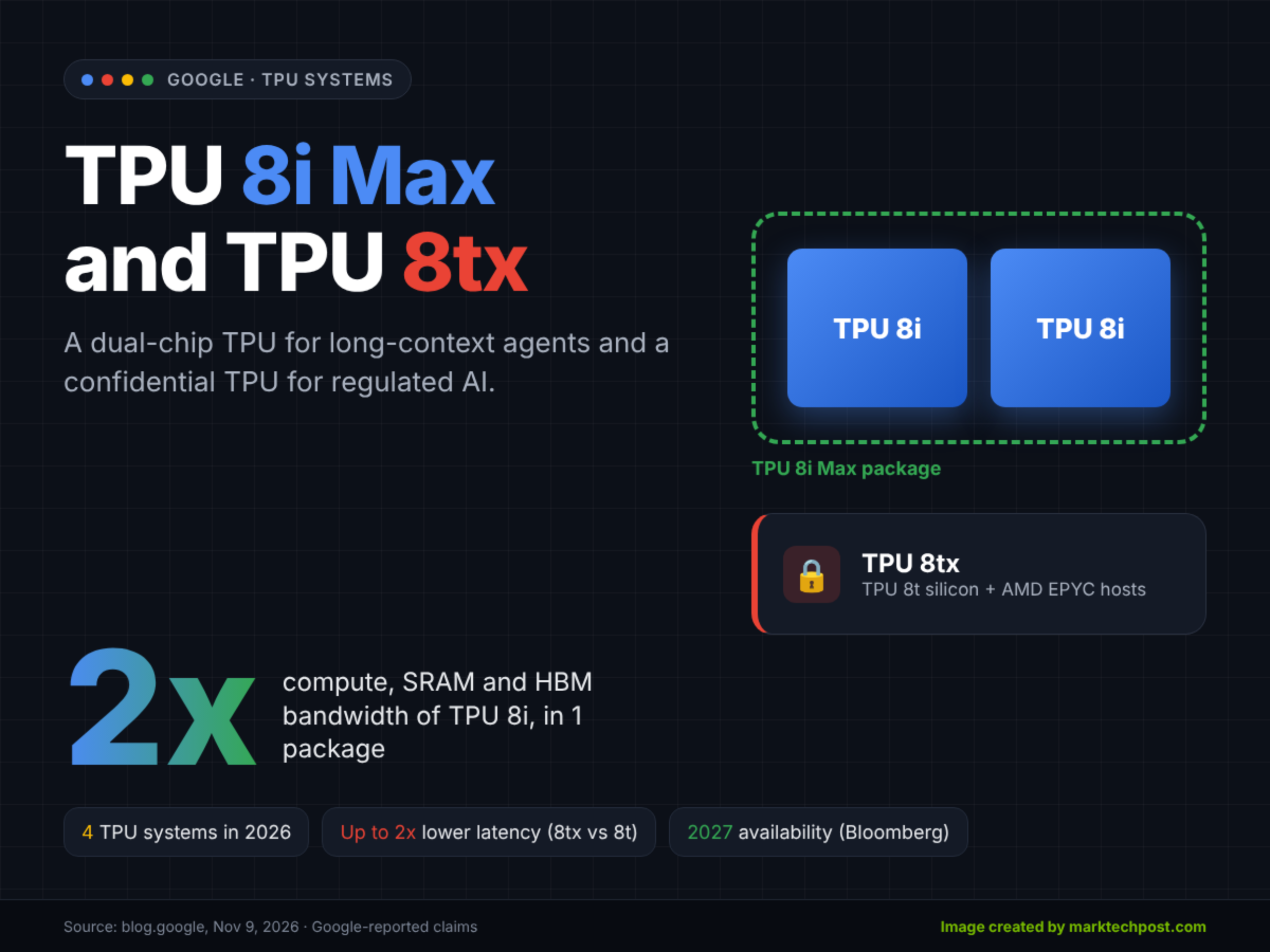
Google unveils TPU 8i Max and TPU 8tx processors
MarkTechPost: Google Unveils TPU 8i Max and TPU 8tx: A Dual-Chip TPU and a Confidential TPU
Google has added two new systems to its eighth-generation TPU lineup. TPU 8i Max targets massive context windows and rack density. TPU 8tx targets secure, confidential inference. Google TPU 8i Max is a dual-chip package built from 2 TPU 8i chips. Both arrive alongside TPU 8t and TPU 8i, announced in April. TL;DR Size: TPU 8i Max = 2 TPU 8i chips in 1 package. TPU 8tx = TPU 8t silicon plus 5th Gen AMD EPYC hosts. Runs on: Google Cloud TPU systems. Performance: 8i Max doubles TPU 8
What happened
Google announced two new systems for its eighth-generation TPU lineup: the TPU 8i Max, which combines two TPU 8i chips into one package to handle large context windows, and the TPU 8tx, which pairs TPU 8t silicon with AMD EPYC CPU hosts for secure, confidential inference. Both systems are repackagings of existing chips rather than entirely new processors. Both are expected to become available in 2027.
What each outlet adds
- MarkTechPost ↗: The TPU 8i Max targets massive context windows and rack density, while the TPU 8tx targets secure, confidential inference.
- Data Center Knowledge ↗: Confidential computing, which protects data while it is actively being used, is emerging as a requirement enterprises increasingly demand, and the move could help Google Cloud expand market reach while easing data center capacity pressures.
Why it matters
These specialized chips represent Google Cloud's strategy of rapidly releasing custom AI processors to differentiate itself from competing cloud providers. Confidential computing is emerging as a requirement enterprises increasingly demand for protecting sensitive AI workloads.
Get smart on it
Google announced two new processor system configurations for its eighth-generation TPU lineup. The TPU 8i Max combines two TPU 8i chips into one package to double computing power and memory bandwidth for handling large context windows, while the TPU 8tx pairs existing TPU 8t silicon with AMD EPYC CPU hosts to enable confidential inference that keeps data encrypted during processing. These are repackagings of existing chips rather than entirely new processors, designed to address specific use cases in long-context AI work and secure enterprise applications. Both systems are expected to become available in 2027.
Relevant courses
Want to go deeper than the news? Explore live, cohort-based AI courses taught by practitioners.
Browse AI courses on MavenRelated news

Anthropic joins AI’s natural gas frenzy, buys $3.4B worth of turbines
Anthropic bought billions of dollars worth of natural gas turbines in a deal that could give it buyer's remorse.

Protesters break into Microsoft data center site in Amsterdam
Members of the action group Geef Tegengas put a banner on a crane during a protest. | Image: Getty Images Protesters have broken into a construction site of a new Microsoft data center in Amsterdam this morning. Members of the Geef Tegengas group helped organize the protest against the construction of three 85-meter data center towers in the outskirts of Amsterdam. Reuters reports that around 100 people made it into the construction site, with some scaling a crane to place a "fu
Also reported by Wired AI

We Visited China’s Stargate in Inner Mongolia
Stargate Abilene has become the symbol of America’s AI buildout. It is a gigawatt-scale campus on the Texas plains built for OpenAI. China has campuses on a similar scale, though few people outside the country have had a look inside. In September, we visited one, and we found the speed, scale, ultra low cost, and deep vertical integration astonishing.During the trip, we toured Inner Mongolia, China’s fastest-growing AI datacenter region. It's the “West Texas” of China, bu

Crusoe sells troubled Wyoming data center project to Google
The deal highlights the challenges of developing massive AI data centers.
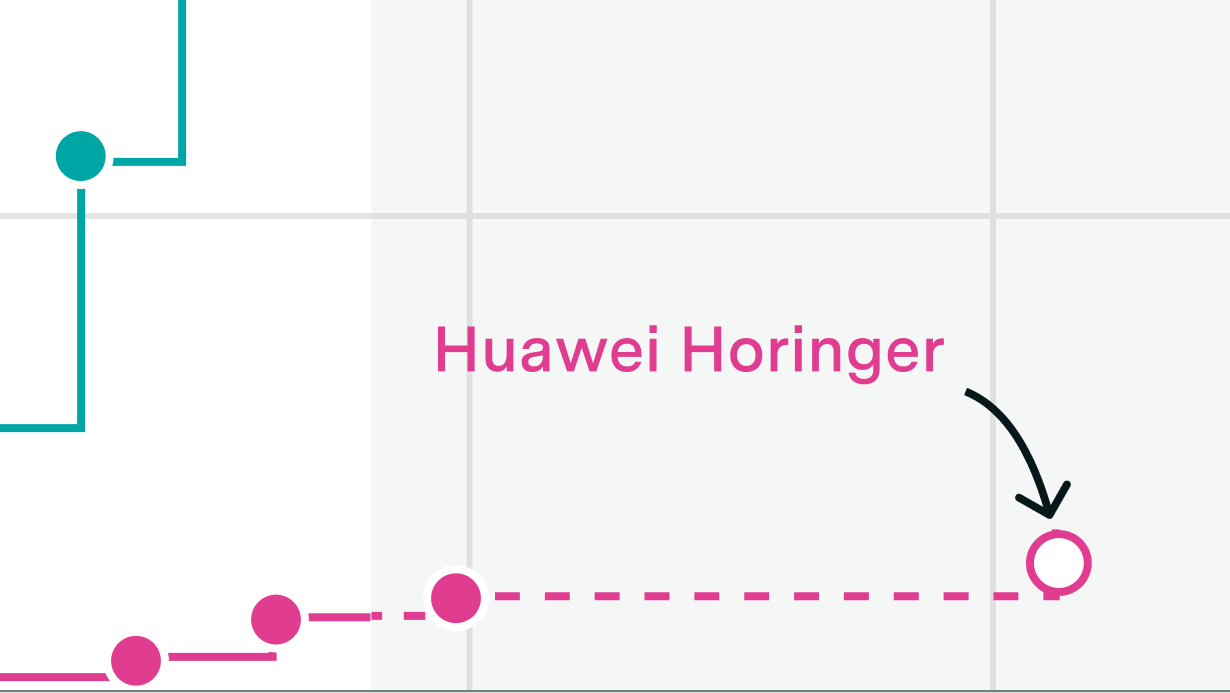
What Huawei’s Horinger data center reveals about China’s compute gap
Huawei’s AI data center in Horinger, Inner Mongolia, uses Ascend chips and has an estimated AI computing capacity that is just 7% that of the world’s largest AI data center, SpaceX’s Colossus 2 in Tennessee.
The Iron(wood) Throne: Google's TPU Stakes Its Claim on Inference
In November 2025, we published a newsletter saying that Google is selling TPUs to external customers. Since then, we have been proven right over and over again with Oracle, OpenAI, Anthropic, and Meta all becoming customers of TPUs just as our Accelerator Model reported.Hardware demand is only half the story, as NVIDIA’s moat has historically been its software and large developer ecosystem. This is where TPU is also making headway, partnering with upstream maintainers across the entire ec