
Nvidia, MediaTek Bring Custom Chips to AI Racks
Nvidia is opening its rack-scale AI systems to custom chips, giving hyperscalers more flexibility as they seek alternatives to off-the-shelf GPUs.
Nvidia is making its rack-scale AI infrastructure available to companies that want to build custom AI accelerators, rather than relying solely on Nvidia's own processors. This partnership with MediaTek allows customers to develop custom accelerators using Nvidia's NVLink technology for connectivity while retaining control over their own chip designs. The move matters because major cloud providers are already building their own processors for AI workloads, and this approach lets them do so without having to rebuild their entire AI infrastructure from scratch. The technology competes with an open-standard alternative called UALink, which is being developed by a group of chip and infrastructure companies as another way to connect accelerators at scale.
One short email a day with the stories that matter. Free. Unsubscribe with one click.
Want to go deeper than the news? Explore live, cohort-based AI courses taught by practitioners.
Browse AI courses on Maven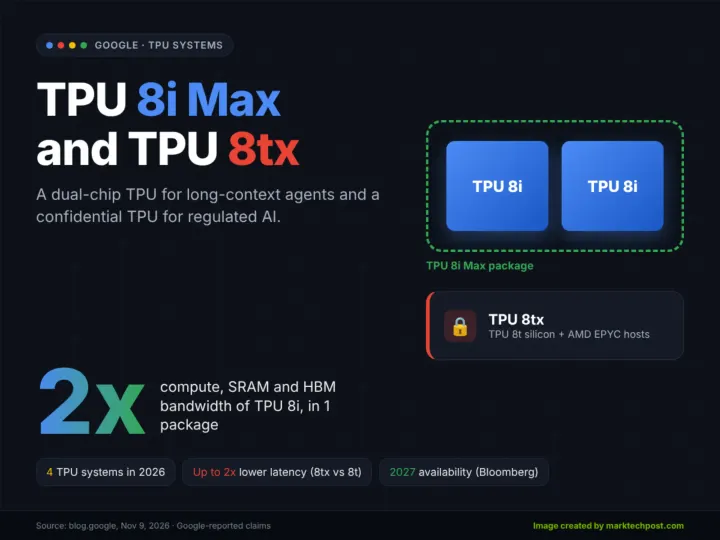
Google Unveils TPU 8i Max and TPU 8tx: A Dual-Chip TPU and a Confidential TPU
Google has added two new systems to its eighth-generation TPU lineup. TPU 8i Max targets massive context windows and rack density. TPU 8tx targets secure, confidential inference. Google TPU 8i Max is a dual-chip package built from 2 TPU 8i chips. Both arrive alongside TPU 8t and TPU 8i, announced in April. TL;DR Size: TPU 8i Max = 2 TPU 8i chips in 1 package. TPU 8tx = TPU 8t silicon plus 5th Gen AMD EPYC hosts. Runs on: Google Cloud TPU systems. Performance: 8i Max doubles TPU 8
Also reported by Data Center Knowledge

Why the data center you dread might never even be built
The data center boom is running into serious real-world obstacles, from widespread local opposition and permitting delays to a scramble for electricity. Before those challenges even come into play, though, there’s a more basic problem: A lot of the projects being announced may never get built in the first place. With billions of dollars in AI infrastructure […]

How backlash and red tape continue to slow data centers post-Blue Wave
The data center boom is running into serious real-world obstacles, from widespread local opposition and permitting delays to a scramble for electricity. Before those challenges even come into play, though, there’s a more basic problem: A lot of the projects being announced may never get built in the first place. With billions of dollars in AI infrastructure […]

AMD Launches Epyc SP7, Helion as AI Rack Demand Rises
AMD has begun shipping sixth-gen Epyc servers and is rolling out Helion AI racks, signaling a bigger push into enterprise and agentic AI infrastructure.

Google broadens its AI hardware portfolio with two new specialized chips
Google's new tensor processing units (TPUs) broaden its chip portfolio to more use cases: confidential model training and more memory capacity.

Anthropic joins AI’s natural gas frenzy, buys $3.4B worth of turbines
Anthropic bought billions of dollars worth of natural gas turbines in a deal that could give it buyer's remorse.