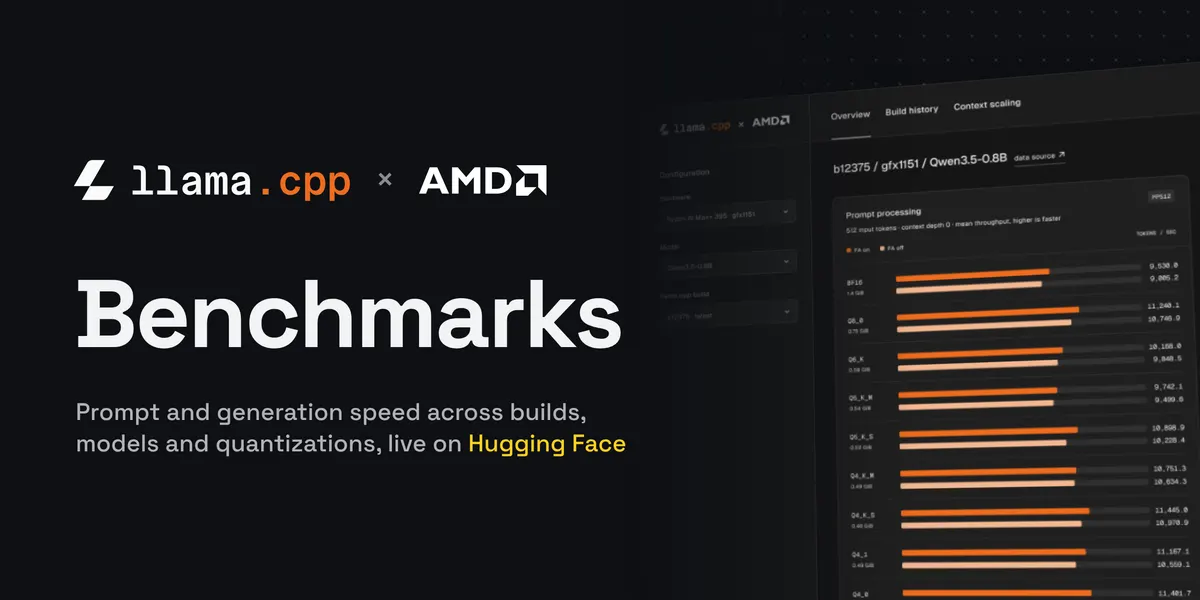
Llama.cpp benchmark dashboard launched for AMD hardware
Hugging Face: Introducing the llama.cpp benchmark dashboard for AMD Ryzen and Radeon
The tool lets developers measure how efficiently AMD's chips run open-source language models locally, filling a gap in performance testing options.
A benchmark dashboard has been introduced that measures how quickly artificial intelligence models can process and generate text on specific AMD hardware. The dashboard tracks performance across different model versions, software builds, and data compression formats, allowing developers to compare results over time and understand how local AI inference performs. Two main tests are measured in tokens per second: one assesses how quickly a model processes input text, while the other measures how quickly it generates output. The benchmark data is publicly available, and developers can inspect the methodology, download results, and conduct their own comparisons.
Explainer: How to Actually Read an AI Benchmark (Without Being Fooled)
One short email a day with the stories that matter. Free. Unsubscribe with one click.
Want to go deeper than the news? Explore live, cohort-based AI courses taught by practitioners.
Browse AI courses on Maven
FCC signs off on SpaceX’s plan to put up to 1 million data center satellites into space
In an announcement on Wednesday, the FCC says it authorized SpaceX to deploy up to 1 million AI chip-equipped satellites as part of the Elon Musk-owned company's "Starmind" initiative. With several others also pursuing the idea of putting AI data centers in space, including Google and Blue Origin, this is the first approval the agency has granted for a full "constellation" of AI satellites. The FCC's approval requires SpaceX to deploy at least one satellite by 2033, and meet th
Also reported by The Decoder

AWS Challenger: Trainium3 Inference and Microarchitecture Deep Dive
The Nvidia GPU was originally built to shade pixels, and every Nvidia generation since 2017 has bolted on another piece of AI-specific hardware to fix the bottleneck the previous one exposed. Volta added Tensor Cores, Hopper added TMA for tile data movement between HBM and SRAM, and Blackwell added Tensor Memory for accumulating. Nvidia removed many hardware units that are required to render graphics for their datacenter GPUsIn comparison, the Trainium microarchitecture is built ground-up specif
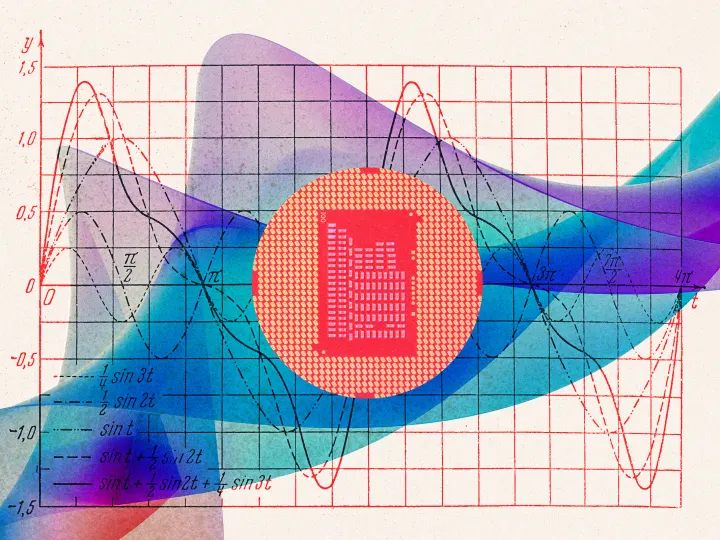
A New Breed of Chip Runs AI Models Using Waves of Light
German company Q.ANT is trying to cut the amount of energy required to run AI models by using light to perform the toughest calculations.

Ars Live recap: Don’t expect military attacks on data centers to stop
Drone attacks on data centers. Amazon data centers came under military attack for the first time ever in the Middle East this year, and Russia and Ukraine exchanged an unprecedented flurry of drone strikes on each other’s data centers. To examine what such attacks on data centers mean for the future of cloud services that all modern societies depend upon, Ars hosted a live discussion. In a conversation with Ars Technica Tech Reporter Jeremy Hsu, Joseph Jarnecki a

Google, Blue Origin Plan Orbital AI Compute Test
The 2029 mission will deploy rack-scale computing satellites, with cooling, autonomous recovery, and hardware longevity likely to determine whether orbital infrastructure can support commercial workloads.

AI data centers are becoming harder to build, and neoclouds are feeling it
Nvidia has made clear it won’t backstop an AI data center until it’s nearly ready to run, and that’s landing just as neoclouds report construction delays and more expensive debt. The message to developers is that land, power and a finished building matter more than a pitch deck. Anita Verma-Lallian has been selling exactly that. […]