Implementation of Machine Learning Workflows with NVIDIA cuML, RAPIDS, GPU Benchmarking, Explainability, Clustering, and Model Inference
In this tutorial, we implement NVIDIA cuML as a GPU-accelerated machine learning framework and build a practical workflow that demonstrates how RAPIDS can accelerate familiar data science and machine learning tasks. We begin by configuring the GPU environment and examining cuml.accel, which lets us accelerate existing scikit-learn workloads with minimal code changes, before moving to the native cuML API for direct CuPy and cuDF interoperability. We then benchmark CPU and GPU implementations of
This tutorial demonstrates how to build machine learning workflows using NVIDIA cuML, a GPU-accelerated framework that can speed up familiar data science tasks. The implementation covers benchmarking CPU versus GPU performance across multiple algorithms including PCA, K-Means, logistic regression, random forests, and clustering methods, while also exploring model explainability with SHAP and hyperparameter optimization. The tutorial shows that existing scikit-learn code can be accelerated with minimal changes through cuml.accel, and includes examples of serializing and moving trained models between GPU and CPU environments.
Explainer: How to Actually Read an AI Benchmark (Without Being Fooled)
One short email a day with the stories that matter. Free. Unsubscribe with one click.
Want to go deeper than the news? Explore live, cohort-based AI courses taught by practitioners.
Browse AI courses on Maven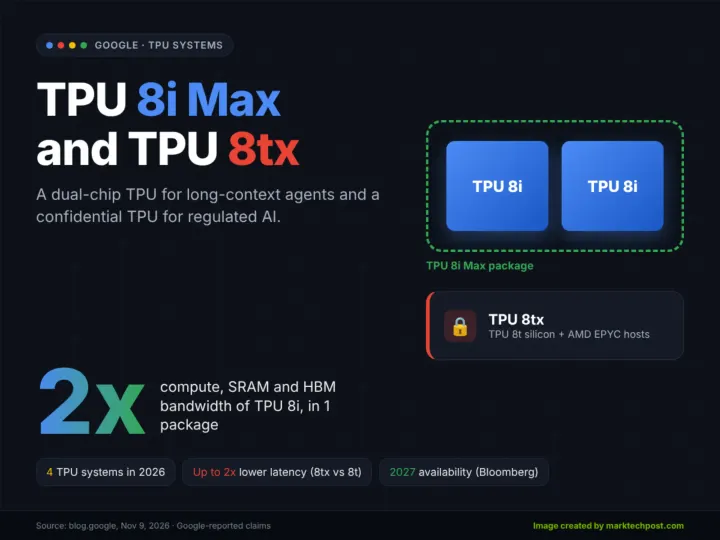
Google Unveils TPU 8i Max and TPU 8tx: A Dual-Chip TPU and a Confidential TPU
Google has added two new systems to its eighth-generation TPU lineup. TPU 8i Max targets massive context windows and rack density. TPU 8tx targets secure, confidential inference. Google TPU 8i Max is a dual-chip package built from 2 TPU 8i chips. Both arrive alongside TPU 8t and TPU 8i, announced in April. TL;DR Size: TPU 8i Max = 2 TPU 8i chips in 1 package. TPU 8tx = TPU 8t silicon plus 5th Gen AMD EPYC hosts. Runs on: Google Cloud TPU systems. Performance: 8i Max doubles TPU 8
Also reported by Data Center Knowledge
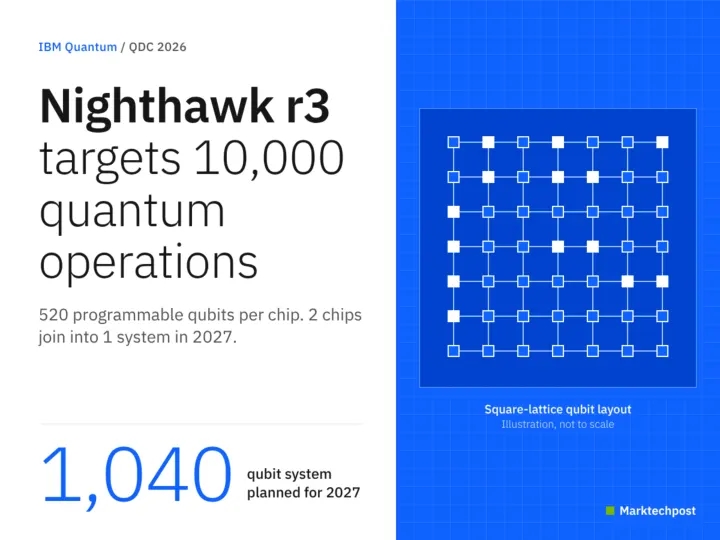
IBM Announces IBM Quantum Nighthawk r3: A New Processor to Support 10k Quantum Operations on 520 Programmable Qubits
IBM has announced IBM Quantum Nighthawk r3, its next superconducting quantum processor. It is designed to run 10,000 quantum operations accurately across 520 programmable qubits. In 2027, IBM plans to link 2 r3 chips into a single 1,040-qubit system. For developers, the announcement is speed. The current Nighthawk r2 already runs workloads up to 19x faster than IBM’s earlier processors. TL;DR Size: Nighthawk r3: 520 programmable qubits, 2,034 physical qubits, 10 l-couplers. Nightha

Why the data center you dread might never even be built
The data center boom is running into serious real-world obstacles, from widespread local opposition and permitting delays to a scramble for electricity. Before those challenges even come into play, though, there’s a more basic problem: A lot of the projects being announced may never get built in the first place. With billions of dollars in AI infrastructure […]

How backlash and red tape continue to slow data centers post-Blue Wave
The data center boom is running into serious real-world obstacles, from widespread local opposition and permitting delays to a scramble for electricity. Before those challenges even come into play, though, there’s a more basic problem: A lot of the projects being announced may never get built in the first place. With billions of dollars in AI infrastructure […]

AMD Launches Epyc SP7, Helion as AI Rack Demand Rises
AMD has begun shipping sixth-gen Epyc servers and is rolling out Helion AI racks, signaling a bigger push into enterprise and agentic AI infrastructure.

Google broadens its AI hardware portfolio with two new specialized chips
Google's new tensor processing units (TPUs) broaden its chip portfolio to more use cases: confidential model training and more memory capacity.