Designing High-Performance GPU Kernels with TileLang: Tensor-Core GEMM, Fused Softmax, FlashAttention, and Autotuning
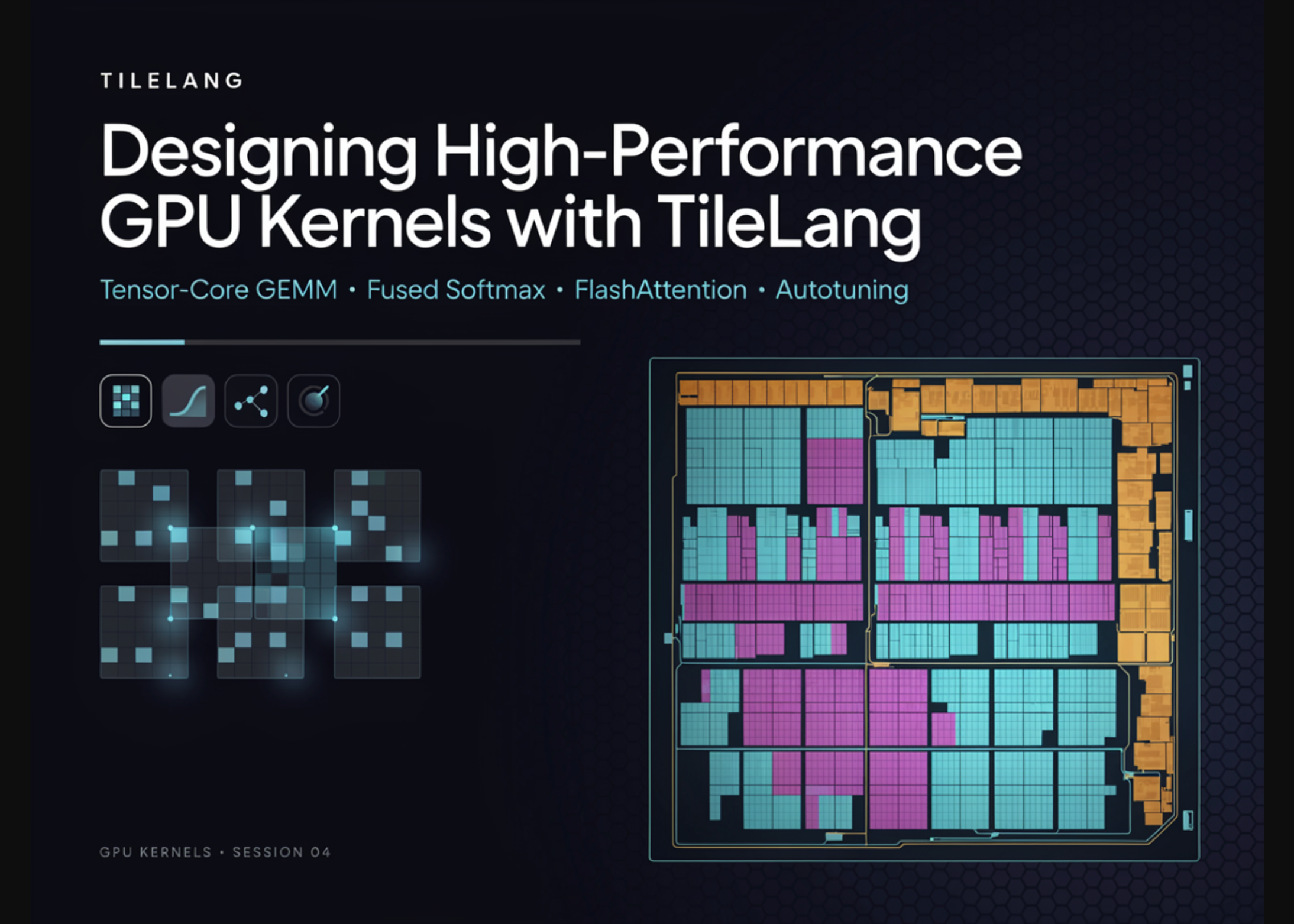
In this tutorial, we explore TileLang as a high-level Python domain-specific language for designing and compiling performance-oriented GPU kernels through TVM. We begin by validating the CUDA environment and establishing reusable benchmarking and numerical-verification utilities, then progressively implement vector addition, tiled tensor-core matrix multiplication, schedule exploration, fused GEMM epilogues, row-wise softmax, and FlashAttention. Throughout the tutorial, we work directly with Ti
Make your prediction
Will TileLang release an official stable version on PyPI by October 31, 2026?
Resolves by Oct 31, 2026
Your prediction
50% · 50/50 coin flip
NOYES
Get smart on it
TileLang is a high-level Python language for writing graphics processing unit (GPU) kernels, which are specialized programs that run on GPUs to perform mathematical operations. The tutorial demonstrates how to use TileLang to design and compile performance-oriented GPU kernels through TVM, covering implementations from basic vector addition to more complex operations like matrix multiplication and FlashAttention. This matters because optimizing GPU kernels directly affects the speed and efficiency of machine learning workloads, and the tutorial shows how to compare custom kernels against established baselines like PyTorch and cuBLAS while using autotuning to find optimal configurations for different GPU architectures. The approach abstracts away low-level details like thread mapping, memory layouts, and synchronization, allowing developers to focus on algorithm design while the compiler handles the technical GPU-specific implementation details.
Related news

One fallen power line exposed a growing AI data center problem. Here’s how to fix it.
A close call in Northern Virginia revealed just how poorly data centers respond to grid disruptions. Here's how to fix the problem.

AI Is Redefining Data Center Ownership: Multiple Assets, Multiple Timelines
As AI infrastructure grows more complex, companies are rethinking how they acquire, own, and finance assets that operate on dramatically different economic timelines.
.jpg%3Fwidth%3D720%26quality%3D80%26disable%3Dupscale&s=kAmg5aaORKYzlMWL0upGuDAjzwWxVE-6xoVpfMYWKf4)