
AI firms want more data centers; Trump's EPA may give neighbors less say
The Trump administration is quietly considering a rule change that could make it easier for polluters to build facilities—including certain gas plants and diesel generators that power data centers—with little to no notice to the public. On Wednesday, the Environmental Protection Agency held a public hearing on a proposed rule change that would hand the power to states to decide how the public participates in the permitting process for certain new sources of air pollution. The proposed rollback c
The Trump administration's EPA is considering a rule that would let states decide whether the public gets notice and input on permits for facilities that pollute the air, including gas plants and diesel generators that power data centers. Currently, the Clean Air Act requires some public participation in permitting processes, but enforcement varies by state, and this change would remove the federal requirement for minor pollution sources. The timing matters because data center companies face growing community opposition, and the Trump administration has actively worked to remove obstacles for data center development as part of its AI strategy. States with stronger public participation laws, like Georgia and Kentucky, could weaken their protections if the federal requirement is eliminated, while states with minimal engagement requirements, like Texas, would have even less oversight.
One short email a day with the stories that matter. Free. Unsubscribe with one click.
Want to go deeper than the news? Explore live, cohort-based AI courses taught by practitioners.
Browse AI courses on Maven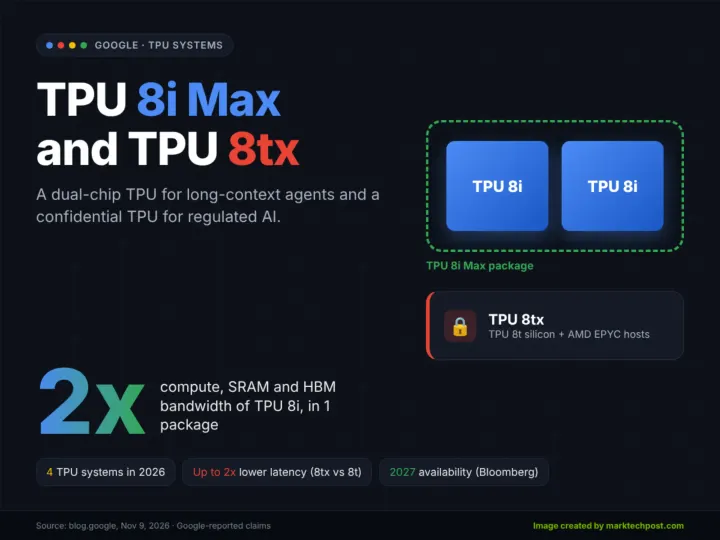
Google Unveils TPU 8i Max and TPU 8tx: A Dual-Chip TPU and a Confidential TPU
Google has added two new systems to its eighth-generation TPU lineup. TPU 8i Max targets massive context windows and rack density. TPU 8tx targets secure, confidential inference. Google TPU 8i Max is a dual-chip package built from 2 TPU 8i chips. Both arrive alongside TPU 8t and TPU 8i, announced in April. TL;DR Size: TPU 8i Max = 2 TPU 8i chips in 1 package. TPU 8tx = TPU 8t silicon plus 5th Gen AMD EPYC hosts. Runs on: Google Cloud TPU systems. Performance: 8i Max doubles TPU 8
Also reported by Data Center Knowledge
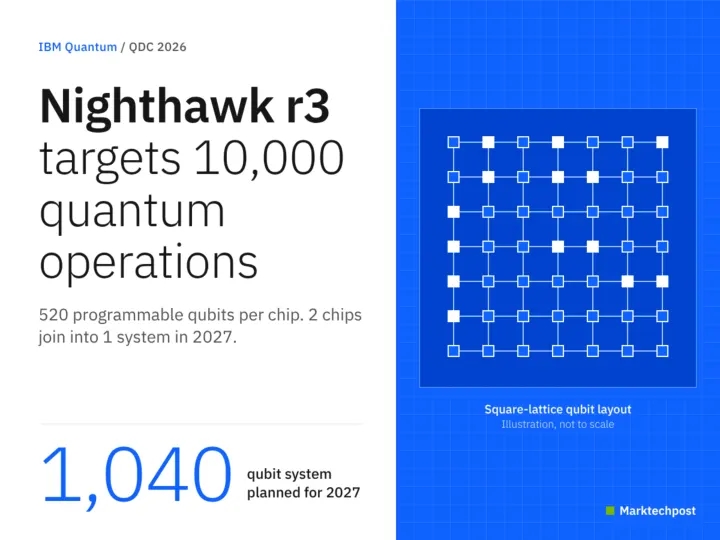
IBM Announces IBM Quantum Nighthawk r3: A New Processor to Support 10k Quantum Operations on 520 Programmable Qubits
IBM has announced IBM Quantum Nighthawk r3, its next superconducting quantum processor. It is designed to run 10,000 quantum operations accurately across 520 programmable qubits. In 2027, IBM plans to link 2 r3 chips into a single 1,040-qubit system. For developers, the announcement is speed. The current Nighthawk r2 already runs workloads up to 19x faster than IBM’s earlier processors. TL;DR Size: Nighthawk r3: 520 programmable qubits, 2,034 physical qubits, 10 l-couplers. Nightha

How backlash and red tape continue to slow data centers post-Blue Wave
The data center boom is running into serious real-world obstacles, from widespread local opposition and permitting delays to a scramble for electricity. Before those challenges even come into play, though, there’s a more basic problem: A lot of the projects being announced may never get built in the first place. With billions of dollars in AI infrastructure […]

Why the data center you dread might never even be built
The data center boom is running into serious real-world obstacles, from widespread local opposition and permitting delays to a scramble for electricity. Before those challenges even come into play, though, there’s a more basic problem: A lot of the projects being announced may never get built in the first place. With billions of dollars in AI infrastructure […]

AMD Launches Epyc SP7, Helion as AI Rack Demand Rises
AMD has begun shipping sixth-gen Epyc servers and is rolling out Helion AI racks, signaling a bigger push into enterprise and agentic AI infrastructure.

Google broadens its AI hardware portfolio with two new specialized chips
Google's new tensor processing units (TPUs) broaden its chip portfolio to more use cases: confidential model training and more memory capacity.