Poolside Releases Laguna S 2.1, an Open-Weight Agentic Coding Model Punching Above Its Weight Class on SWE-Bench Multilingual
Poolside has released Laguna S 2.1, a 118B-parameter open-weight model built for agentic coding. It is a Mixture-of-Experts (MoE) model with 8B activated parameters per token. It supports a context window of up to 1M tokens in both thinking and no-thinking modes. The weights are on Hugging Face under an OpenMDW-1.1 license, and the model is small enough to run on a single NVIDIA DGX Spark. On long-horizon coding benchmarks, Laguna S 2.1 holds its own against models several times its size, in
Poolside has released an open-weight model designed for coding tasks that uses a sparse architecture, meaning only a fraction of its total parameters activate per step, allowing it to perform comparably to much larger models while remaining cheaper to run. The model scores competitively on coding benchmarks against larger closed and open models, ranking first among open models with disclosed sizes on some benchmarks. It can run on a single GPU at lower precision levels and was trained in under nine weeks. The model includes a "thinking mode" that enables it to spend more computational effort on complex problems, though this increases token usage substantially.
Explainer: What Is a Mixture of Experts Model and Why Does It Use Fewer Resources?
One short email a day with the stories that matter. Free. Unsubscribe with one click.
Want to go deeper than the news? Explore live, cohort-based AI courses taught by practitioners.
Browse AI courses on Maven
Google DeepMind just mathematically verified key parts of Signal
Google DeepMind researchers used agentic AI to mathematically prove, or “formally verify,” a number of the Signal protocol’s key cryptographic guarantees—a landmark development for the widely used cryptography and AI itself. Conducted as a sort of proof-of-concept project in just four weeks, the work is significant in two ways. It serves as further independent validation of the cryptography that protects massive quantities of the world's communications on platforms like the Signal app, Google Me
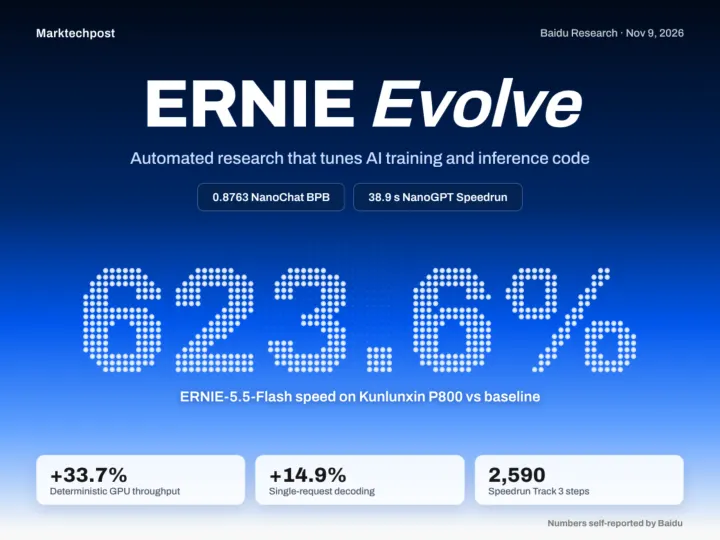
Baidu’s ERNIE Evolve Automated Research System Beats NanoChat and NanoGPT Records
Baidu has just released ERNIE Evolve, an automated research system that improves AI training and inference code. Given a repository, an objective and evaluation criteria, it picks research directions, edits code and runs experiments. Only changes that pass a hidden evaluator and a separate reviewer are kept. Baidu team tested the ERNIE Evolve automated research system on three public benchmarks. It then optimized inference for ERNIE-5.5-Flash, still in development. TL;DR Size: It is an

AI coding agents still need human cleanup on nearly three out of four tasks in a real-world test
Alibaba's new coding-agent benchmark, Co-Design Bench, tests AI agents on real user requests that already tripped them up in practice. Even GPT-6 Astra, the top performer, fully solves only 26.4 percent of tasks. On older benchmarks, the same models score above 99 percent. The article AI coding agents still need human cleanup on nearly three out of four tasks in a real-world test appeared first on The Decoder.

The gap between open and closed AI models in cyber capabilities keeps shrinking
In the Vals AI benchmark, OpenAI's GPT-6 Sol Daybreak hits 80.8 percent of attack objectives in simulated corporate networks. Worse, the open-weight model DeepSeek V4.1 Flash reaches 72.8 percent at a tenth of the cost. Because open models can no longer be restricted, analysts say the window for defenders is shrinking fast. The article The gap between open and closed AI models in cyber capabilities keeps shrinking appeared first on The Decoder.

Nine AI agents tried autonomous research on open questions from US national labs and none passed the experts' bar
The "Into the Unknown" benchmark tasks nine AI agents with tackling open research questions from U.S. national laboratories. None of the 135 submissions meets all requirements. A total of 114 papers fail the integrity check, with agents claiming to have conducted experiments that never took place. GPT-6 Astra performs best but still doesn't meet the experts' standards. The article Nine AI agents tried autonomous research on open questions from US national labs and none passed the expert
Ripple-65B Preview delivers strong agentic coding results as a fully Apache 2.0 open US model
Ricursive Intelligence is releasing Ripple-65B Preview, a 65-billion-parameter open-weight language model that the company says achieves the top score among open-source U.S. models on the TerminalBench 2.1 coding benchmark at a total R&D cost of $32 million. On other benchmarks, however, Ripple falls behind the likewise newly released western open model Inkling 2 Small. The article Ripple-65B Preview delivers strong agentic coding results as a fully Apache 2.0 open US model appeare