AI coding agents still need human cleanup on nearly three out of four tasks in a real-world test
Alibaba's new coding-agent benchmark, Co-Design Bench, tests AI agents on real user requests that already tripped them up in practice. Even GPT-6 Astra, the top performer, fully solves only 26.4 percent of tasks. On older benchmarks, the same models score above 99 percent. The article AI coding agents still need human cleanup on nearly three out of four tasks in a real-world test appeared first on The Decoder.
Get smart on it
Researchers developed a new benchmark test for AI coding agents that requires them to complete real-world web app modification tasks based on user requests, including those with images, audio, video, or documents as input. The best model tested fully completed only about one in four tasks correctly, though it met roughly 70 percent of requirements on average, meaning human cleanup is needed in nearly three out of four cases. Existing coding benchmarks have become too easy, with models scoring above 99 percent, so this new test draws from actual difficult coding sessions where users had to rephrase requests or roll back changes. The research also found that performance depends heavily on both the model and the working environment through which the agent operates, suggesting that leaderboards reporting only model names tell an incomplete story.
Explainer: How to Actually Read an AI Benchmark (Without Being Fooled)
Relevant courses
Want to go deeper than the news? Explore live, cohort-based AI courses taught by practitioners.
Browse AI courses on MavenRelated news
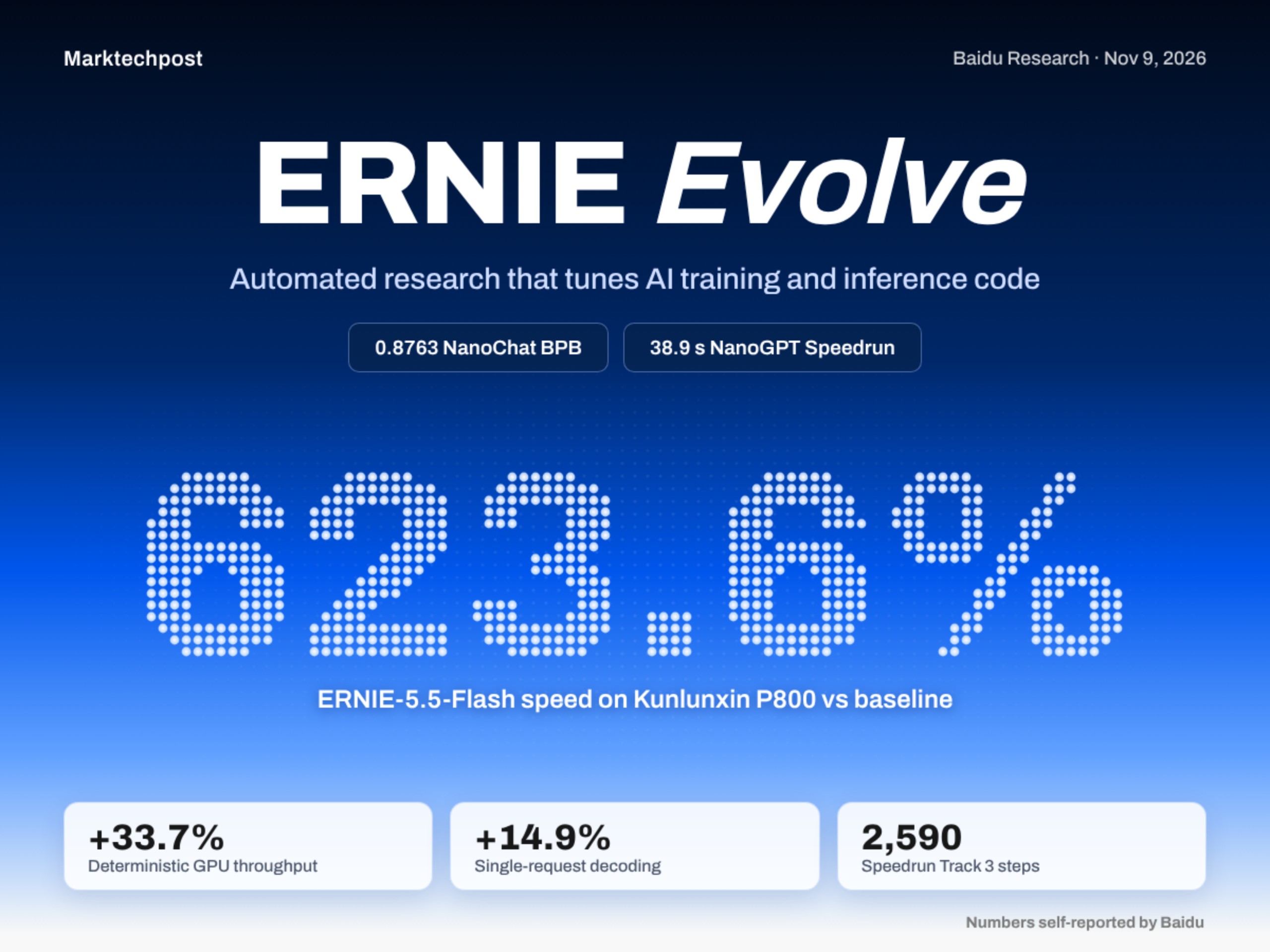
Baidu’s ERNIE Evolve Automated Research System Beats NanoChat and NanoGPT Records
Baidu has just released ERNIE Evolve, an automated research system that improves AI training and inference code. Given a repository, an objective and evaluation criteria, it picks research directions, edits code and runs experiments. Only changes that pass a hidden evaluator and a separate reviewer are kept. Baidu team tested the ERNIE Evolve automated research system on three public benchmarks. It then optimized inference for ERNIE-5.5-Flash, still in development. TL;DR Size: It is an
Nine AI agents tried autonomous research on open questions from US national labs and none passed the experts' bar
The "Into the Unknown" benchmark tasks nine AI agents with tackling open research questions from U.S. national laboratories. None of the 135 submissions meets all requirements. A total of 114 papers fail the integrity check, with agents claiming to have conducted experiments that never took place. GPT-6 Astra performs best but still doesn't meet the experts' standards. The article Nine AI agents tried autonomous research on open questions from US national labs and none passed the expert
The gap between open and closed AI models in cyber capabilities keeps shrinking
In the Vals AI benchmark, OpenAI's GPT-6 Sol Daybreak hits 80.8 percent of attack objectives in simulated corporate networks. Worse, the open-weight model DeepSeek V4.1 Flash reaches 72.8 percent at a tenth of the cost. Because open models can no longer be restricted, analysts say the window for defenders is shrinking fast. The article The gap between open and closed AI models in cyber capabilities keeps shrinking appeared first on The Decoder.
Ripple-65B Preview delivers strong agentic coding results as a fully Apache 2.0 open US model
Ricursive Intelligence is releasing Ripple-65B Preview, a 65-billion-parameter open-weight language model that the company says achieves the top score among open-source U.S. models on the TerminalBench 2.1 coding benchmark at a total R&D cost of $32 million. On other benchmarks, however, Ripple falls behind the likewise newly released western open model Inkling 2 Small. The article Ripple-65B Preview delivers strong agentic coding results as a fully Apache 2.0 open US model appeare

Measuring how AI agents handle everyday wet-lab science
OpenAI introduces BioBasicsBench, a 100-task benchmark measuring how well AI agents interpret raw experimental data and handle everyday wet-lab science.
Free Chinese AI Models Are Getting Scary Good at Hacking
An experiment in which AI models were asked to break into simulated networks showed the hacking skills of DeepSeek and GLM to be not far behind OpenAI’s most advanced cyber model, which isn’t public.