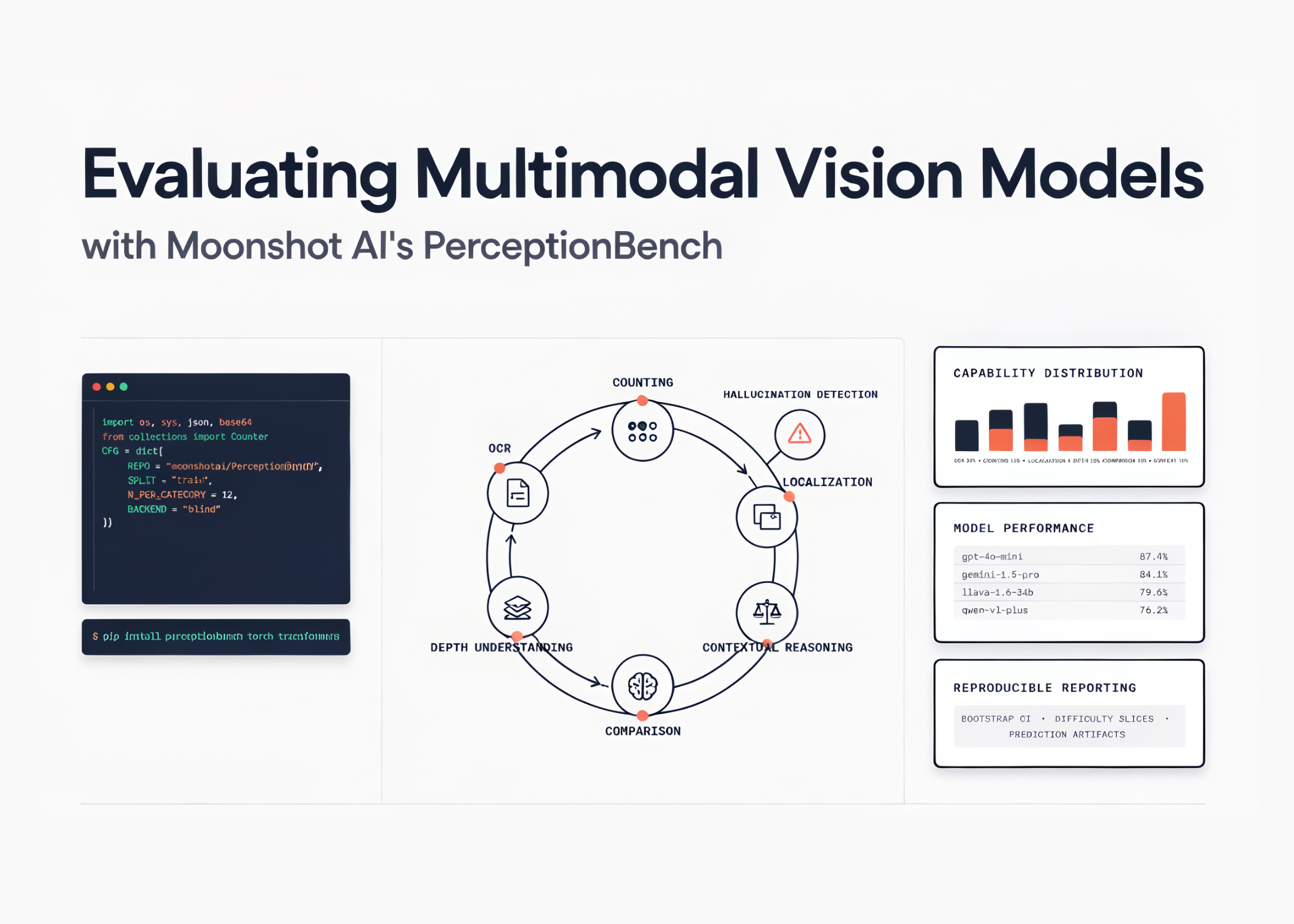
Evaluating Multimodal Vision Models with Moonshot PerceptionBench Using Robust Data Loading and Automated Judging
In this tutorial, we design an end-to-end evaluation workflow for PerceptionBench. This multimodal benchmark measures fine-grained visual perception capabilities across tasks such as OCR, counting, localization, contextual reasoning, comparison, depth understanding, and hallucination detection. We begin by configuring a Colab-compatible environment, installing the required libraries, and loading a balanced subset of the dataset through a robust multi-stage streaming and download strategy. We th
Get smart on it
PerceptionBench is a multimodal benchmark that evaluates vision models across tasks including optical character recognition, counting, localization, and reasoning about images. The tutorial describes building an end-to-end evaluation workflow that loads the benchmark dataset through a multi-stage streaming strategy, processes images, and runs models through different backends while measuring performance using both rule-based and language model-assisted judging. This matters because it provides researchers with a structured method to assess how well vision models perform on fine-grained visual perception capabilities and compare results against a leaderboard. The workflow supports multiple evaluation approaches, from simple baselines to cloud-based APIs and local open-source models, making it adaptable to different computational environments and needs.
Related news

Microsoft Open Sources code-testing-generator: a Polyglot Unit-Test Agent That Hits 92.1% Task Completion Versus 78.9% for Stock Copilot
Microsoft has open sourced code-testing-generator, a polyglot agent that writes unit tests and then proves they work. It ships in the dotnet-test plugin inside the MIT-licensed dotnet/skills repository. The agent targets a gap that coding assistants usually leave open. A prompt like ‘generate unit tests’ does not say which framework, file location or assertions to use. code-testing-generator settles those decisions by reading the repository before it writes anything. It then pla

Open-weight AI models are catching up to the frontier. The safety gap remains.
A new SaferAI report finds Z.ai's open-weight GLM-5.2 approaches frontier AI capabilities while lacking key safety mitigations, renewing concerns that powerful open models could outpace governance and safeguards.