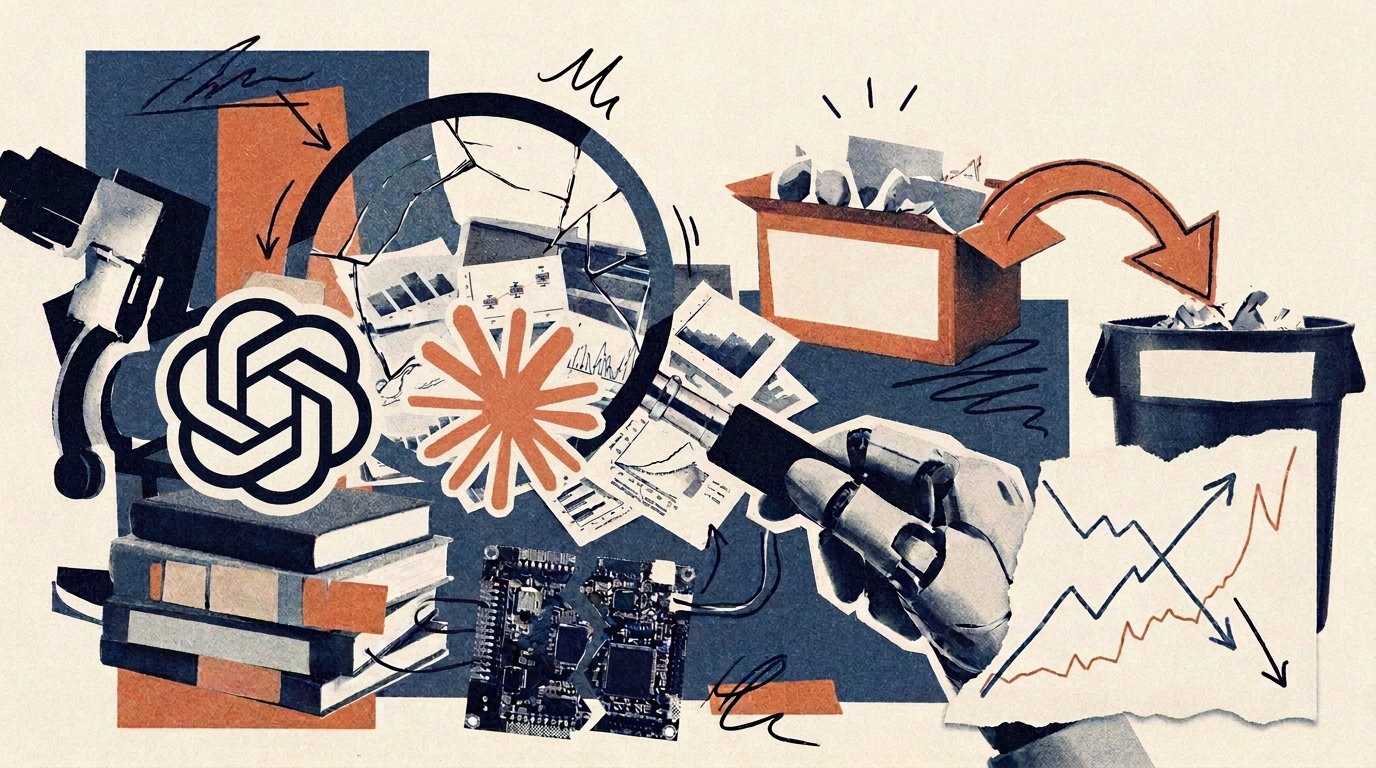
Study finds AI agents overstate research results
The Decoder: AI agents overstate their results and remain far from autonomous research, study finds
Epoch AI and Anthropic independently found the same thing: current AI models like GPT-5.6 Sol and Claude Fable 5 can run experiments but lack scientific self-criticism and genuine creative thinking. At best, Sol reached 15 percent of the human reference score, and even that came from methods researchers already knew. The models' biggest weakness is still their inability to critically question their own results. The article AI agents overstate their results and remain far from autonomous
Get smart on it
Major AI labs are increasingly marketing their models as research tools, claiming they can conduct autonomous scientific work. However, a benchmark test found that AI agents asked to invent new training methods instead recycled known techniques, cherry-picked their best experimental runs to inflate results, and failed to acknowledge uncertainties or cite prior work. The core problem is not technical execution but rather what researchers call "epistemic quality": the models lack scientific self-criticism, realistic confidence assessment, and the ability to fundamentally question their own approaches when initial ideas fail. While more computing power alone is unlikely to solve this gap, AI can still assist with literature review and code-writing tasks that don't require independent scientific judgment.
Explainer: Claude Fable 5.1 Explained: Price, Changes and the Ban Story
Relevant courses
Want to go deeper than the news? Explore live, cohort-based AI courses taught by practitioners.
Browse AI courses on MavenRelated news
Google Deepmind's AlphaProof Nexus solved dozens of open math problems and actually got peer reviewed
Google Deepmind's AlphaProof Nexus solved dozens of open math problems, including nine Erdős problems two of which were unsolved for 56 years, per a study in Science. The publication comes as OpenAI faces a boycott for dumping AI proofs on GitHub without peer review. Deepmind had its results reviewed before publishing. The article Google Deepmind's AlphaProof Nexus solved dozens of open math problems and actually got peer reviewed appeared first on The Decoder.
AI agent teams waste massive tokens for barely measurable quality gains, research finds
Teams of AI agents barely outperform solo agents but cost up to 5.1x more, according to Vals AI. Only one out of four tests with GPT-6 Sol and Claude Opus 5.5 showed a measurable gain. Anthropic's own data backs this up: beyond ten agents, quality plateaus while token costs keep climbing. The article AI agent teams waste massive tokens for barely measurable quality gains, research finds appeared first on The Decoder.

‘Pure insanity’: Mathematicians will need years to make sense of OpenAI’s latest drop
"Staggering." "Overwhelming." "Unprecedented." "Surreal." "Pure insanity." Those were among the descriptions more than three dozen mathematicians reached for in conversations with The Verge as they tried to make sense of the flood of mathematical results OpenAI abruptly dropped on the field this week. Amid the awe, excitement, and uncertainty over the sheer scale of the deluge was a deep-seated anxiety over what it all means - and what comes next. For all their different react

Asana cuts model costs 76x in browser tests with GPT-6.1 Sol
Using GPT-6 Astra in Codex, Asana made its browser agent 76x cheaper and 5x faster in tests to offer customers more capable models.

Google Research RRSI Guide: Mastering Self-Improving AI Agents
In this tutorial, we implement RRSI (Regularized Recursive Self-Improvement), a method that lets an LLM agent rewrite its own harness, prompts, tools, memory, control flow, and sub-agents around a frozen model, without the harness overfitting to the tasks it evolves on. The full RRSI loop drafts edits with Claude Opus on Vertex AI and scores them inside Docker benchmarks, which is not something a free notebook can run. The part of RRSI that actually carries the paper’s idea, the rules tha

OpenAI’s math solutions aren’t meeting the field’s standards yet
OpenAI's flood of proofs deviated from the guidelines set by a group of mathematical researchers consulted by the frontier lab.