‘Pure insanity’: Mathematicians will need years to make sense of OpenAI’s latest drop
"Staggering." "Overwhelming." "Unprecedented." "Surreal." "Pure insanity." Those were among the descriptions more than three dozen mathematicians reached for in conversations with The Verge as they tried to make sense of the flood of mathematical results OpenAI abruptly dropped on the field this week. Amid the awe, excitement, and uncertainty over the sheer scale of the deluge was a deep-seated anxiety over what it all means - and what comes next. For all their different react
Get smart on it
OpenAI recently released nearly 400 AI-generated mathematical results spread across more than 700 manuscripts covering diverse fields including combinatorics, geometry, number theory, and theoretical computer science. Mathematicians told researchers that understanding this volume of work could take years, and they expressed deep anxiety about the quality and verification of the results, with fewer than half of the manuscripts having been formally verified using computational proof methods. A major concern among researchers is that much of the work contains what they call "slop," a term for low-quality, frequently erroneous AI-generated material that is confusing, hard to read, and sometimes lacks proper attribution to other researchers. The sheer scale and pace of AI-generated mathematical output has left the field uncertain about how to assess the work and what role human mathematicians will play going forward.
Related news
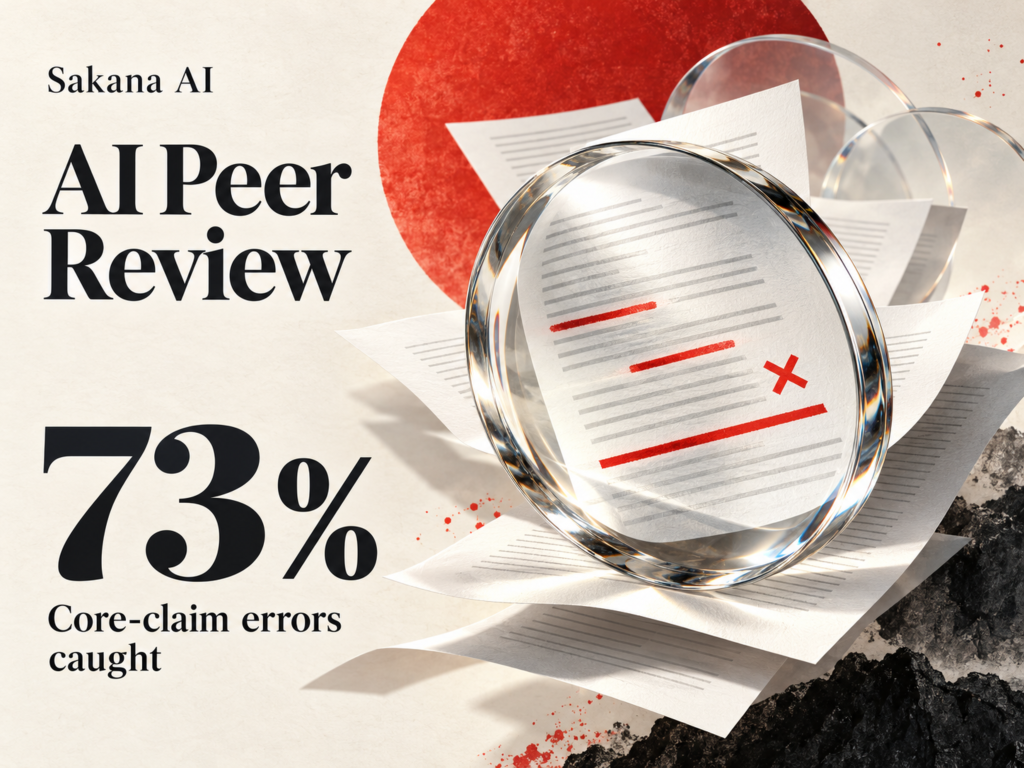
Sakana AI’s LLM Peer Review System Catches 73% of Core-Claim Errors
Sakana AI has published Beyond Imitation, a TMLR research paper on LLM-assisted peer review built around error detection. Most AI reviewers are graded on how closely they copy human reviews. This work asks a harder question: can an AI reviewer find a planted mistake? The research team ships two pieces: a Contradiction Benchmark and a Multi-Layered Review (MLR) system. For developers building research agents, the lesson is practical. Both system design and model choice move error detection. T

Asana cuts model costs 76x in browser tests with GPT-6.1 Sol
Using GPT-6 Astra in Codex, Asana made its browser agent 76x cheaper and 5x faster in tests to offer customers more capable models.