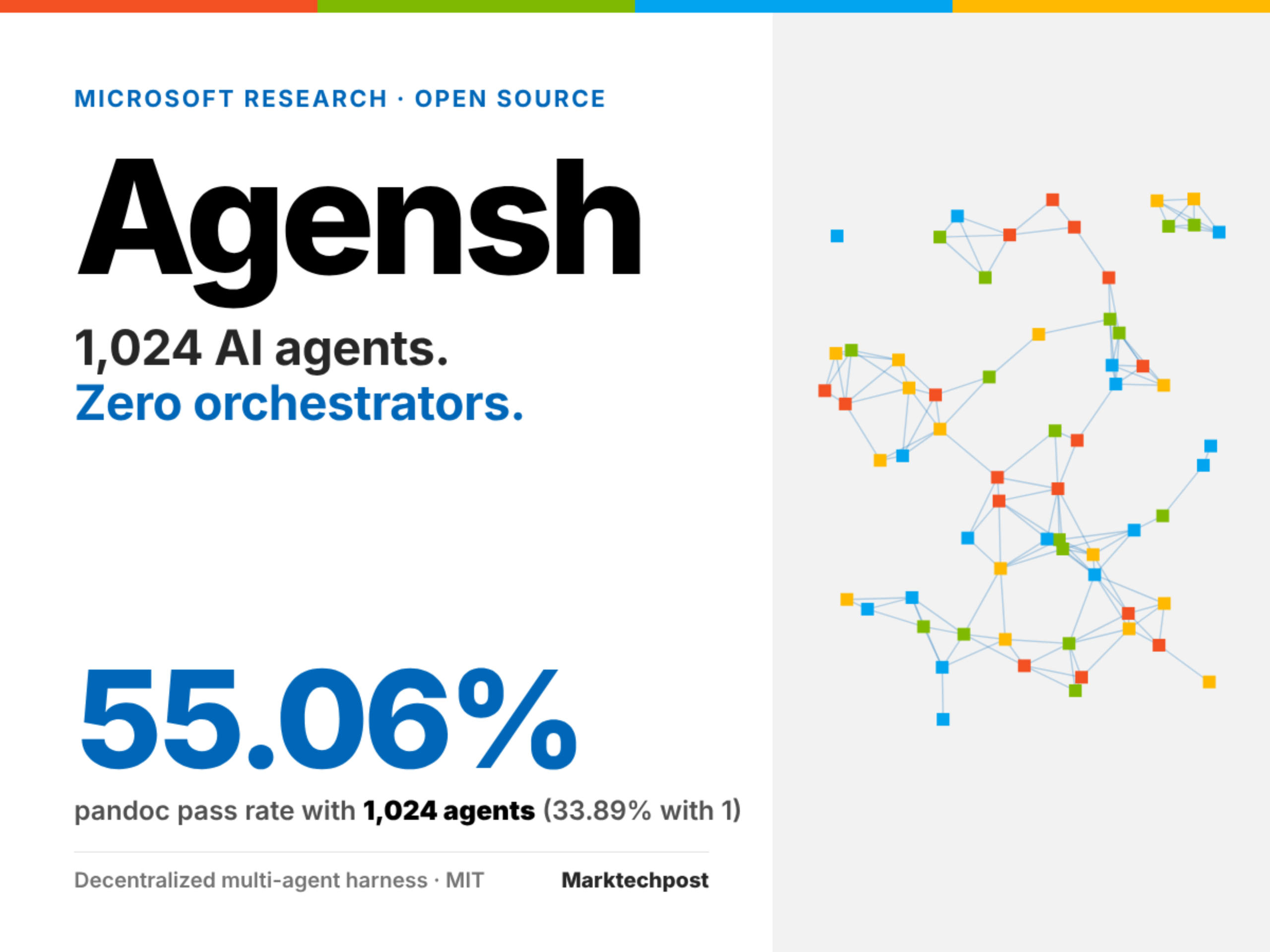
Microsoft open-sources Agensh for coordinating coding agents
MarkTechPost: Microsoft Open-Sources Agensh: A Multi-Agent Harness for 1,024 Agents
Microsoft Research has open-sourced Agensh, a decentralized harness for large teams of coding agents. The Agensh multi-agent harness removes the central orchestrator that most agent frameworks depend on. Every worker picks its own sub-task, shares findings and merges code into a common Git repo. On ProgramBench, the team scaled the setup from 1 agent to 1,024 agents. TL;DR A Harness: Tested from 1 to 1,024 agents. Each worker gets a 272,000-token input and 128,000-token output limit.
Get smart on it
Agensh is a multi-agent harness that coordinates large teams of coding agents without requiring a central orchestrator, allowing workers to self-coordinate by claiming tasks, sharing findings, and merging code into a shared repository. Most existing multi-agent frameworks rely on a lead agent to plan and assign work, which creates a bottleneck, whereas Agensh removes this limitation by having each worker run the same coordination loop independently using shared tools like a code repository, messaging system, and context board. Testing on the five hardest programming tasks showed that performance improved as agent count increased, with 128 agents achieving approximately 50 percent higher pass rates than a single agent. The system is open source and can scale from single-node setups with 8 workers up to 1,024 agents across multiple nodes.
Explainer: The 90% That Matters: Why Your Agent's Harness Beats the Model
Relevant courses
Want to go deeper than the news? Explore live, cohort-based AI courses taught by practitioners.
Browse AI courses on MavenRelated news

OpenAI models are coming to Google Cloud
OpenAI and Google Cloud are bringing frontier models and Codex workflows to Gemini’s Model Garden, available through Google Cloud Marketplace.
Also reported by Ars Technica, The Decoder and SiliconANGLE
AI makes junior patent attorneys instantly better but may quietly stunt their professional growth
A three-month field experiment with 133 patent attorneys shows that AI boosts immediate performance, with junior lawyers gaining the most. But when the AI is taken away, only senior attorneys retain the benefits, suggesting that baseline expertise is a prerequisite for turning AI-assisted practice into lasting skill. The article AI makes junior patent attorneys instantly better but may quietly stunt their professional growth appeared first on The Decoder.

Meet Anthropic’s sandbox-runtime: OS-Level Sandboxing for AI Agents, No Containers
In this article, we will discuss newly trending open sourced Anthropic’s sandbox-runtime (srt), the OS-level sandbox behind Claude Code’s sandboxed bash tool. The Anthropic sandbox-runtime limits which files a process can touch and which hosts it can reach. It does this without spinning up a container. It is also not tied to Claude Code. Your own agents, local MCP servers and plain command-line programs can run inside it. TL;DR Size: npm package @anthropic-ai/sandbox-runtime

Claude Duet app is Anthropic’s bet on agents
Claude Duet is available through waitlist for Pro and Max plan users
Also reported by The Verge and SiliconANGLE

Anthropic's Claude now writes code and proves it safe automatically
Anthropic had Claude generate mathematical proofs that existing code is correct, producing roughly 180 million lines of proof code for 123 open-source libraries. Along the way, the model caught bugs that years of testing had missed. Anthropic's goal: making formal verification with AI as routine as standard testing. The article Anthropic's Claude now writes code and proves it safe automatically appeared first on The Decoder.

Major US banks are locking out AI agents that log in with customer credentials
Customers are letting AI agents use their credentials to access accounts at Morgan Stanley, JPMorgan, and other major U.S. banks, sometimes without direct instructions. Morgan Stanley has blocked agents, while other banks are restricting access. Most plan to limit agents to read-only access. The article Major US banks are locking out AI agents that log in with customer credentials appeared first on The Decoder.