Cognition releases free plugin to patch critical vulnerabilities
MarkTechPost: Cognition Open-Sources an Agent Plugin that Helps Secure Systems against Recent Cybersecurity Threats
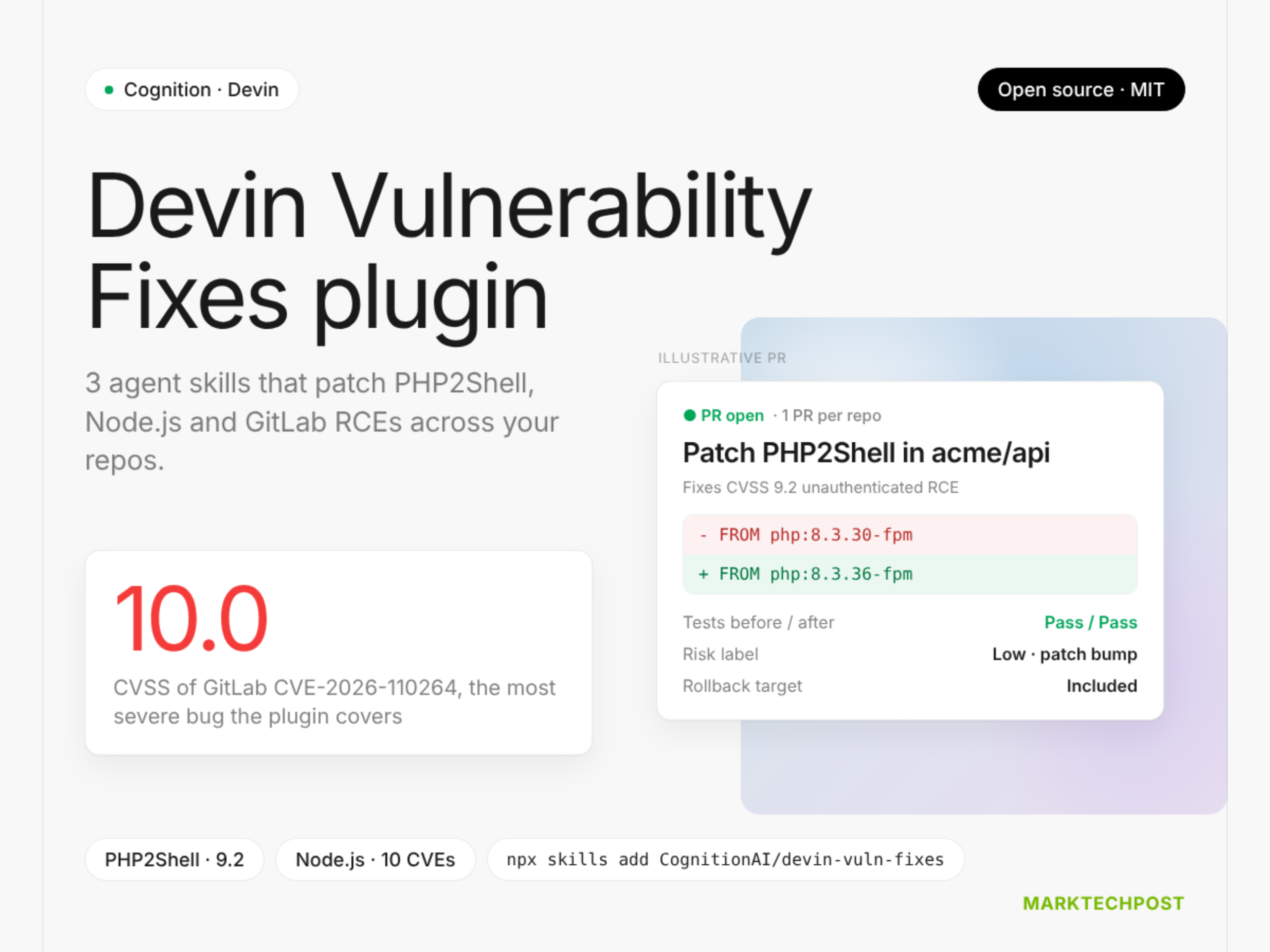
Cognition has released the Devin Vulnerability Fixes plugin, a free, open-source set of agent skills. It targets three critical remote code execution (RCE) advisories. They cover PHP2Shell, the Node.js October 21, 2026 security release and a CVSS 10.0 self-managed GitLab bug. The skills run in Devin and in any coding agent that reads SKILL.md files. Cognition packaged the remediation workflow it used internally. Developers can do inventory, approve, patch, test, then ship 1 pull request per rep
Get smart on it
Cognition has released a free, open-source plugin consisting of three agent skills designed to automatically find and patch three critical security vulnerabilities affecting PHP, Node.js, and self-managed GitLab systems. The plugin works by conducting a read-only inventory scan, requiring user approval before making changes, verifying patches against official sources, and running tests before and after applying fixes to ensure no system regressions occur. This targets the runtime layer including base images, operating system packages, and infrastructure-as-code, distinguishing it from other security tools that focus on application dependencies and source code. The plugin is available for multiple coding agents and is released under an MIT license at no cost.
Relevant courses
Want to go deeper than the news? Explore live, cohort-based AI courses taught by practitioners.
Browse AI courses on MavenRelated news

OpenAI models are coming to Google Cloud
OpenAI and Google Cloud are bringing frontier models and Codex workflows to Gemini’s Model Garden, available through Google Cloud Marketplace.
Also reported by Ars Technica, The Decoder and SiliconANGLE

AI makes junior patent attorneys instantly better but may quietly stunt their professional growth
A three-month field experiment with 133 patent attorneys shows that AI boosts immediate performance, with junior lawyers gaining the most. But when the AI is taken away, only senior attorneys retain the benefits, suggesting that baseline expertise is a prerequisite for turning AI-assisted practice into lasting skill. The article AI makes junior patent attorneys instantly better but may quietly stunt their professional growth appeared first on The Decoder.

Meet Anthropic’s sandbox-runtime: OS-Level Sandboxing for AI Agents, No Containers
In this article, we will discuss newly trending open sourced Anthropic’s sandbox-runtime (srt), the OS-level sandbox behind Claude Code’s sandboxed bash tool. The Anthropic sandbox-runtime limits which files a process can touch and which hosts it can reach. It does this without spinning up a container. It is also not tied to Claude Code. Your own agents, local MCP servers and plain command-line programs can run inside it. TL;DR Size: npm package @anthropic-ai/sandbox-runtime

Claude Duet app is Anthropic’s bet on agents
Claude Duet is available through waitlist for Pro and Max plan users
Also reported by The Verge and SiliconANGLE

Major US banks are locking out AI agents that log in with customer credentials
Customers are letting AI agents use their credentials to access accounts at Morgan Stanley, JPMorgan, and other major U.S. banks, sometimes without direct instructions. Morgan Stanley has blocked agents, while other banks are restricting access. Most plan to limit agents to read-only access. The article Major US banks are locking out AI agents that log in with customer credentials appeared first on The Decoder.

Anthropic's Claude now writes code and proves it safe automatically
Anthropic had Claude generate mathematical proofs that existing code is correct, producing roughly 180 million lines of proof code for 123 open-source libraries. Along the way, the model caught bugs that years of testing had missed. Anthropic's goal: making formal verification with AI as routine as standard testing. The article Anthropic's Claude now writes code and proves it safe automatically appeared first on The Decoder.