Building a Scaffold-Split Random Forest QSAR Co-Scientist for EGFR Inhibitor Discovery Using ChEMBL, RDKit, SHAP, and BRICS
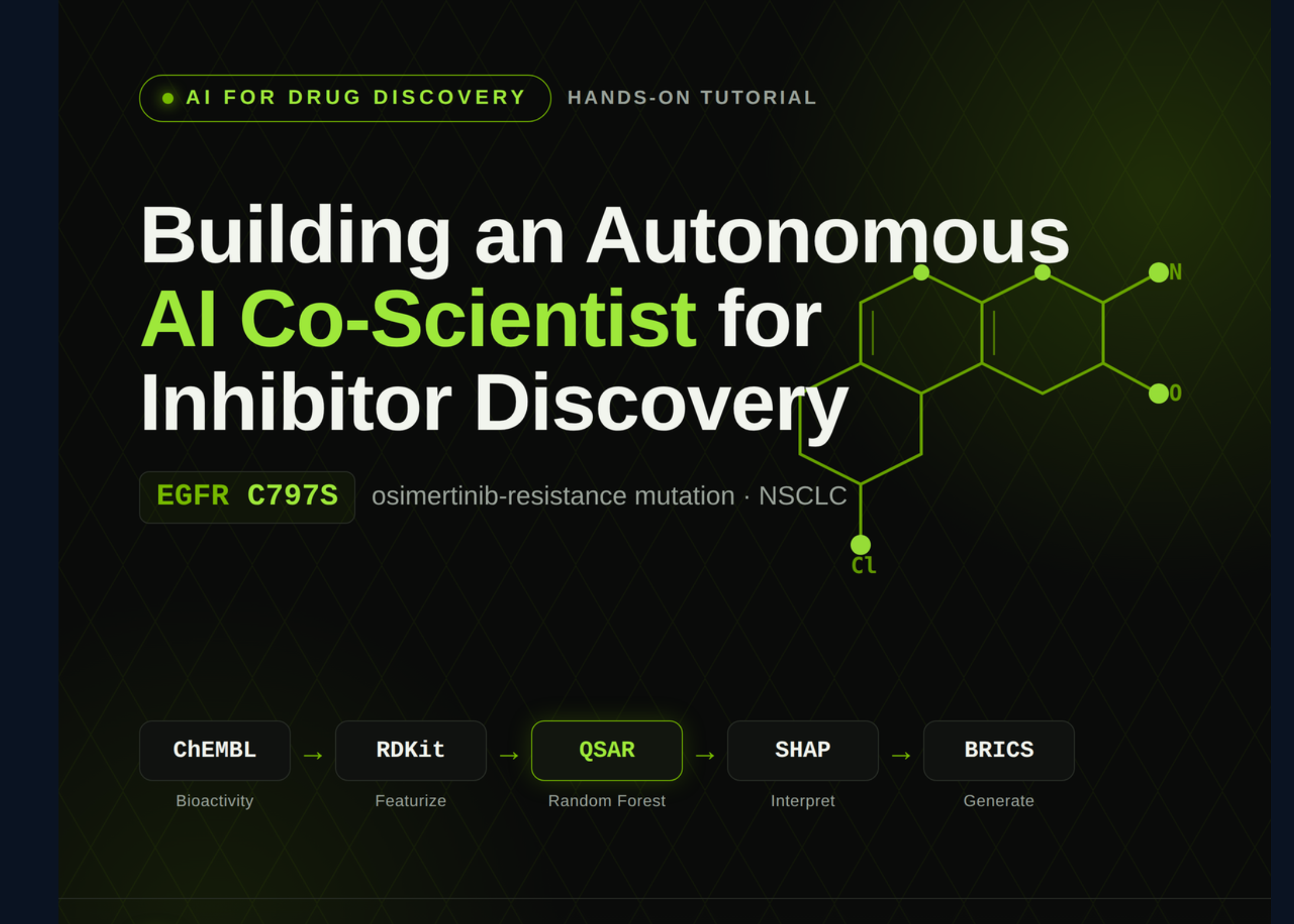
In this tutorial, we build an end-to-end autonomous AI co-scientist workflow for next-generation EGFR inhibitor discovery, focusing on the C797S osimertinib-resistance mutation in non-small cell lung cancer. We start by resolving the biological target through ChEMBL and UniProt, then mine curated EGFR IC50 bioactivity records and convert them into a clean pIC50 modeling dataset. We use RDKit to standardize molecules, remove salts, aggregate replicate measurements, compute Morgan fingerprints, e
Make your prediction
Will EGFR inhibitor AI research using scaffold-split validation be cited in a peer-reviewed paper by October 1?
Resolves by Oct 1, 2026
Your prediction
50% · 50/50 coin flip
NOYES
Get smart on it
This tutorial describes building an AI workflow to discover new drugs that target EGFR, a protein involved in cancer. The workflow combines several tools to mine existing drug data from ChEMBL, train a machine learning model to predict which molecular structures are most potent, and then generate novel candidate molecules by recombining fragments from known effective drugs. The biological context is that certain cancer mutations like C797S have developed resistance to current EGFR inhibitor drugs, making it necessary to design new compounds that could overcome this resistance.
Related news

You can now customize Siri’s pace and expressivity in the latest iOS 27 beta
The update is part of Apple's broader effort to make Siri feel more natural and personal, as it rebuilds the assistant around generative AI.

Reddit is using LLMs to solve a problem LLMs largely created
In the AI era, platforms have no choice but to fight fire with fire to cull spam.