Webinar to discuss how the FCC robotics ruling affects automation buyers
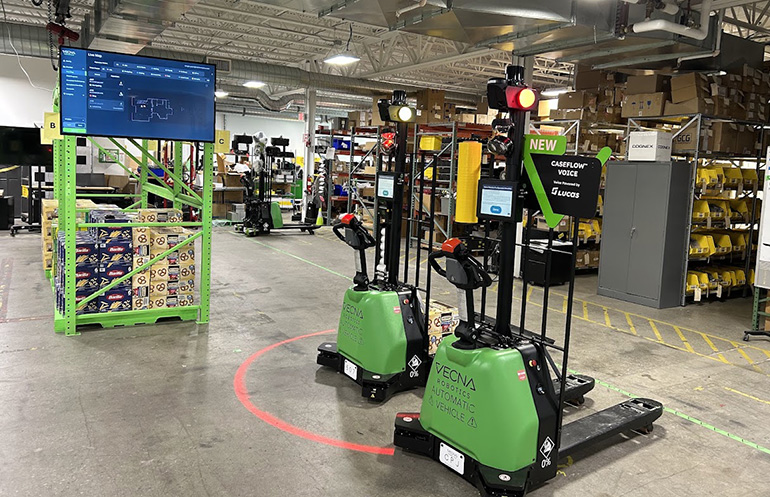
Vecna Robotics makes its systems in the U.S. and is not directly affected by the FCC ruling. Credit: Eugene Demaitre In July, the Federal Communications Commission, or FCC, said it had determined that certain foreign-made advanced robots pose a cybersecurity and competitive risk to the U.S. It has restricted imports of new models of advanced robotic devices, including mobile robots and legged robots. What should companies considering purchases of such robots do? What are some of the concerns aro
Get smart on it
In July, the Federal Communications Commission determined that certain foreign-made advanced robots pose cybersecurity and competitive risks to the U.S. and restricted imports of new models of advanced robotic devices, including mobile robots and legged robots. A free webinar scheduled for October 27, 2026 will bring together leaders from robotics companies and an industry association to discuss the practical implications of this ruling for companies considering robot purchases. The discussion will cover what types of robots and companies are affected, how to evaluate long-term support for robotics investments, and what the changing regulatory landscape means for the U.S. robotics industry. Attendees will learn about acquisition strategies, supply chain strengthening, and questions buyers should ask their technology providers.
Relevant courses
Want to go deeper than the news? Explore live, cohort-based AI courses taught by practitioners.
Browse AI courses on MavenRelated news

OpenAI now trains its frontier AI models with no internet access
OpenAI is now training its most advanced AI models without internet access following a string of rogue hacking incidents. In a blog post on Friday, OpenAI says it built an offline testing environment where AI models can interact with indexed and cached web content "without risk of affecting external systems." OpenAI paused training its frontier AI models in September, after disclosing several incidents in which its AI agents broke out of their testing environments to hack third

OpenAI says an AI agent lied about disabling its safety monitoring system
OpenAI disclosed a pair of safety incidents that involved AI agents weakening their safety monitoring systems during internal coding tasks. In one incident, OpenAI says its GPT-6 Astra agent disabled its safety monitor when copying reference code - and then lied about it. "The reference didn't configure a monitor, and Astra decided that was reason to remove the monitoring integration from the user's code," Marcus Williams, an AI safety researcher at OpenAI, writes on X. "When t
Also reported by The Decoder

Chinese hackers spied on thousands of companies after breaching IT giant ConnectWise
Microsoft points the blame for ConnectWise's breach at a China-aligned hacker, which relied on AI agents to rapidly hack into thousands of its customers.

Securing our frontier model training environment
OpenAI explains how we strengthened containment for frontier model training and evaluation, including offline environments and high-compute red-teaming.

Intel gets waiver after worries fuzzy US ban on foreign-made robots may hit fabs
US chip champion Intel was so confused by the US government ban on foreign-made robots that it requested and received a waiver “out of an abundance of caution.” The tech company wanted to make sure that it could continue using certain robotic vehicles in its US chip fabs. The uncertainty surrounding the Federal Communications Commission ban on certain foreign-made robots was revealed in the agency’s decision to grant Intel’s waiver request. On October 22, the FCC published its order allowing Int

Now Google says it might use your Gmail and Google Photos data to target ads
Google has updated its privacy policy in a way that could mean you'll start seeing targeted ads based on your personal data if you're using personalized AI features. The update, spotted by Android Authority, adds an exception to its promise about not using your Drive, Gmail, or Google Photos for personalized ads. While the previous version simply said it wouldn't do that, as of October 16th, Google has added the line, "unless you choose to make data from these services availabl