Writer introduces new AI model and upgraded harness to contain token costs
Built as a post-training variation on Z.ai's open source model GLM-5.2, Writer says the new system should provide deployment-ready capabilities at a much lower price.
Get smart on it
A company has launched a new AI model built from an open source foundation, along with infrastructure upgrades designed to reduce costs for customers using AI tools. Users across the industry are increasingly focused on controlling AI deployment expenses, and while open source models offer lower costs per token, finding the right model for specific tasks remains challenging. The company estimates these changes will cut costs by as much as 50% for basic tasks, with the new approach emphasizing complex multi-step tasks executed faster and with fewer tokens. Research from the company's team found that optimizing the infrastructure layer proved more reliable for reducing costs than switching between different models, suggesting that how AI systems are operated matters as much as which model is chosen.
Related news
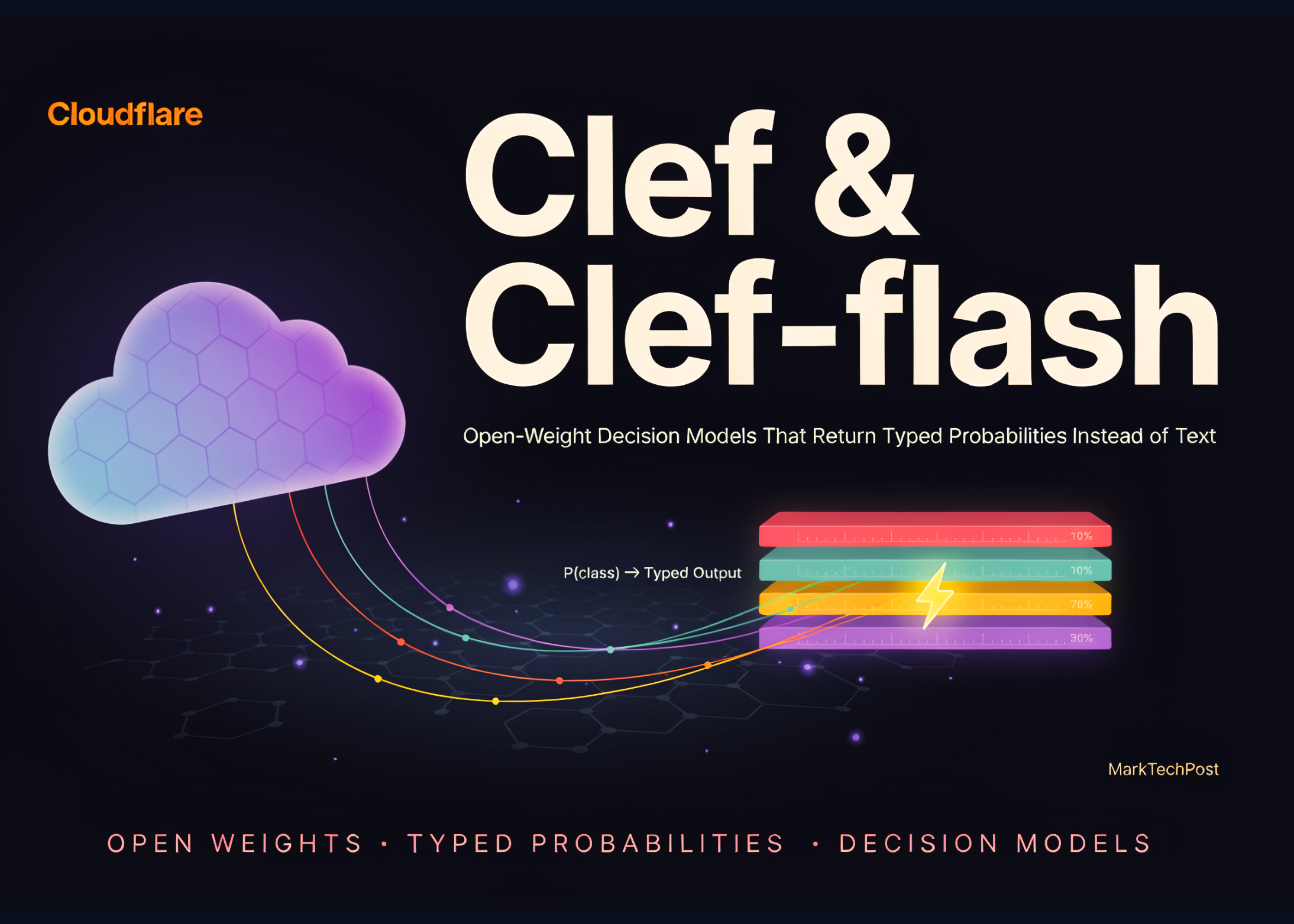
Cloudflare Releases Clef and Clef-flash: Open-Weight Decision Models That Return Typed Probabilities Instead of Text
Cloudflare has released Clef and Clef-flash, the first models trained by its Workers AI team. They are decision models, not chatbots. Each reads an input state and a schema of typed questions. It returns a probability for every allowed answer, with no free-form text. Both are open-weight under Apache 2.0 and compatible with TypeSafe AI’s Jev API. Is it deployable? Yes, Both models run today on Workers AI, and the weights are on Hugging Face for self-hosting. What a Decision Model Do
A Coding Guide to Google Research’s Kauldron: Configs That Are Plain Data, Components Wired by String, and a JAX Trainer You Can Read End to End
In this tutorial, we implement Kauldron, the JAX training library from Google Research that describes itself as optimized for research velocity and modularity, and we take those two words literally by testing what they actually buy us. We install it, then spend the first half of the notebook on the three mechanisms that make Kauldron different from a stack of Flax and Optax: konfig, which turns an experiment into a tree of plain dictionaries that round-trip through JSON; kontext, which wires co