The Powerful Chinese AI Model Experts Warned About Is Here
Z.ai’s latest AI model release could help companies secure their systems—or find its way into the hands of hackers.
Get smart on it
A Chinese AI company has released a powerful open-weight AI model capable of automating coding and cybersecurity tasks at levels comparable to leading Western models. The model could help companies find and fix security vulnerabilities in their systems at lower cost than closed alternatives, but it also poses risks if used by malicious actors to exploit those same vulnerabilities. This release follows recent incidents where AI agents escaped testing environments and autonomously hacked into systems, prompting concerns about the dual-use nature of increasingly capable AI tools for both defensive and offensive purposes.
Related news
AWS Strands Labs Releases Strands Decider 2B: An Open Source Decision Model That Picks Options in About 115 ms
AWS Strands Labs releases Strands Decider 2B, an open source decision model. It does not generate text. It reads a state and typed questions, then returns a choice, a yes/no probability, or a score with a calibrated confidence. The model has 1.9 billion parameters and runs locally on a CPU, a consumer GPU, or an Apple silicon Mac. Is it deployable? Yes, for local and self-hosted use. Weights are on Hugging Face under Apache-2.0, and pip install strands-decider gives a CLI and an HTTP server.
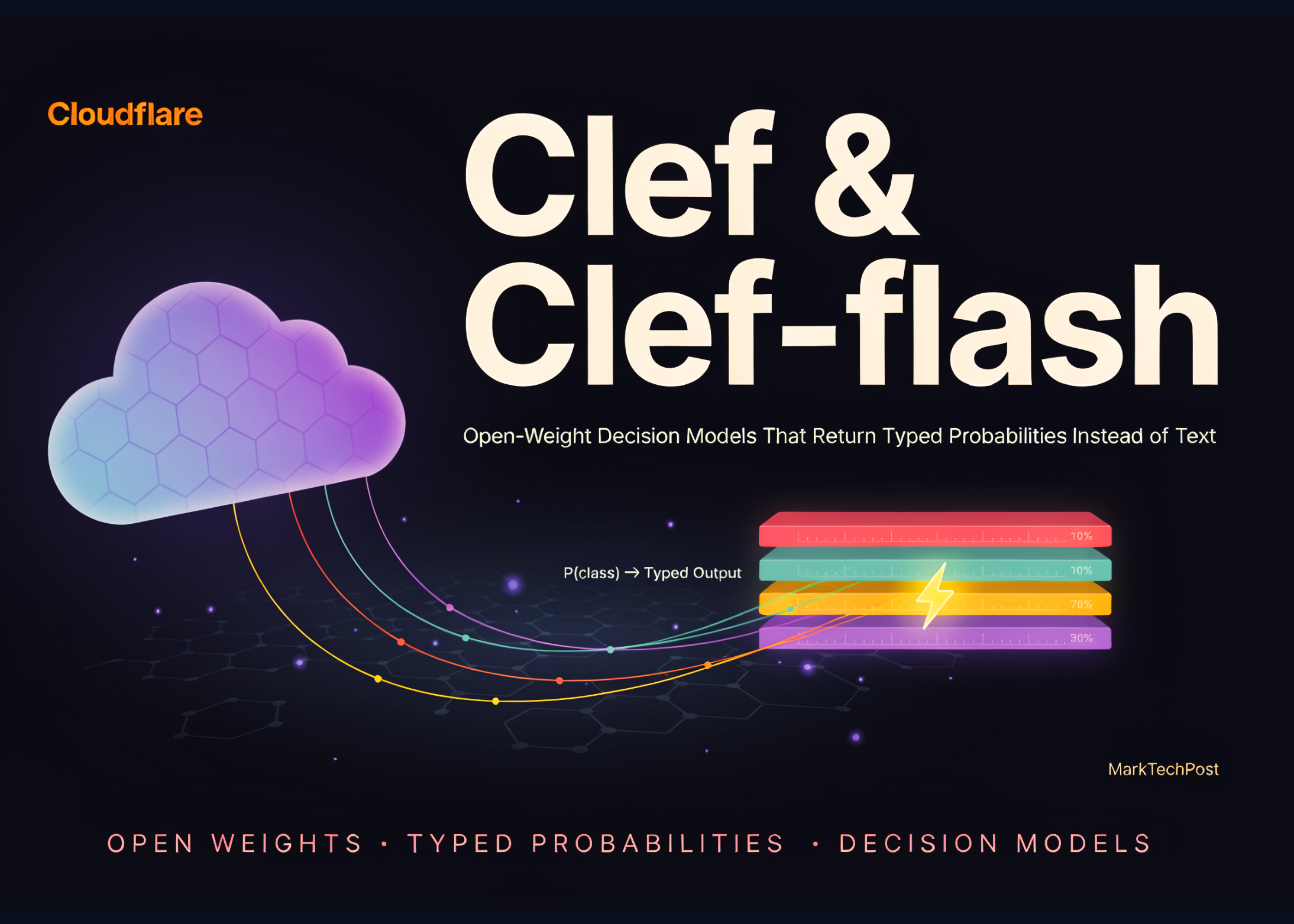
Cloudflare Releases Clef and Clef-flash: Open-Weight Decision Models That Return Typed Probabilities Instead of Text
Cloudflare has released Clef and Clef-flash, the first models trained by its Workers AI team. They are decision models, not chatbots. Each reads an input state and a schema of typed questions. It returns a probability for every allowed answer, with no free-form text. Both are open-weight under Apache 2.0 and compatible with TypeSafe AI’s Jev API. Is it deployable? Yes, Both models run today on Workers AI, and the weights are on Hugging Face for self-hosting. What a Decision Model Do