Sakana AI releases Namazu Small reasoning model
MarkTechPost: Sakana AI Releases Namazu Small, a 30B Model Built on Nemotron 3 Nano
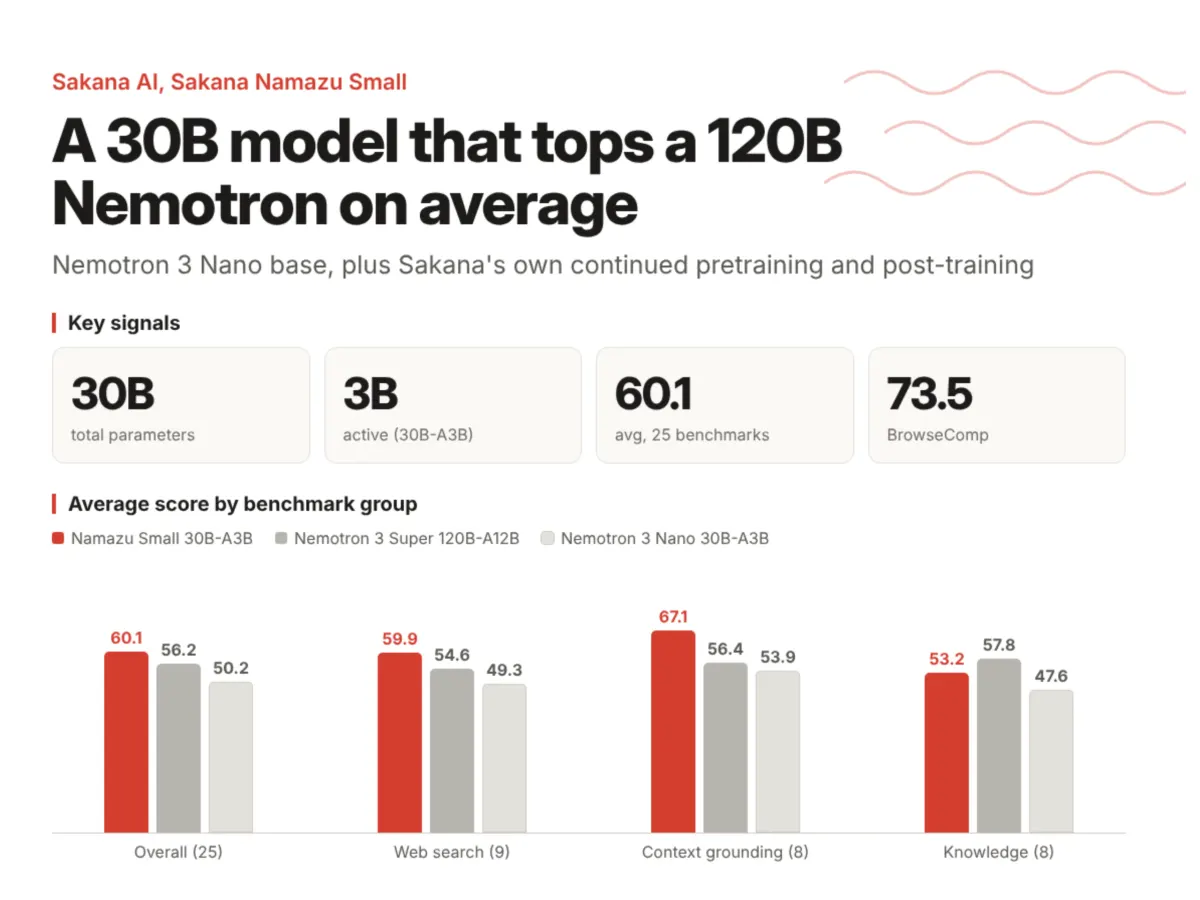
Sakana AI has announced Sakana Namazu Small, a 30-billion-parameter reasoning model built on NVIDIA Nemotron 3 Nano. The Japan-based lab ran continued pretraining and post-training in-house, starting from Nemotron 3 Nano’s pretrained base. Sakana AI team states that the result beats NVIDIA’s 120B Nemotron 3 Super on its 25-benchmark average. TL;DR Size: 30B total parameters, 3B active (labeled 30B-A3B in Sakana’s chart). Context length: Not disclosed. Runs on: Hardw
A Japan-based AI lab released a 30-billion-parameter reasoning model built on another company's smaller base model, then enhanced it through additional training techniques. The model performed better on average than a larger 120-billion-parameter competitor across 25 benchmarks, particularly excelling at web research and long-document question-answering tasks. It showed weakness in closed-book knowledge recall, where it must retrieve facts from internal memory alone. The model's weights have not yet been released, with on-premises deployment details expected at a future date.
Explainer: How to Actually Read an AI Benchmark (Without Being Fooled)
- Three studies from Meta and AMI Labs back Yann LeCun's bet on JEPA world models over large language models · The Decoder
- OpenAI updates ChatGPT to handle complex everyday questions, web searches, and images more reliably · The Decoder
- After OpenAI and Anthropic shut the door on their data, a Chinese AI developer is turning to Google and Meta instead · The Decoder
- All of today’s AI news, biggest first →
One short email a day with the stories that matter. Free. Unsubscribe with one click.
Want to go deeper than the news? Explore live, cohort-based AI courses taught by practitioners.
Browse AI courses on Maven
Three studies from Meta and AMI Labs back Yann LeCun's bet on JEPA world models over large language models
Yann LeCun is pushing forward with his alternative to language models through his startup AMI Labs. The JEPA architecture aims to give machines an internal world model that captures cause and effect. Three new studies show progress in robot planning, more efficient training, and error correction, though the pieces still need to grow together. The article Three studies from Meta and AMI Labs back Yann LeCun's bet on JEPA world models over large language models appeared first on The
OpenAI updates ChatGPT to handle complex everyday questions, web searches, and images more reliably
OpenAI is making GPT-6.2 Sol the new default model in ChatGPT's chat tab, rolling it out worldwide. In internal tests, image understanding jumped from 47.4 to 71.7 percent, and the model now handles difficult instructions correctly 78.1 percent of the time. It also sticks to safety policies more consistently. The article OpenAI updates ChatGPT to handle complex everyday questions, web searches, and images more reliably appeared first on The Decoder.

After OpenAI and Anthropic shut the door on their data, a Chinese AI developer is turning to Google and Meta instead
Chinese AI companies Z.AI and Moonshot AI have to delay their next flagship models and are looking for new sources of training data. The article After OpenAI and Anthropic shut the door on their data, a Chinese AI developer is turning to Google and Meta instead appeared first on The Decoder.

Z.ai follows OpenAI into loop transformer territory with its new 750B flagship model
Z.ai is moving its flagship GLM-5.4 model to a loop architecture in which 28 layers run twice, which the company says lets the 750-billion-parameter model match models with 2 to 3 trillion parameters. Benchmark scores are only available for a smaller 30B test model so far, and Z.ai is positioning GLM-5.4 as the start of "Generalized Coding," where code also generates videos, games, and CAD models. The article Z.ai follows OpenAI into loop transformer territory with its new 750B flagship
Also reported by MarkTechPost

AI may soon change what it means to be a theoretical physicist
About six months ago, Suvrat Raju, a professor of theoretical physics at the International Centre for Theoretical Sciences in Bengaluru, India, asked a frontier AI model to solve a physics problem. He didn’t ask because he needed to know the answer. He had actually solved this particular problem already. But he had never published the solution—which made it a perfect question to test how good AI was at physics. LLMs have been trained on the whole Internet, so if a physics problem has been discus

PrismML shrinks a 54 GB language model to 5.9 GB by reducing every weight to just three possible values
Startup PrismML has released Ternary Bonsai 2.5 27B, an updated version of its aggressively compressed language model. The article PrismML shrinks a 54 GB language model to 5.9 GB by reducing every weight to just three possible values appeared first on The Decoder.